


AI patient data privacy: five fears healthcare teams have, and which ones are real
HIPAA Compliant Hosting · https://hipaacomplianthosting.com/blog/ai-patient-data-privacy
Last updated: November 14, 2026
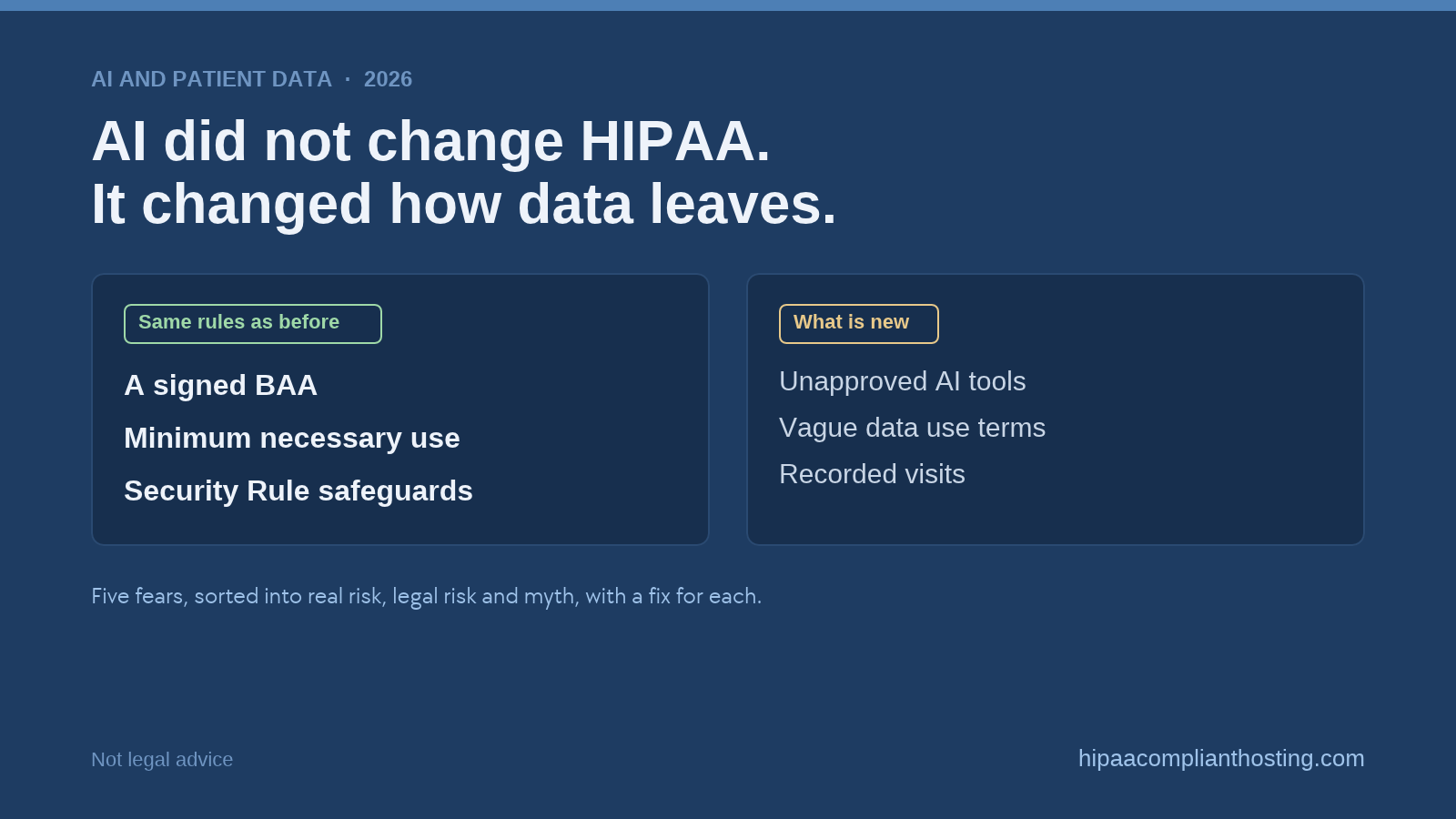
AI does not change HIPAA. An AI tool gets the same rules as any other vendor: a signed business associate agreement (BAA), minimum necessary use and the Security Rule safeguards. What AI changes is how easily patient data leaves your control. That is the core of AI patient data privacy.
This guide to AI patient data privacy sorts five common fears into real risk, legal risk and myth, with a fix for each. It is written for practice owners, compliance leads and IT teams at clinics, health systems and healthtech companies. We are HIPAA Compliant Hosting, and we sell managed hosting. Weigh the one marked section about our plans as a disclosure.
TL;DR: Quick answer
Unapproved tools are the top risk. In one 2025 survey, 40% of hospital staff had seen an unapproved AI tool at work. Nearly 20% had used one.
The BAA test still decides. If an AI vendor handles protected health information (PHI) for you, you need a BAA with it first. Consumer chatbots usually come without one.
Recording needs consent. A 2026 lawsuit claims two California health systems recorded visits with an AI scribe without informed consent.
Access controls are the gap. In IBM's 2025 study, 97% of organizations with an AI breach had no AI access controls.
No rule bans AI. AI patient data privacy is a contract, access and consent problem. Each part has a fix.
What is the real risk to patient data from AI?
The real risk is patient data leaving through tools that nobody reviewed. The model itself is rarely the weak point. The weak points are contracts, access and consent.
HIPAA already covers all three. An AI vendor that creates, receives, maintains or transmits PHI for you is a business associate. You need a BAA before any PHI reaches it. Our guide to the business associate agreement explains the contract.
The minimum necessary standard also applies. Staff should give a tool only the PHI the task needs. And the Security Rule asks you to assess the risk of each system that holds electronic PHI (ePHI). An AI tool is one more system on that list.
So AI patient data privacy is less about new law than about old rules applied to new tools. The five fears below show where those rules get missed.
Fear 1: Are staff pasting patient data into chatbots?
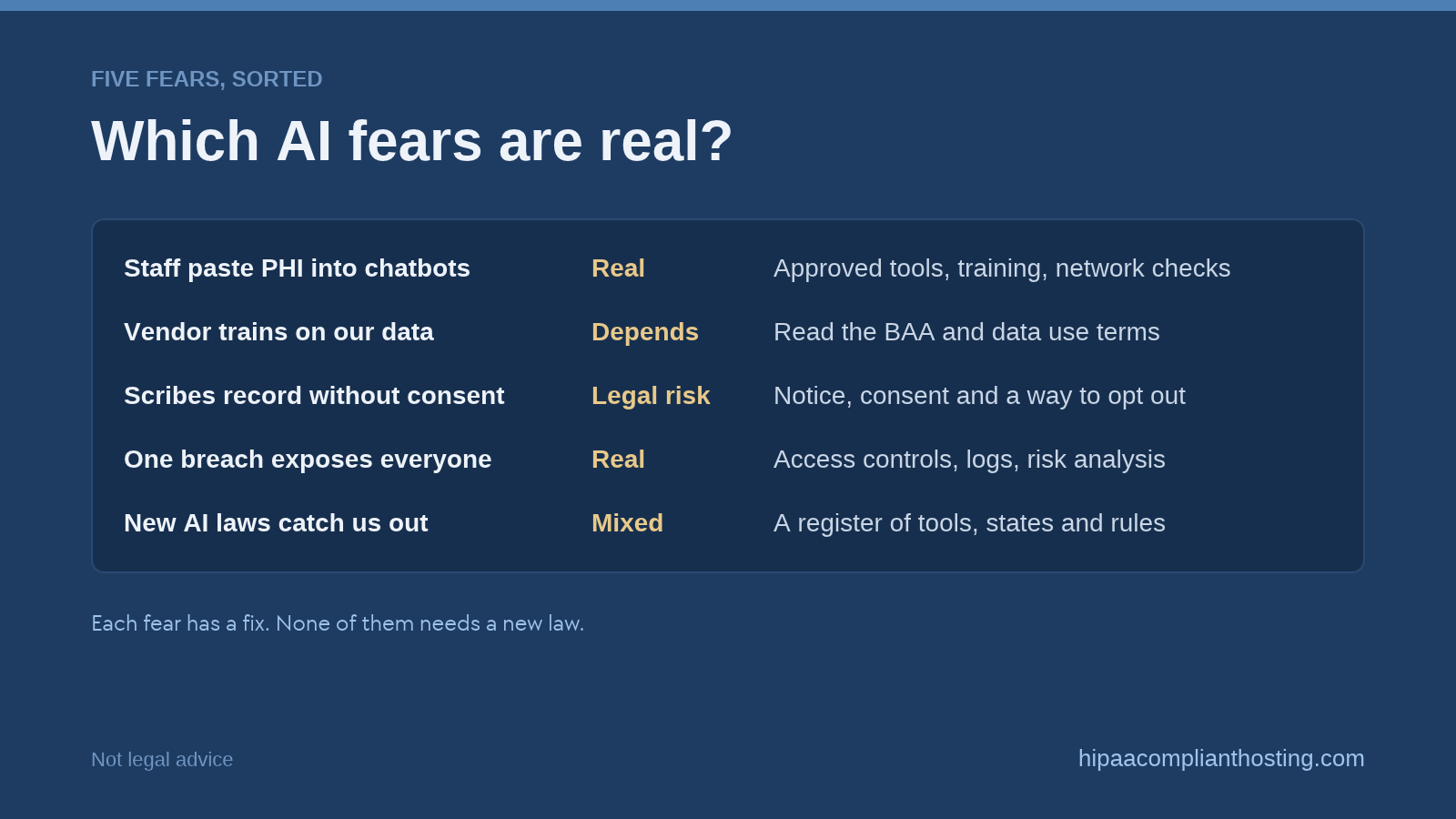
Yes, this one is real. A Wolters Kluwer survey of 518 US hospital and health system staff ran in December 2025. In it, 40% had come across an unauthorized AI tool at work, and nearly 20% had used one.
IBM's 2025 breach study found the same pattern across industries. One in five organizations reported a breach due to shadow AI. Heavy shadow AI use added about $670,000 to the average breach cost.
The AI patient data privacy problem here is simple. If a nurse pastes a chart note into a consumer chatbot, PHI has gone to a vendor with no BAA. That can be an impermissible disclosure under the Privacy Rule. OpenAI's help page says it does "not offer a BAA for ChatGPT" at present. OpenAI also says its separate ChatGPT for Healthcare product, launched in January 2026, comes with a BAA.
How to fix this AI patient data privacy gap:
Publish an approved list. Name the AI tools staff may use with PHI, and the ones they may not.
Give staff a safe option. People use unapproved tools because they save time. An approved tool removes the reason.
Train and repeat. Add AI rules to your HIPAA training, with examples of what not to paste.
Watch the network. Your IT team can log or block traffic to unapproved AI sites.
Fear 2: Will an AI vendor train on our patients' data?
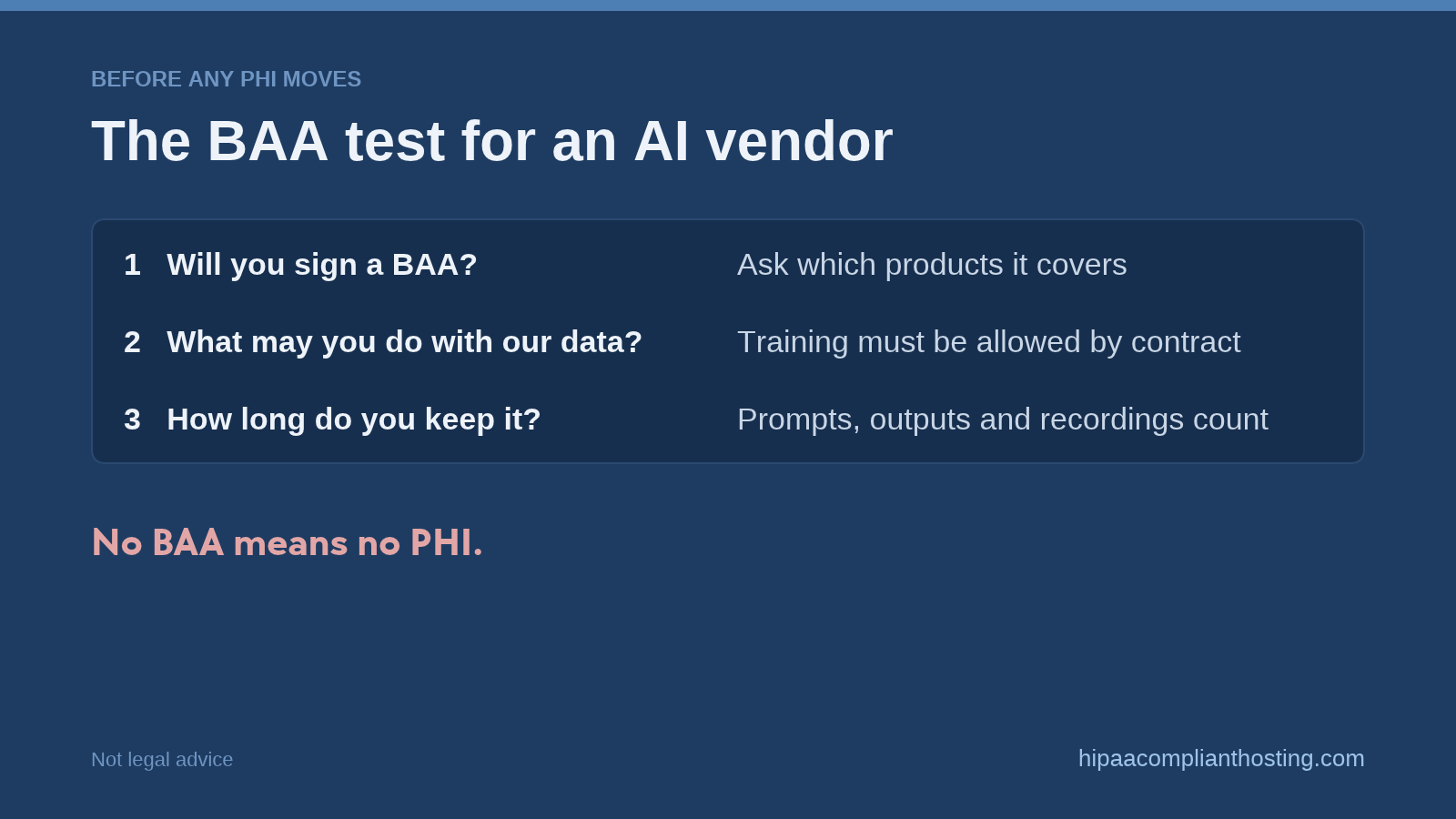
It depends on the contract, so read it. This is the AI patient data privacy question vendors hear most. A business associate may use PHI only as its BAA allows. If the BAA and service terms do not allow training on your data, the vendor may not do it.
The risk sits in tools with no BAA at all, and in vague data-use terms. Some vendors limit their BAA to certain products or settings. OpenAI, for example, says a BAA is needed to use its API with PHI. It also says only endpoints eligible for zero retention are covered.
Ask every AI vendor these questions in writing:
Will you sign a BAA, and which products and features does it cover?
Do you use our data to train or improve models? Can we turn that off?
How long do you keep prompts, outputs and recordings?
Which subcontractors see our data, and does each have a BAA with you?
How do we get our data back, and when is it deleted?
These are the same questions you would ask any host. Our checklist of HIPAA compliant hosting requirements shows how to put them in an RFP. Good AI patient data privacy starts with written answers.
Fear 3: Are AI scribes recording visits without consent?
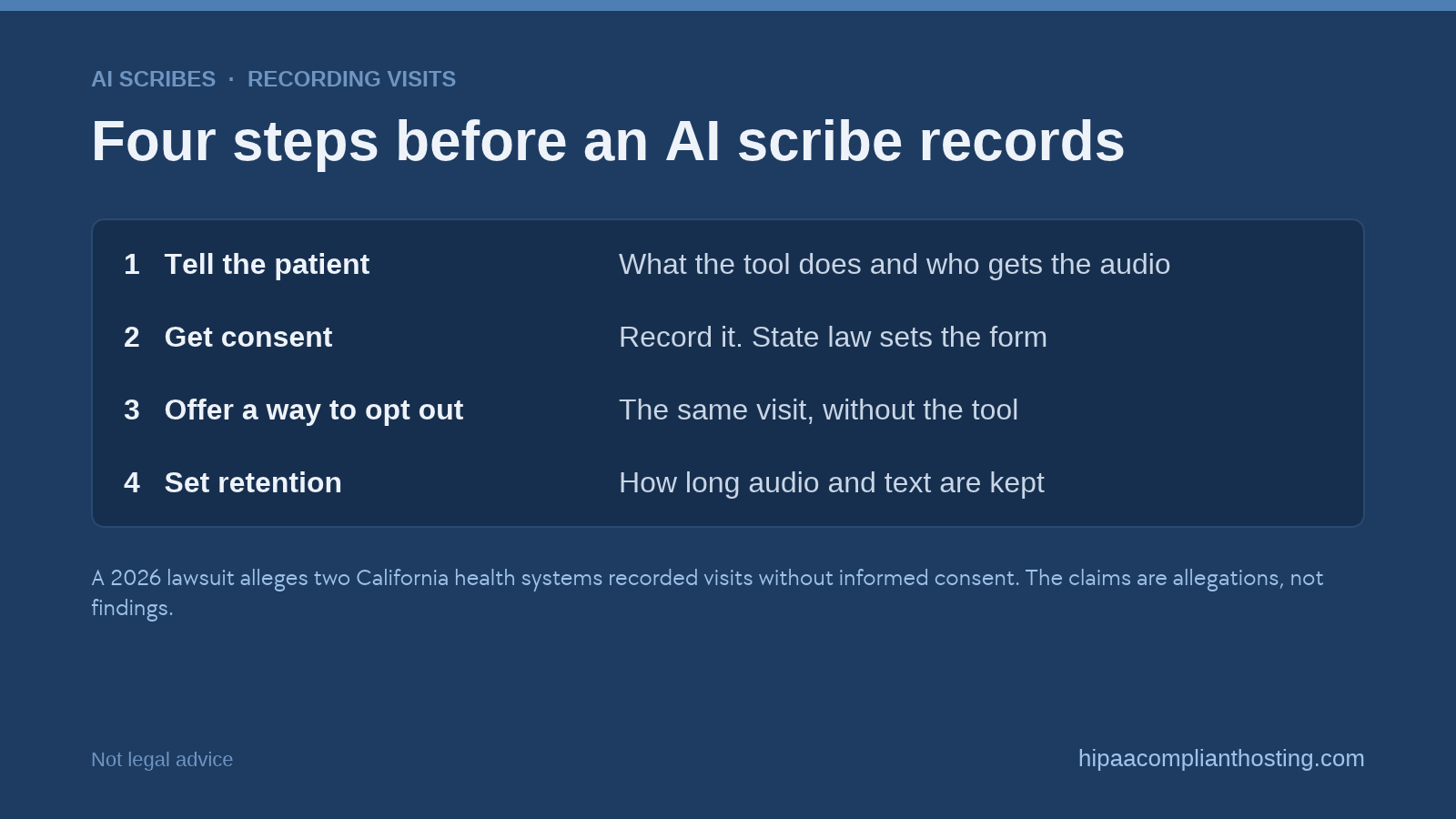
This is a live legal risk, and the newest front in AI patient data privacy. A proposed class action was filed on April 8, 2026, in federal court in Northern California. It names Sutter Health and MemorialCare over their use of the Abridge AI scribe.
According to news reports, the complaint claims visits were recorded "without obtaining meaningful, informed consent" from patients. It cites California's medical privacy law, the California Invasion of Privacy Act and the federal Wiretap Act. These are allegations. No court has ruled on them, and Sutter has said it is reviewing the matter.
The legal theory is familiar. Plaintiffs used the same wiretap and privacy laws against hospitals over website tracking tools. Our review of healthcare pixel lawsuits covers who paid and who won.
Note what the case shows about AI patient data privacy. A BAA with the scribe vendor answers the HIPAA question. It does not answer state recording laws. California, for one, requires consent from all parties to record a confidential conversation.
How to lower the risk:
Tell patients before recording. Say what the tool does and who receives the audio.
Get consent and record it. Ask counsel what form your state requires.
Offer a real opt-out. A patient who says no should get the same visit without the tool.
Set retention. Agree in the contract how long audio and transcripts are kept.
Fear 4: Could one AI breach expose everyone?
The scale is real, and it is why AI patient data privacy worries boards. The Change Healthcare breach affected about 192.7 million people, according to the figure reported to HHS in July 2025. That breach was not an AI incident. It shows how far one vendor's failure can reach.
AI adds new ways in. In IBM's 2025 study, 13% of organizations reported a breach of an AI model or application. Of those, 97% had no AI access controls in place. And 63% of breached organizations had no AI governance policy or were still writing one.
Cost follows. Healthcare breaches averaged $7.42 million in that study, the highest of any industry.
HHS has noticed. Its proposed Security Rule update says new tools such as AI "come with increased risks and vulnerabilities to ePHI" and its systems. Regulated entities, it says, "must be prepared to identify, mitigate, and remediate" them. The update is a proposal, not law. The duty to assess risk already is law.
How to fix it:
List every AI tool. Add each one that touches ePHI to your HIPAA risk analysis.
Control access. Give each user a named account. Limit what data the tool itself can reach.
Keep logs. Record who sent what to the tool. Our guide to HIPAA audit logs covers what to keep.
Write the policy. One page on approved tools, banned uses and who signs off is a start.
Fear 5: Will new AI laws catch us out?
Partly. The rules on AI patient data privacy are moving, but the main ones are already known.
HIPAA applies as written. No AI exception exists, in either direction.
The FTC covers apps outside HIPAA. Its Health Breach Notification Rule, amended in April 2024, reaches health apps that HIPAA does not cover. The FTC says an unauthorized disclosure counts as a breach.
The FTC has acted before. GoodRx paid a $1.5 million civil penalty in 2023 for sharing health data with advertisers. BetterHelp was ordered to pay $7.8 million in refunds.
State laws vary. Recording consent, AI disclosure and health data laws differ by state, and several are new. Check each state where you treat patients.
Keep a short register: each AI tool, the states it is used in and the rule that applies. That one page turns AI patient data privacy from a worry into a list.
Which fears about AI and patient data are overblown?
Three common claims about AI patient data privacy do not hold up.
"HIPAA bans AI." No rule does. An AI tool can handle PHI under a BAA, with safeguards and a risk analysis behind it.
"Any AI use is a breach." Not if no PHI is involved. Drafting a staff memo or a blog post with AI is not a HIPAA matter.
"A BAA makes an AI tool safe." A BAA is required, but it is not enough. Consent, access and retention still need work, as the scribe lawsuit shows.
Fear is a poor guide here. The risks that matter are specific, and so are the fixes.
Ten questions to ask before an AI tool touches PHI
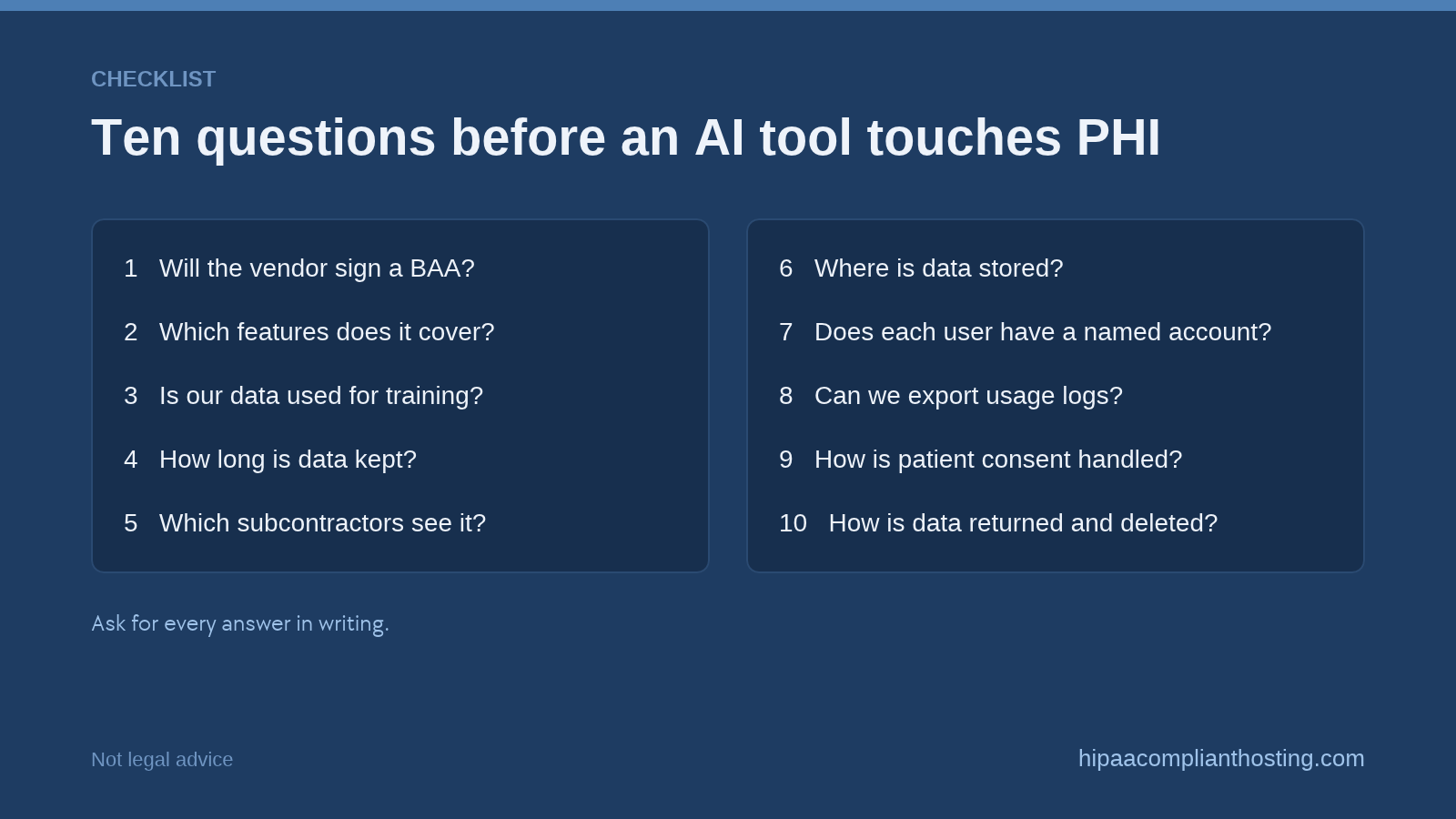
Use this list as your AI patient data privacy check for any new tool. Ask for each answer in writing.
Will the vendor sign a BAA before any PHI moves?
Which products and features does the BAA cover?
Is our data used to train or improve models?
How long are prompts, outputs and recordings kept?
Which subcontractors handle our data, and under what contract?
Where is the data stored and processed?
Does each user have a named account, with access we can remove?
Can we export logs of who used the tool and what was sent?
Does the tool record patients, and how is consent handled?
How is data returned and deleted when the contract ends?
If the AI tool runs on servers you manage, ask the host the same questions. That includes your own app that calls an AI model. The host's BAA covers the hosting. The model vendor needs its own.
How do our standard plans fit?
Here is where our hosting fits in AI patient data privacy, and where it does not. We sell this, so weigh it as a disclosure.
BAA. We sign the BAA within 24 hours of signup, before patient data moves. Our BAA covers the servers and services we run. Email, SMS, EHR, form and AI model vendors need their own BAA.
Tenancy. Single-tenant AWS. Each plan is one server in one AWS availability zone.
Safeguards. Every plan includes CloudFront CDN, a web application firewall (WAF), encryption at rest and in transit, six-year audit logging and tested encrypted backups.
What stays with you. Your application code, your choice of AI vendor, that vendor's BAA and patient consent stay with you.
Monthly plans have no long-term contract. Managed plans from $229 a month. If your website, portal or app handles PHI, request a quote and tell us which AI tools it connects to.
Frequently asked questions
Is it a HIPAA violation to put patient data into ChatGPT?
It can be. Sharing PHI with a vendor that has no BAA with you is an impermissible disclosure in most cases. OpenAI's help page says it does not offer a BAA for ChatGPT. It says its API and its ChatGPT for Healthcare product can be covered by one.
Does HIPAA allow AI tools?
Yes. HIPAA has no rule against AI, and AI patient data privacy rests on rules you already follow. The vendor must sign a BAA if it handles PHI. You must also limit the PHI shared and include the tool in your risk analysis.
Do patients have to consent to an AI scribe?
HIPAA generally does not require consent to use a vendor for treatment notes. State recording laws may. California requires all parties to consent to recording a confidential conversation. Ask counsel about your state.
What is shadow AI in healthcare?
Shadow AI means AI tools that staff use without approval from the organization. In a December 2025 survey of 518 hospital staff, nearly 20% said they had used one.
Does a BAA with an AI vendor make its tool HIPAA compliant?
No. A BAA is one requirement. You still need access controls, logs, a risk analysis and staff training. State consent and privacy laws apply as well. AI patient data privacy needs all of these.
Recap: AI patient data privacy
AI patient data privacy comes down to three old questions. Is there a BAA? Who can reach the data? Did the patient agree where the law asks for it? Approve the tools, get the answers in writing and add each tool to your risk analysis.
This article is general information, not legal advice. Rules, guidance, vendor terms and the lawsuit described are as read on November 13, 2026, and they can change. The lawsuit claims are allegations, not findings. Ask counsel about your state's recording and privacy laws. We sell HIPAA compliant hosting. Reviewed November 2026.
Sources
Wolters Kluwer: survey on unsanctioned AI tools (January 22, 2026).
IBM: 2025 Cost of a Data Breach Report release (July 30, 2025).
OpenAI: BAA help article and OpenAI for Healthcare (January 8, 2026).
News reports on Washington et al. v. Sutter Health: TechTarget and Becker's.
FTC: Health Breach Notification Rule changes, GoodRx and BetterHelp.
Proposed Security Rule: Federal Register, January 6, 2025 (90 FR 898).