


HIPAA Compliant Hosting for Medical Billing and RCM Companies in 2026
HIPAA Compliant Hosting · https://hipaacomplianthosting.com/blog/hipaa-compliant-hosting-for-medical-billing
Last updated: June 30, 2026
HIPAA compliant hosting for medical billing is infrastructure that keeps claims data and patient records safe while you process them for provider clients. It runs on a full chain of Business Associate Agreements (BAAs). It keeps electronic protected health information (ePHI) encrypted at rest and in transit. And it adds access control, audit logging, and tested backups. Does your company submit claims, post payments, or chase denials for healthcare providers? Then you are a Business Associate under 45 CFR § 160.103, with direct liability to the HHS Office for Civil Rights (OCR). A medical billing or revenue cycle management (RCM) company touches some of the densest patient data anywhere. This guide covers what your hosting has to do, and why the stakes are higher than most billing teams expect.
TL;DR: Quick answer
- A billing or RCM company that handles claims for providers is a Business Associate under 45 CFR § 160.103, and billing is a named Business Associate function under 45 CFR § 164.504(e).
- HIPAA compliant hosting for medical billing needs a full BAA chain: your hosting provider signs a BAA with you, and you sign one with each provider client.
- Claims data is dense ePHI. It includes diagnosis codes, procedure codes, patient identifiers, and full payment history, all of which must stay encrypted and access controlled under 45 CFR § 164.312.
- If you translate claims between formats, you may be a healthcare clearinghouse, which is a Covered Entity in its own right, not just a Business Associate.
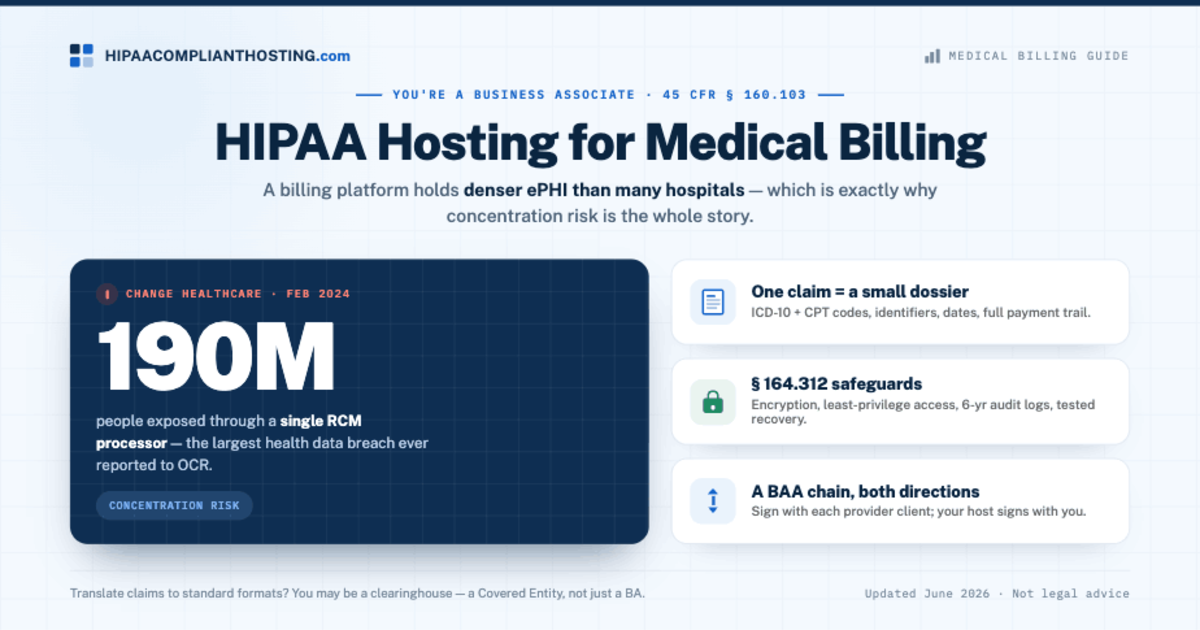
- The 2024 Change Healthcare attack exposed about 190 million people through a single RCM processor. It is the largest health data breach ever reported, and a warning about concentration risk.
Is a medical billing company covered by HIPAA?
Yes. A billing company creates, receives, stores, and transmits PHI for its provider clients, so it is a Business Associate under 45 CFR § 160.103. HIPAA even names billing directly. The regulation lists claims processing, billing, and practice management among the functions that make a vendor a Business Associate under 45 CFR § 164.504(e). The same is true for revenue cycle management firms, coding services, and denial management vendors. Since the 2013 Omnibus Rule, Business Associates are directly liable to OCR, not just to the client who hired them. So HIPAA compliant hosting for medical billing is not a nice-to-have. It is the floor you build on. If you are unsure whether your specific service is in scope, our guide to who needs HIPAA-compliant hosting walks through the test.
The BAA chain runs in both directions
This is the part billing teams miss most often. You sit in the middle of a chain. Your provider clients are Covered Entities, so you sign a BAA with each of them. Below you, your hosting provider and any subcontractor that touches claims data must sign a BAA with you. If any link is missing, the chain breaks. A signed client BAA on top of infrastructure with no BAA is still a violation under 45 CFR § 164.308(b). So HIPAA compliant hosting for medical billing starts with one question: will your host sign a BAA for the exact services that store and move your claims data?
Are you a Business Associate or a clearinghouse?
Billing companies often assume they are Business Associates and stop there. Check the details. A healthcare clearinghouse translates claims between nonstandard and standard formats, and a clearinghouse is a Covered Entity under 45 CFR § 160.103. Many RCM firms scrub and convert claims into the standard 837 transaction, then handle the 835 remittance that comes back. If your software does that translation, you may be acting as a clearinghouse for part of your work and a Business Associate for the rest. The duties overlap, but the classification changes who is directly responsible for what. Confirm your status with counsel, because it shapes your contracts and your hosting requirements.
Claims data is some of the densest ePHI there is
A single claim is a small dossier. It carries the patient name and identifiers, the diagnosis as ICD-10 codes, the service as CPT or HCPCS codes, dates, the rendering provider, and the full payment trail. Multiply that across thousands of patients and dozens of practices, and a billing platform holds more concentrated PHI than many hospitals. That is why HIPAA compliant hosting for medical billing has to meet the technical safeguards at 45 CFR § 164.312:
- Encryption at rest and in transit, with TLS 1.2 or higher and managed keys.
- Access control with named accounts, least privilege, and multi-factor authentication, so a biller sees only the clients they work.
- Audit logging that records who viewed or changed ePHI, kept for the six years required by 45 CFR § 164.316(b)(2)(i).
- Integrity controls so claims data cannot be altered without a trace.
- Encrypted, tested backups and a recovery plan you have actually run, since a ransomware hit stops cash flow for every client at once.
The database tier is where most of this risk concentrates, and it deserves its own hardening. The specifics are in HIPAA compliant database hosting. Most billing platforms run in the cloud, where the shared responsibility model leaves these controls to you. The cloud secures the data centers. You secure what you run on them, as covered in HIPAA cloud hosting explained.
Do not forget payment card data
Billing companies often collect patient payments too. The moment you take a card, a second rulebook applies. PCI DSS governs cardholder data, and it runs alongside HIPAA rather than replacing it. The two sets of safeguards overlap but are not the same, and an audit can check both. If you process payments, your hosting has to satisfy each one. We cover where they meet in PCI compliant hosting.
The Change Healthcare lesson
In February 2024, a ransomware attack hit Change Healthcare, one of the largest claims processors in the country. It exposed the protected health information of about 190 million people, the biggest health data breach ever reported to OCR, and it froze claims and payments across thousands of practices for weeks. The lesson for every billing and RCM company is concentration risk. When one platform holds the claims for a huge slice of the market, a single failure becomes a national event. Your clients now ask harder questions about where their data lives and how it is protected. HIPAA compliant hosting for medical billing, with isolation, tested recovery, and clear logging, is how you answer them. The full year-by-year numbers are in our healthcare data breach statistics. Billing firms that hold Texas patients' records also fall under Texas SB 1188, which has required US storage of those records since January 1, 2026.
Build it yourself or use a managed host
You have two paths. Configure and operate the cloud yourself, which gives full control and full responsibility for hardening, patching, logging, and incident response. Or use a managed host that runs that layer, so your team focuses on claims and collections instead of server tuning. For a billing company without a dedicated security staff, the managed path usually closes the compliance gap faster and answers client security reviews with less effort. Either way, the safeguards at 45 CFR § 164.312 are not optional.
If you would rather have the compliance layer handled
The fastest way to give provider clients confidence is to run on infrastructure that already meets the bar. Our healthcare hosting gives billing and RCM companies BAA-covered environments with encryption, a web application firewall, audit logging, and encrypted backups. Our managed HIPAA cloud hosting scales as your claim volume grows. For a billing team, HIPAA compliant hosting for medical billing handled for you means the BAA and the safeguards are done, so you can focus on revenue. That is HIPAA compliant hosting built for healthcare. We sell these services, so weigh that as a disclosure. If you want a straight read on your setup, tell us what you store and who your clients are.
Frequently asked questions
Is a medical billing company a Business Associate under HIPAA?
Yes. A billing company creates, receives, stores, or transmits PHI for provider clients, which makes it a Business Associate under 45 CFR § 160.103. Billing is also a named Business Associate function under 45 CFR § 164.504(e), so the classification is explicit. That brings direct liability to OCR and a duty to sign BAAs.
Does a billing company need a BAA with its hosting provider?
Yes. Any vendor that stores or transmits your claims data is a subcontractor that must sign a BAA with you under 45 CFR § 164.308(b). A client BAA on top of unsigned infrastructure is still a violation. Confirm your host will sign a BAA for the exact services you use.
Is a revenue cycle management company a clearinghouse?
Sometimes. If your service translates claims between nonstandard and standard formats, you may be acting as a healthcare clearinghouse, which is a Covered Entity under 45 CFR § 160.103, not just a Business Associate. Many RCM firms operate in both roles, so confirm your status with counsel.
Does HIPAA cover the payment cards we collect?
HIPAA covers the PHI, and PCI DSS covers the cardholder data. If your billing company takes patient payments, both rulebooks apply at once. Your hosting has to satisfy each, since the safeguards overlap but are not identical.
What made the Change Healthcare breach so serious?
A single RCM processor held claims for a large share of the market, so one ransomware attack exposed about 190 million people and stalled payments across thousands of practices. It is the largest health data breach ever reported to OCR and the clearest case for isolation and tested recovery.
Recap: HIPAA compliant hosting for medical billing
To recap, HIPAA compliant hosting for medical billing means running your claims platform under a full BAA chain, on encrypted and access-controlled infrastructure, with audit logging and tested backups. You are a Business Associate, and you may even be a clearinghouse, so the liability is yours. Claims data is dense ePHI, payment data adds PCI rules, and the Change Healthcare breach shows what concentration risk looks like. Get the BAAs in place, secure the data, and build on infrastructure that already meets the bar.
This article is general information, not legal advice. Confirm your obligations with qualified counsel and base your safeguards on a documented risk analysis specific to your operation. Reviewed June 2026.
Sources
- 45 CFR § 160.103 (definitions, Business Associate and healthcare clearinghouse): ecfr.gov
- 45 CFR § 164.504(e) (Business Associate contracts, named functions): ecfr.gov
- 45 CFR § 164.312 (technical safeguards): ecfr.gov
- HHS: Business Associates guidance
- HHS OCR: enforcement and resolution agreements