


HIPAA Compliant Hosting for Multi-Location Clinics and Healthcare Networks in 2026
HIPAA Compliant Hosting · https://hipaacomplianthosting.com/blog/hipaa-compliant-hosting-for-multi-location-clinics
Last updated: July 1, 2026
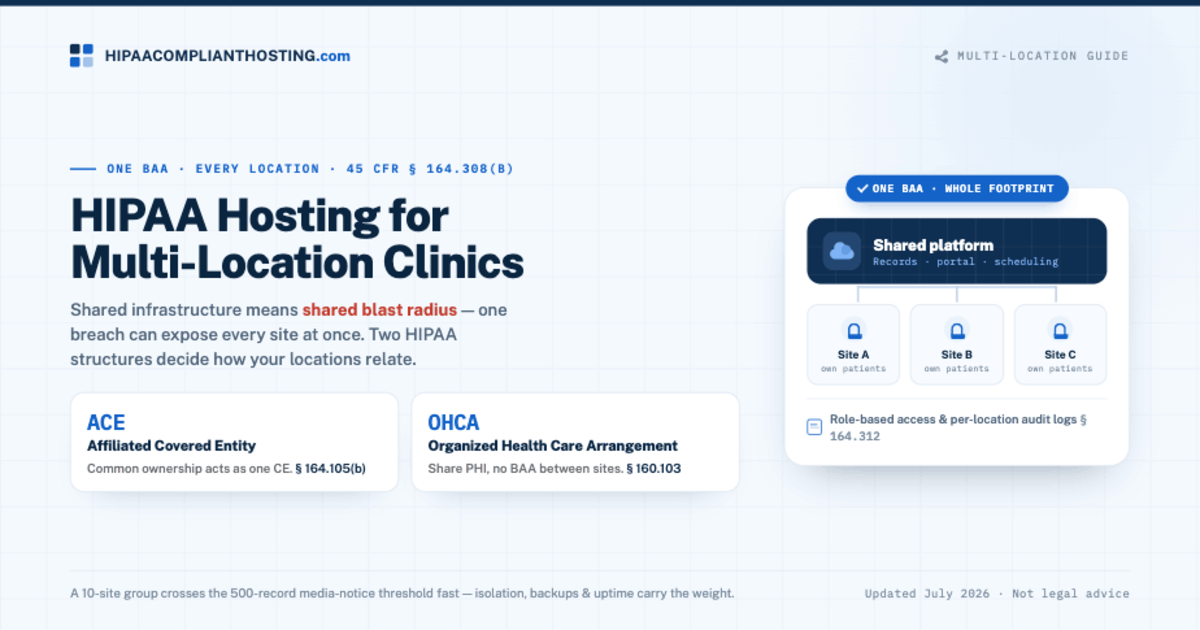
HIPAA compliant hosting for multi-location clinics is infrastructure that protects patient data across every site under one accountable setup. It runs under a signed Business Associate Agreement (BAA) that covers all locations. It gives each site role-based access, so staff see only their own patients. It keeps audit logs that show which site and which user opened a record. And it stays online. Downtime does not stop one office. It stops the whole network. A clinic group or health system is a Covered Entity under 45 CFR § 160.103. Its shared systems hold a lot of risk in one place. This guide covers what multi-site hosting must do. It also covers the two HIPAA structures that set how your locations relate.
TL;DR: Quick answer
- A clinic group or health network is a Covered Entity under 45 CFR § 160.103. Its hosting provider is a Business Associate that signs one BAA for every site.
- HIPAA compliant hosting for multi-location clinics needs role-based access and unique user IDs under 45 CFR § 164.312(a). Each site reaches only its own patients.
- Audit logging under 45 CFR § 164.312(b) must record the user and the site, so a review can tell one office from another.
- Sites under common ownership or control can act as one Covered Entity. This is an Affiliated Covered Entity under 45 CFR § 164.105(b).
- Sites that deliver care together can share patient data as an Organized Health Care Arrangement under 45 CFR § 160.103, with no BAA between them.
- Shared systems mean shared risk. One breach can expose every location at once, so isolation, backups, and uptime matter more.
Is a multi-location clinic group covered by HIPAA?
Yes. Each clinic that bills insurance electronically is a healthcare provider and a Covered Entity under 45 CFR § 160.103. Put several under one parent, and the whole group is in scope. The hosting that runs the shared website, patient portal, scheduling, and records is a Business Associate. It maintains ePHI for the group. So HIPAA compliant hosting for multi-location clinics starts with a BAA that covers every site, not just the headquarters. Not sure which parts of your operation are in scope? Our guide to who needs HIPAA-compliant hosting walks through the test by role.
How do your locations relate under HIPAA?
This part is unique to networks, and it shapes your hosting. HIPAA gives multi-site groups two structures.
- Affiliated Covered Entity (ACE). Separate clinics under common ownership or control can act as a single Covered Entity under 45 CFR § 164.105(b). Common ownership can be as little as a 5 percent stake. Common control counts too. The group signs one written document that lists every site. After that, it manages HIPAA as one unit. Policies, notices, and access get simpler across locations.
- Organized Health Care Arrangement (OHCA). Sites that deliver care together can share patient data for joint operations. This falls under 45 CFR § 160.103 and § 164.506(c)(5). No BAA is needed between the participants. Health systems and hospital networks use this to coordinate care.
Your structure decides who can see what. So HIPAA compliant hosting for multi-location clinics has to match it. An ACE may want shared access with per-site roles. A looser group of independent practices may need hard walls between sites. Confirm your structure with counsel first. Then build the hosting to fit.
What the infrastructure has to do
The technical safeguards at 45 CFR § 164.312 apply to every system that holds ePHI. Multi-site operations add more on top. Here is what HIPAA compliant hosting for multi-location clinics has to deliver.
- Role-based access control with unique user IDs under 45 CFR § 164.312(a)(2)(i). Front-desk staff at one clinic should not reach another clinic's records, unless the structure allows it.
- Audit logging under 45 CFR § 164.312(b) that records the user, the action, and the site. Keep it for the six years required by 45 CFR § 164.316(b)(2)(i). Cross-site logs are how you answer an OCR request.
- Encryption at rest and in transit, with TLS 1.2 or higher. Data moving between sites stays protected.
- Network isolation between sites and tenants. A problem at one site should not spread to the group.
- High availability and tested backups. A shared platform that goes down stops care at every site at once. Redundancy and a tested recovery plan are not optional.
Most networks keep records in one place. That database tier holds the most patient data. It needs its own hardening, covered in HIPAA compliant database hosting. For the shared cloud picture, and where the host's job ends and yours begins, see how HIPAA cloud hosting works. For the single-site view that each clinic still needs, see medical website hosting.
Why shared infrastructure raises the stakes
A single clinic breach stays at that clinic. A network breach can be everywhere at once. When every site runs on one platform, one attacker or one broken access rule can expose patients across the whole group. The numbers scale the same way. A breach that affects 500 or more residents of a state triggers media notice under 45 CFR § 164.406. On top of that, you owe individual notice within 60 days under § 164.404 and a report to HHS under § 164.408. A ten-site group crosses those lines fast. This is why HIPAA compliant hosting for multi-location clinics leans hard on isolation, monitoring, and recovery. The penalty side of getting it wrong is in our guide to HIPAA violation fines and penalties.
Centralized or per-site: how should a network host?
Networks usually pick one of two models. Many blend them.
| Model | What it means | Best when |
|---|---|---|
| Centralized | One environment, one records system, per-site roles on top | Sites are an ACE or OHCA and need shared care coordination |
| Per-site isolation | Separate environments or strong tenant walls per location | Locations are independent practices under a shared brand |
| Blended | Central records with isolated segments per region or site | Large networks that need both coordination and containment |
There is no single right answer. The choice follows your legal structure and your care model. Three things stay constant. You need one BAA that covers every site. You need access control that respects site boundaries. And you need logging that can tell locations apart. Good HIPAA compliant hosting for multi-location clinics gives you all three.
Build it yourself or use a managed host
You have two paths. You can run the cloud yourself. That gives full control, and full responsibility for hardening, patching, logging, and incident response across every site. Or you can use a managed host that runs that layer for you. Then your IT team supports clinicians instead of tuning servers. For a growing network, the managed path keeps things consistent as you add sites. Each new clinic inherits the same safeguards on day one. That is the real value of HIPAA compliant hosting for multi-location clinics: it scales without gaps.
If you would rather have one host cover every location
The simplest way to keep a network compliant is to run it on infrastructure built for the job, under one agreement. Our healthcare hosting gives clinic groups and networks BAA-covered environments. They come with encryption, a web application firewall, audit logging, network isolation, and encrypted backups. Our managed HIPAA cloud hosting scales as you add sites and traffic. For a multi-site group, HIPAA compliant hosting for multi-location clinics handled for you means one BAA, one hardened platform, and the same safeguards everywhere. That is HIPAA compliant hosting built for healthcare. We sell these services, so weigh that as a disclosure. Want a straight read on your setup? Tell us how many locations you run and how they share data.
Frequently asked questions
Does each clinic location need its own BAA with the host?
No. One BAA between the host and the covered entity, or its designated arrangement, can cover the whole group. It just has to name the scope. A host that maintains ePHI for the group is a Business Associate under 45 CFR § 164.308(b). The BAA should list the sites and services it covers.
What is an Affiliated Covered Entity?
Under 45 CFR § 164.105(b), separate clinics under common ownership or control can act as a single Covered Entity for HIPAA. Common ownership can be as little as a 5 percent stake, or common control. The designation is a written document. It lets a group manage compliance as one unit.
Can our locations share patient records without a BAA between them?
Yes, if they form an Organized Health Care Arrangement under 45 CFR § 160.103. Participants that deliver care together can share PHI for the joint operations of the arrangement under § 164.506(c)(5). No BAA between the sites is needed. Confirm your arrangement with counsel before you rely on it.
Should a network host all locations on one platform or separately?
It depends on your legal structure and care model. Integrated groups often centralize records with per-site roles. Independent practices under a shared brand often need separate environments. Either way, keep one BAA over the group and access controls that respect site boundaries. That is the core of HIPAA compliant hosting for multi-location clinics.
Why does uptime matter more for a network?
A shared platform outage does not stop one office. It stops care and scheduling at every site at once. That makes high availability, redundancy, and a tested recovery plan core parts of the hosting, not extras.
Recap: HIPAA compliant hosting for multi-location clinics
To recap, HIPAA compliant hosting for multi-location clinics means running the whole network under one BAA. You add role-based access that respects site boundaries. You add audit logging that names the site. You add encryption, isolation, and high availability. Your legal structure shapes who can see what, whether an Affiliated Covered Entity or an Organized Health Care Arrangement. Shared systems mean shared risk, so a breach can reach every site at once. Match the hosting to your structure. Cover every location. Build on a platform that keeps the safeguards the same as you grow.
This article is general information, not legal advice. Confirm your covered-entity structure and any ACE or OHCA designation with qualified counsel, and base your safeguards on a documented risk analysis specific to your network. Reviewed July 2026.
Sources
- 45 CFR § 160.103 (definitions, Covered Entity and OHCA): ecfr.gov
- 45 CFR § 164.105 (organizational requirements, Affiliated Covered Entity): ecfr.gov
- 45 CFR § 164.312 (technical safeguards): ecfr.gov
- 45 CFR § 164.506(c)(5) (uses and disclosures within an OHCA): ecfr.gov
- HHS: Covered Entities and Business Associates