


Accidental HIPAA Violation: What to Do in the First 24 Hours (2026)
HIPAA Compliant Hosting · https://hipaacomplianthosting.com/blog/accidental-hipaa-violation
Last updated: August 29, 2026
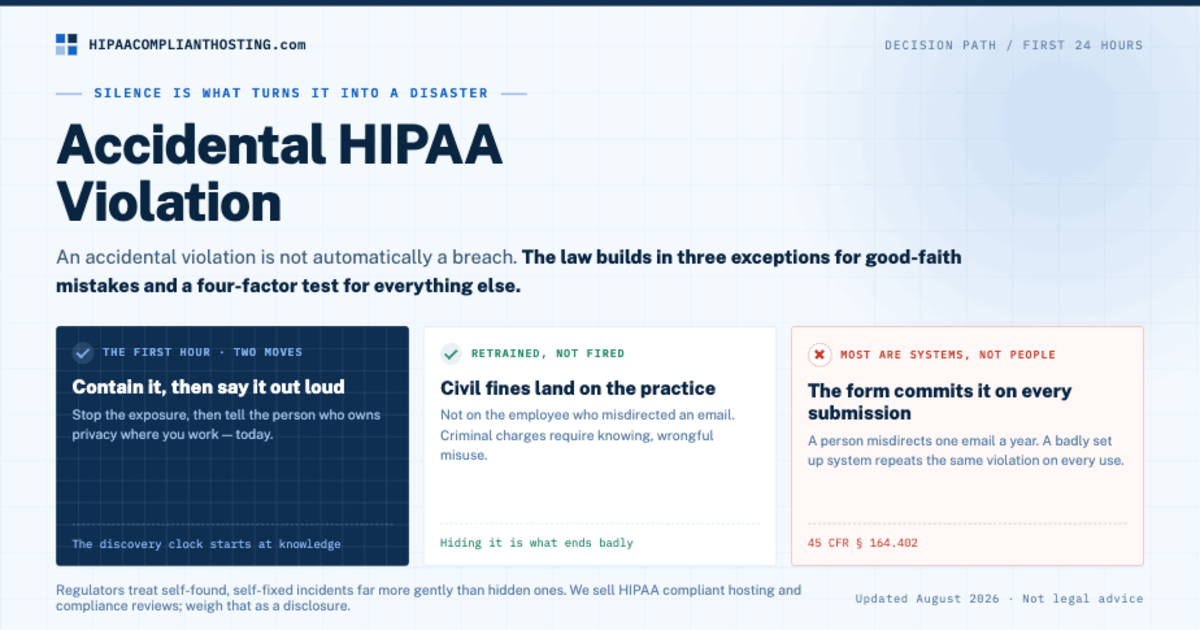
An accidental HIPAA violation is not automatically a breach, and it is almost never a career-ending event when it is handled fast and honestly. The law itself builds in three exceptions for good-faith mistakes and a four-factor test for everything else. What turns a mistake into a disaster is silence. This guide is the decision path for the first 24 hours after an accidental HIPAA violation. Contain it. Report it inside your practice. Check the three exceptions. Run the four-factor test. Notify only if the test says so. It is written for the person who just sent the wrong email, left the chart open, or found the form leak, and for the owner who has to decide what happens next.
TL;DR: Quick answer
Stop the exposure, then report the mistake inside your practice the same day. Reporting is routine; hiding it is what regulators punish.
Not every accidental HIPAA violation is a breach. 45 CFR § 164.402 excludes three kinds of good-faith mistakes outright.
Everything else gets the four-factor test: what data, who got it, was it actually viewed, and how well it was contained. A documented low-risk finding means no notices go out.
Real breaches have clocks: tell affected people within 60 days of discovery; tell HHS within 60 days for 500 or more, or in the annual log for smaller ones.
Most accidental violations are system-caused, not people-caused. The form that emails answers in plain text commits the same violation on every submission until someone fixes the system.
The first hour: contain it and say it out loud
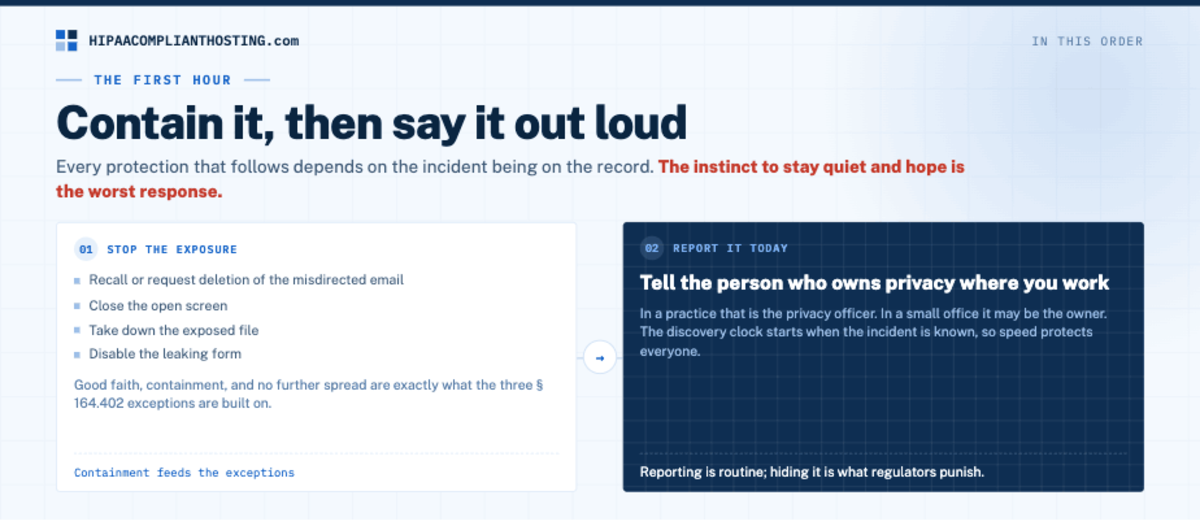
Two moves, in order. First, stop the exposure: recall or request deletion of the misdirected email, close the open screen, take down the exposed file, disable the leaking form. Second, tell the person who owns privacy where you work, today. In a practice that is the privacy officer. In a small office it may be the owner. The discovery clock in the Breach Notification Rule starts when the incident is known, so speed protects everyone. The instinct to stay quiet and hope is the worst response to an accidental HIPAA violation. Every protection that follows, the exceptions, the four-factor test, the credit for fast cleanup, depends on the incident being on the record. Regulators treat self-found, self-fixed incidents far more gently than hidden ones. If the leak came from a website form, keep that form offline until it runs on HIPAA compliant website hosting under a signed BAA.
Is it even a breach? Check the three exceptions first
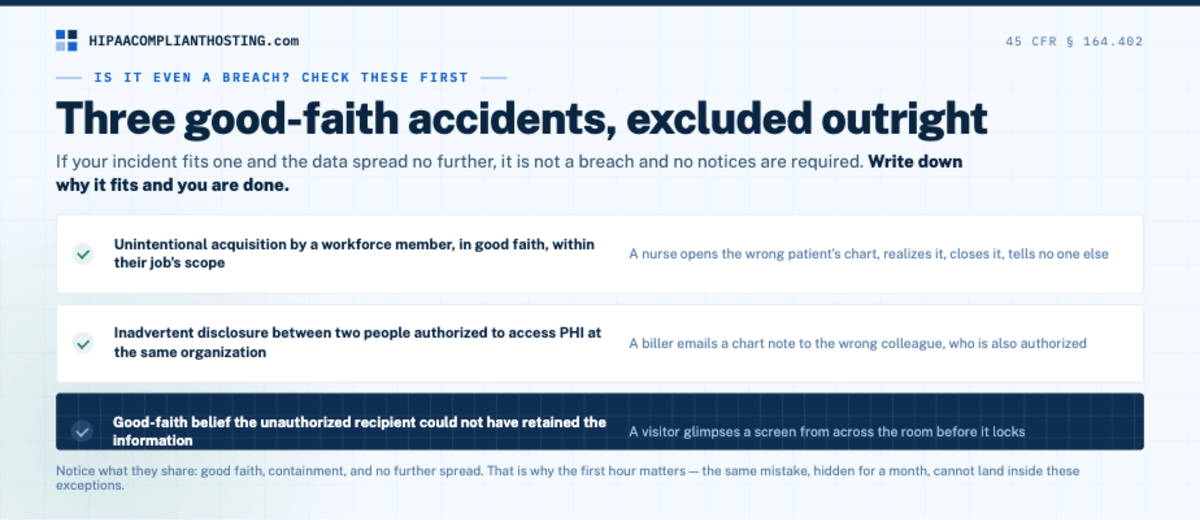
The definition of breach at 45 CFR § 164.402 excludes three kinds of accidents outright. If your incident fits one, and the data spread no further, it is not a breach and no notices are required. Write down why it fits and you are done.
Exception | Everyday example |
|---|---|
1. Unintentional acquisition by a workforce member, in good faith, within their job's scope | A nurse opens the wrong patient's chart, realizes it, closes it, tells no one else |
2. Inadvertent disclosure between two people authorized to access PHI at the same organization | A biller emails a chart note to the wrong colleague, who is also authorized |
3. Good-faith belief the unauthorized recipient could not have retained the information | A visitor glimpses a screen from across the room before it locks |
Notice what the exceptions share: good faith, containment, and no further spread. That is why the first hour matters. An accidental HIPAA violation that is caught, closed, and reported often lands inside these exceptions. The same mistake, hidden for a month, cannot.
The four-factor test, with a worked example
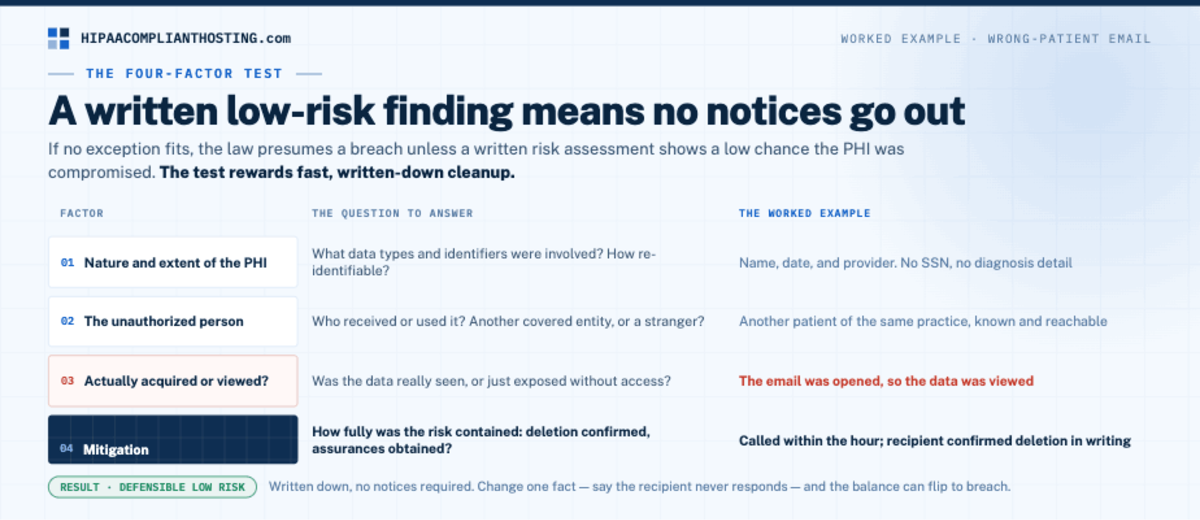
If no exception fits, the law presumes a breach, unless a written risk assessment shows a low chance the PHI was compromised. The four factors come straight from § 164.402:
Factor | The question to answer |
|---|---|
1. Nature and extent of the PHI | What data types and identifiers were involved? How re-identifiable? |
2. The unauthorized person | Who received or used it? Another covered entity, or a stranger? |
3. Actually acquired or viewed? | Was the data really seen, or just exposed without access? |
4. Mitigation | How fully was the risk contained: deletion confirmed, assurances obtained? |
Here is one row of an accidental HIPAA violation worked through the test. The incident: a receptionist emails an appointment summary to the wrong patient. Factor 1: name, date, and provider. No SSN, no diagnosis detail. Factor 2: the recipient is another patient of the same practice, known and reachable. Factor 3: the email was opened, so the data was viewed. Factor 4: the practice called within the hour, and the recipient confirmed deletion in writing. The result: a defensible low-risk finding, written down, no notices required. Change one fact, say the recipient never responds, and the balance can flip to breach. That is the point of the test. It rewards fast, written-down cleanup.
If it is a breach: the notification clocks
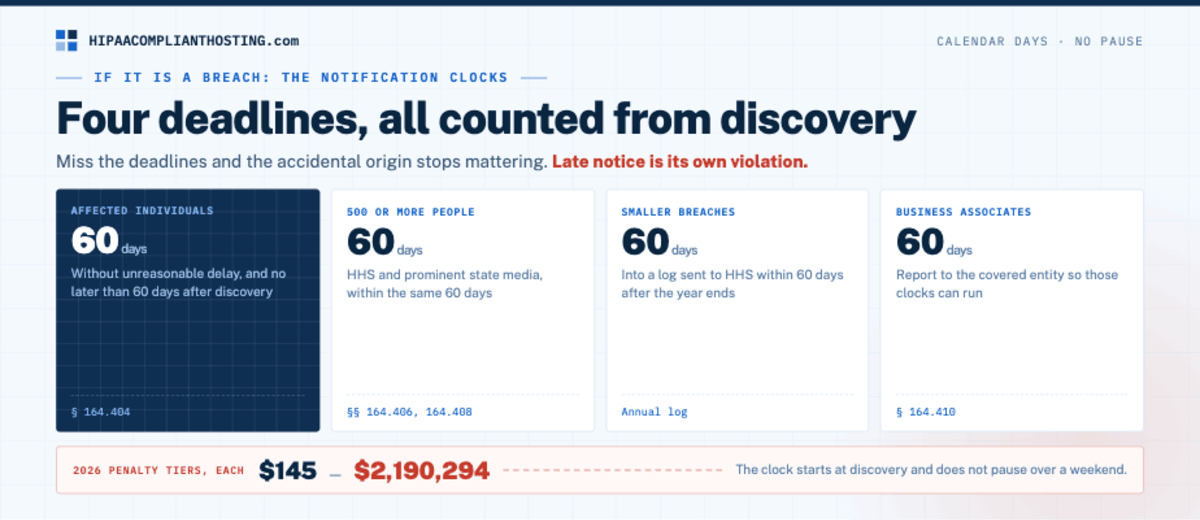
When the test cannot support a low-risk finding, the Breach Notification Rule takes over, and the deadlines are hard. Affected people must be told without unreasonable delay, and no later than 60 days after discovery (45 CFR § 164.404). If 500 or more people are affected, HHS and prominent state media are told within the same 60 days (§§ 164.406, 164.408). Smaller breaches go into a log sent to HHS within 60 days after the year ends. Business associates report to the covered entity within 60 days so those clocks can run (§ 164.410). Miss the deadlines and the accidental origin stops mattering. Late notice is its own violation, and the 2026 penalty tiers run $145 to $2,190,294 each. The enforcement backdrop is tracked in our healthcare data breach statistics.
What actually happens to the person who made the mistake
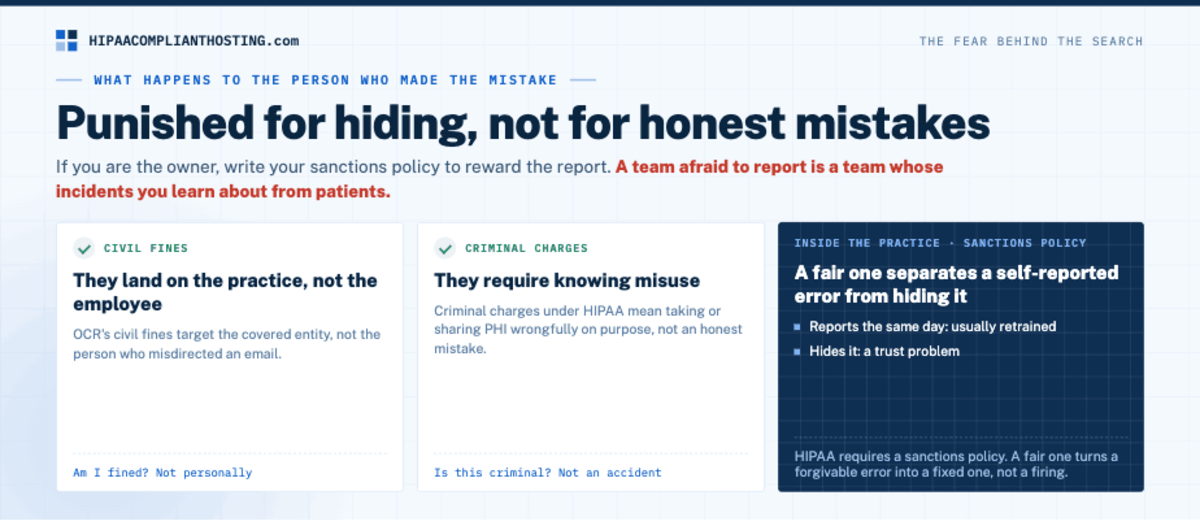
The fear behind most searches for accidental HIPAA violation is personal: am I fired, am I fined, is this criminal? The honest answers. OCR's civil fines land on the practice, not on the employee who misdirected an email. Criminal charges under HIPAA require knowing misuse, taking or sharing PHI wrongfully on purpose, not an honest mistake. Inside the practice, HIPAA requires a sanctions policy, and a fair one separates a self-reported, good-faith error from hiding it or repeating it. In practice, the employee who reports the mistake the same day is usually retrained, not fired. The one who hides it turns a forgivable error into a trust problem. If you are the owner, write your sanctions policy to reward the report. A team afraid to report is a team whose incidents you learn about from patients.
The uncomfortable truth: most accidental violations are systems, not people
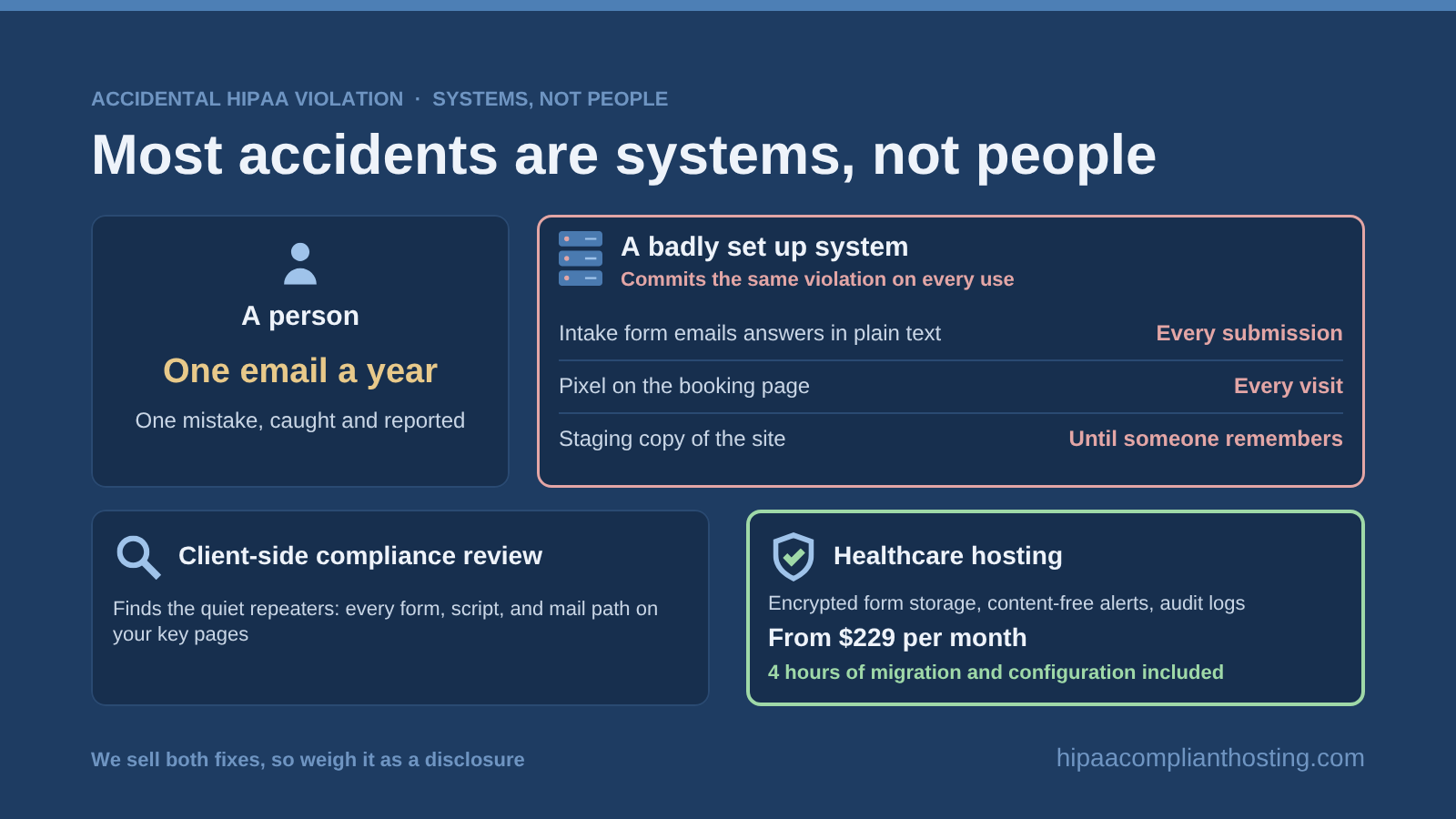
Here is the pattern behind the examples above, and the honest pain point. A person misdirects one email a year. A badly set up system commits the same accidental HIPAA violation on every use. The intake form that emails answers in plain text fires on every submission. The pixel on the booking page discloses on every visit. The staging copy of the site leaks until someone remembers it exists. Punishing people cannot fix those, and our unintentional HIPAA violations examples show how often the website is the repeat offender. Two fixes cover the website class of accidents, and we sell both, so weigh that as a disclosure. Our client-side compliance review finds the quiet repeaters, every form, script, and mail path on your key pages, before a patient or a regulator does. Our healthcare hosting removes the most common ones at the root: encrypted form storage, content-free alerts, and audit logs that make the four-factor test answerable. Managed plans start at $229 per month, with 4 hours of migration and configuration included. And if your incident had nothing to do with your website, the decision path above is yours free either way. Tell us what leaked and from where and we will tell you whether your systems were the cause.
Frequently asked questions
Is an accidental HIPAA violation a breach?
Not automatically. Three good-faith accident types are excluded outright by 45 CFR § 164.402, and everything else gets the four-factor test. Only incidents that fail both are breaches that require notices. Fast cleanup, written down, is what keeps an accident on the right side of that line.
Should I report my own accidental HIPAA violation?
Yes, the same day, to your privacy officer or owner. Reporting starts the protections: the exceptions, the cleanup credit, and a fair sanctions response. Hiding it is the version of events that ends badly.
Can I be fired for an accidental HIPAA violation?
Employers must have a sanctions policy, but fair ones separate good-faith, self-reported mistakes from hiding and repeating. Retraining is the common outcome for a promptly reported accident. Firing usually follows hiding it, not making it.
Can I personally be fined for an accidental mistake?
OCR's civil fines target the practice, not the individual employee. Criminal charges exist only for knowing, wrongful misuse of PHI, which an honest mistake is not.
Does the 60-day clock run over a weekend?
Yes. The clock starts at discovery, calendar days, and does not pause. That is one more reason to report and contain the same day you find the problem, even on a Saturday.
What if the mistake keeps happening?
Then it is a system problem, not an accident, and a repeating accidental HIPAA violation is how small leaks become reportable ones. Fix the mechanism, write the fix down as mitigation, and update the risk analysis so the pattern is closed on the record. The HIPAA compliance checklist walks through the 12 areas where repeat offenders hide.
Recap: accidental HIPAA violation
To recap, an accidental HIPAA violation is handled in an ordered path: contain the exposure, report it the same day, check the three § 164.402 exceptions, run the four-factor test in writing, and notify on the 60-day clocks only if the test says breach. People are punished for hiding and for knowing misuse, not for honest mistakes. And when the same accident repeats, stop blaming people and fix the system that commits it.
This article is general information, not legal advice. Regulatory citations reflect 45 CFR Parts 160 and 164, including the Breach Notification Rule, as of August 2026. Breach determinations are fact-specific: confirm your obligations with qualified counsel and your privacy officer, and base your safeguards on a written risk analysis. We sell HIPAA compliant hosting and compliance reviews. Reviewed August 2026.
Sources
45 CFR § 164.402 (breach definition, exceptions, four-factor assessment): law.cornell.edu
45 CFR §§ 164.404, 164.406, 164.408, 164.410 (notification to individuals, media, HHS, and by business associates): law.cornell.edu
HHS OCR: Enforcement process and results