


HIPAA Compliant Website Builder: What Actually Works in 2026
HIPAA Compliant Hosting · https://hipaacomplianthosting.com/blog/hipaa-compliant-website-builder
Last updated: July 11, 2026
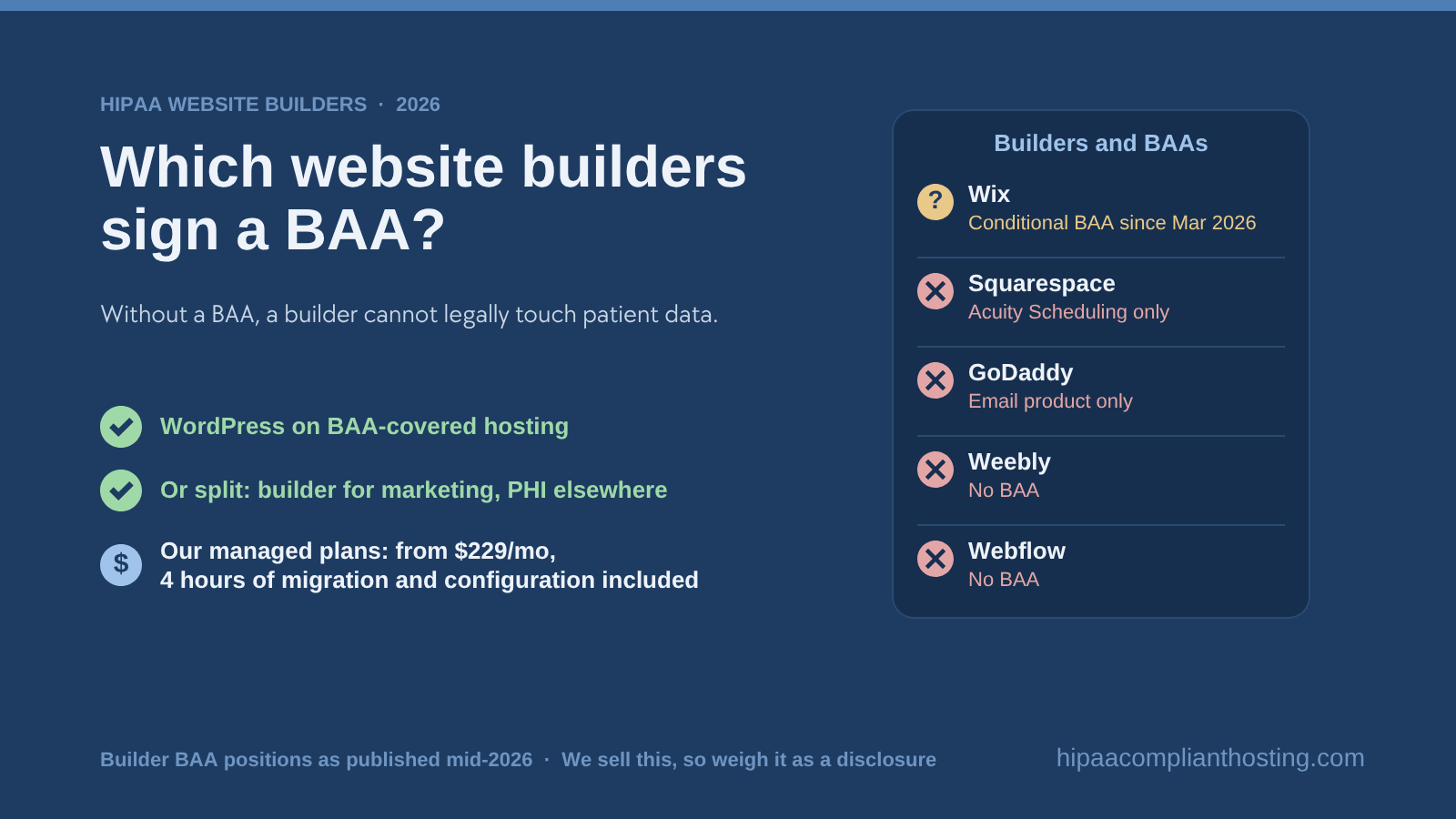
Only one mainstream website builder can be made HIPAA compliant in 2026: Wix, conditionally, after a March 2026 policy change. Weebly and Webflow sign no Business Associate Agreement (BAA) at all. Squarespace signs one only for its Acuity Scheduling product, not its website builder. GoDaddy signs one only for an email product. Wix now signs one on eligible plans with its PHI Protection feature activated, with real conditions covered in our guide to is Wix HIPAA compliant. Without a BAA, a builder cannot legally touch patient data, no matter how it is configured, under 45 CFR § 164.308(b). So healthcare practices have three paths that actually work: a properly configured Wix plan, WordPress hosted in a BAA-covered environment, which remains the closest thing to a HIPAA compliant website builder with full control, or keeping any builder for the marketing site and moving every patient-data workflow onto compliant infrastructure. This guide walks through all of them, builder by builder. The requirements any build must meet are in our HIPAA compliant website guide. Disclosure up front: we sell the compliant WordPress hosting, from $229 per month.
TL;DR: Quick answer
- Wix is the one conditional exception among drag-and-drop builders: since March 2026 it signs a BAA on eligible plans with PHI Protection activated. Weebly and Webflow sign no BAA, Squarespace covers only Acuity Scheduling, and GoDaddy covers only an email product.
- The missing BAA is a contract problem, not a settings problem. No configuration, plugin, or consent banner fixes it.
- Path 1: WordPress on BAA-covered hosting gives you a visual, template-driven builder experience on infrastructure that can lawfully hold patient data, with none of a walled garden's app restrictions.
- Path 2: keep the builder for a no-PHI marketing site and put intake forms, scheduling, and portals on compliant infrastructure. The split must be real.
- A builder site becomes a violation the moment one form asks about symptoms, unless the platform's BAA and protections are actually in place. Map where patient data flows before choosing anything.
Why do most website builders fail HIPAA?
Two reasons. The first is contractual: a builder that stores your form submissions maintains electronic protected health information (ePHI) on your behalf, which makes it a Business Associate under 45 CFR § 160.103, and § 164.308(b) requires a signed BAA before any patient data arrives. Most mainstream builders decline to sign one for their website products, because HIPAA liability is not worth it at $16 per month; Wix broke from the pack in March 2026. The second is architectural: builders run on dense shared infrastructure without the isolation, audit logging, or export controls the Security Rule safeguards at 45 CFR § 164.312 expect. The business model that makes builders cheap is the same one that historically made them non-compliant.
The builders, one by one
| Builder | Signs a BAA? | What that means |
|---|---|---|
| Wix | Yes, since March 2026, with conditions | Eligible plan + signed BAA + PHI Protection activated; app restrictions apply |
| Squarespace | Only for Acuity Scheduling (Powerhouse/Enterprise) | The website builder itself stays off-limits for PHI |
| GoDaddy Website Builder | Only for a Microsoft 365 email product | The builder and hosting are not covered |
| Weebly | No | Weebly forms cannot take patient data; third-party BAA-covered form embeds are the only workaround |
| Webflow | No | No BAA, and no ePHI-grade logging or access controls |
The platform-by-platform detail is in is Wix HIPAA compliant, is Squarespace HIPAA compliant, and is GoDaddy HIPAA compliant. Vendor positions change, as Wix just proved, so confirm the current BAA answer in writing before relying on any of them.
Path 1: WordPress on BAA-covered hosting, the builder experience with full control
WordPress with its block editor and page-builder themes gives you the same visual, drag-and-drop experience a website builder does. The difference is that WordPress is software you can run anywhere, which means it can run on infrastructure that signs a BAA and implements the Security Rule safeguards: encryption, access controls, audit logging, and tested backups. The host itself still has to sign that BAA, and even premium managed WordPress hosts often decline, as covered in is WP Engine HIPAA compliant. Unlike a walled-garden builder, nothing filters which plugins, integrations, or data structures you can use, which is why this remains the path for portals, custom intake, and anything a security questionnaire will probe. For stores specifically, the self-hosted route is judged in is WooCommerce HIPAA compliant.
It is also the path we sell, so weigh this as a disclosure. Our HIPAA compliant WordPress hosting is fully managed. Managed plans start at $229 per month, with 4 hours of migration and configuration included, and add updates, monitoring, and operations. The application layer stays your job: forms, plugins, and access control, covered step by step in how to make WordPress HIPAA compliant. Once the builder is chosen, the hosting layer still has to fit a practice; see medical website hosting.
Path 2: keep the builder, move the patient data
If you love your Squarespace site, or your Wix plan does not qualify for its HIPAA support, there is a legitimate way to keep it: use it only for the marketing site, and run every patient-data workflow somewhere compliant. The builder holds the service pages, the bios, the directions. The intake forms, scheduling, uploads, and portal live on BAA-covered infrastructure, either embedded from a BAA-signing form vendor or hosted on a compliant environment. What makes the split real: no symptom questions or health details in any builder-hosted form, no "tell us about your condition" chat widget, and no tracking pixel capturing what patients type. The form side of that split is covered in HIPAA compliant forms, and whether your site is in scope at all is the subject of who needs HIPAA-compliant hosting.
This path is also the budget answer. A builder at $16 per month for marketing plus one small compliant environment for PHI usually costs less than moving everything, which is why it leads our roundup of the cheapest HIPAA compliant hosting strategies.
The trap: the builder site that quietly crossed the line
Most builder violations are not decisions. They are drift. The site launched as a brochure, then someone added an appointment form, then a field asking what the visit is about. At that moment the form began collecting PHI on servers with no BAA in effect, an impermissible arrangement under 45 CFR § 164.308(b) before any breach happens; on Wix, that is the position of every site whose owner never signed the BAA and activated PHI Protection. The 2026 penalty tiers start at $145 per violation and reach $73,011 in the lowest tier. If your builder site has any form today, read the fields it asks for before anything else on this page.
How to choose between the paths
- Choose Wix's own HIPAA support if you are already on Wix, your plan qualifies, and simple forms and bookings inside its compliant app set cover your needs. Sign the BAA, activate PHI Protection, and accept the app restrictions; the conditions are in our Wix guide.
- Choose WordPress on compliant hosting if patient interaction is core to the site: intake, scheduling, uploads, a portal, or anything beyond a filtered app market. One environment, one BAA, no seams to police. Managed plans start at $229 per month, with 4 hours of migration and configuration included.
- Choose the split if the site is mostly marketing and you want to keep the builder workflow your team knows. Budget for the compliant piece where PHI actually lands.
- Choose neither if your site truly collects no patient data. A phone-number brochure site on any builder is fine, and cheaper than anything on this page.
If you want a straight answer for your site
Tell us what your current builder site collects, and we will tell you which path fits, including "stay on Wix and configure its HIPAA support properly" when that is the truth. That is HIPAA compliant hosting advice from a company that sells path one and will still recommend the others when they fit. We sell these services, so weigh that as a disclosure.
Frequently asked questions
Is there a HIPAA compliant website builder?
One, conditionally: Wix, since its March 2026 policy change, on eligible plans with a signed BAA and PHI Protection activated. Weebly and Webflow sign no BAA, Squarespace covers only Acuity Scheduling, and GoDaddy covers only an email product. The full-control equivalent remains WordPress on BAA-covered hosting.
Is Wix HIPAA compliant?
Conditionally, since March 2026. It requires an eligible plan (Business, Plus, Elite, Business Elite, Enterprise, or eligible Studio sites), a signed BAA with Wix, and PHI Protection activated, which restricts apps and channels. Default Wix sites remain non-compliant. The details are in our full Wix guide.
Can I make Squarespace HIPAA compliant?
Only partially. Squarespace signs a BAA for Acuity Scheduling on Powerhouse and Enterprise plans, so scheduling can be compliant, but the website builder and its forms remain uncovered. Patient data has to stay inside Acuity or off the platform entirely.
Can I keep my builder site and still be compliant?
Yes, with a real split: the builder hosts only no-PHI marketing content, and every patient-data workflow, forms, scheduling, uploads, runs on BAA-covered infrastructure or a BAA-signing form vendor. One symptom field on the builder side breaks it.
What does the WordPress path cost?
Managed plans start at $229 per month, with 4 hours of migration and configuration included. Across the market, specialist WordPress plans run roughly $84 to $500 depending on management level.
Recap: HIPAA compliant website builder
To recap, one mainstream platform can now be made a HIPAA compliant website builder: Wix, conditionally, since March 2026, with an eligible plan, a signed BAA, and PHI Protection activated. Weebly and Webflow sign no BAA, and Squarespace and GoDaddy cover only narrow side products. The paths that work are a properly configured Wix plan for simple sites, WordPress on BAA-covered hosting for full control, and the split architecture, where the builder keeps the marketing site and patient data lives on covered systems. Map where patient data flows, pick the path that matches, and get every BAA answer in writing.
This article is general information, not legal advice. Builder BAA positions are as published in mid-2026 and change, as Wix's March 2026 shift shows; confirm current terms directly with each vendor, and base your safeguards on a documented risk analysis. We sell the WordPress hosting described in path one. Reviewed July 2026.
Sources
- 45 CFR § 164.308 (administrative safeguards, BAA provisions): ecfr.gov
- 45 CFR § 160.103 (Business Associate definition): ecfr.gov
- Wix Help Center: Enabling HIPAA compliance for your Wix site
- Squarespace: HIPAA and Acuity Scheduling documentation
- Paubox: Is Weebly HIPAA compliant?
- Blaze: Is Webflow HIPAA compliant?