


Is Phalcon HIPAA Compliant? The PHP Framework, Not the AI Company (2026)
HIPAA Compliant Hosting · https://hipaacomplianthosting.com/blog/is-phalcon-hipaa-compliant
Last updated: October 22, 2026
Phalcon, the PHP framework, is not HIPAA compliant on its own, and no framework is. HIPAA regulates the organizations that handle patient data, not the code they use. A Phalcon app becomes part of a compliant system when a host signs a Business Associate Agreement (BAA). The app must also use Phalcon's security tools well, and it must be patched. A Phalcon HIPAA compliant app starts with a patched Phalcon 5, a signed BAA, and a few settings. One note first. Phalcon, LLC, a cancer-care AI company, and BlockSec's Phalcon Compliance, a crypto compliance product, also use the name. This page is about the open-source PHP framework. Phalcon 5 ships as a compiled C extension with strong encryption and access control tools. A pure PHP Phalcon 6 is still a release candidate. Phalcon 5 has no audit log, no two-factor login, and a busy 2026 security record. Every Phalcon fact below was checked against Phalcon's docs and GitHub on October 20, 2026. We sell HIPAA compliant Phalcon hosting, so weigh our view with that in mind.
TL;DR: Quick answer
Phalcon 5 includes a Crypt component with signing on by default. It also has bcrypt and Argon2i hashing, CSRF tokens, and an ACL that denies access by default.
Phalcon's Crypt uses AES-256-CFB by default. Its docs call AES-256-GCM the preferable cipher.
The new Auth component documents no two-factor login, and the Logger has no audit trail.
A Critical flaw, CVE-2026-59989, let attacker-controlled Volt templates run code on the server in versions up to 5.15.0. Run the latest release, 5.23.0 as of October 20, 2026, and nothing older than 5.20.3.
Phalcon has no official hosting product. Its hosting page says the C extension needs a server where you can install PHP extensions. It never mentions HIPAA or a BAA.
Our HIPAA compliant Phalcon hosting runs on single-tenant AWS from $259 a month on the Performance tier, with a BAA within 24 hours of signup.
Is Phalcon HIPAA compliant? The three-layer answer
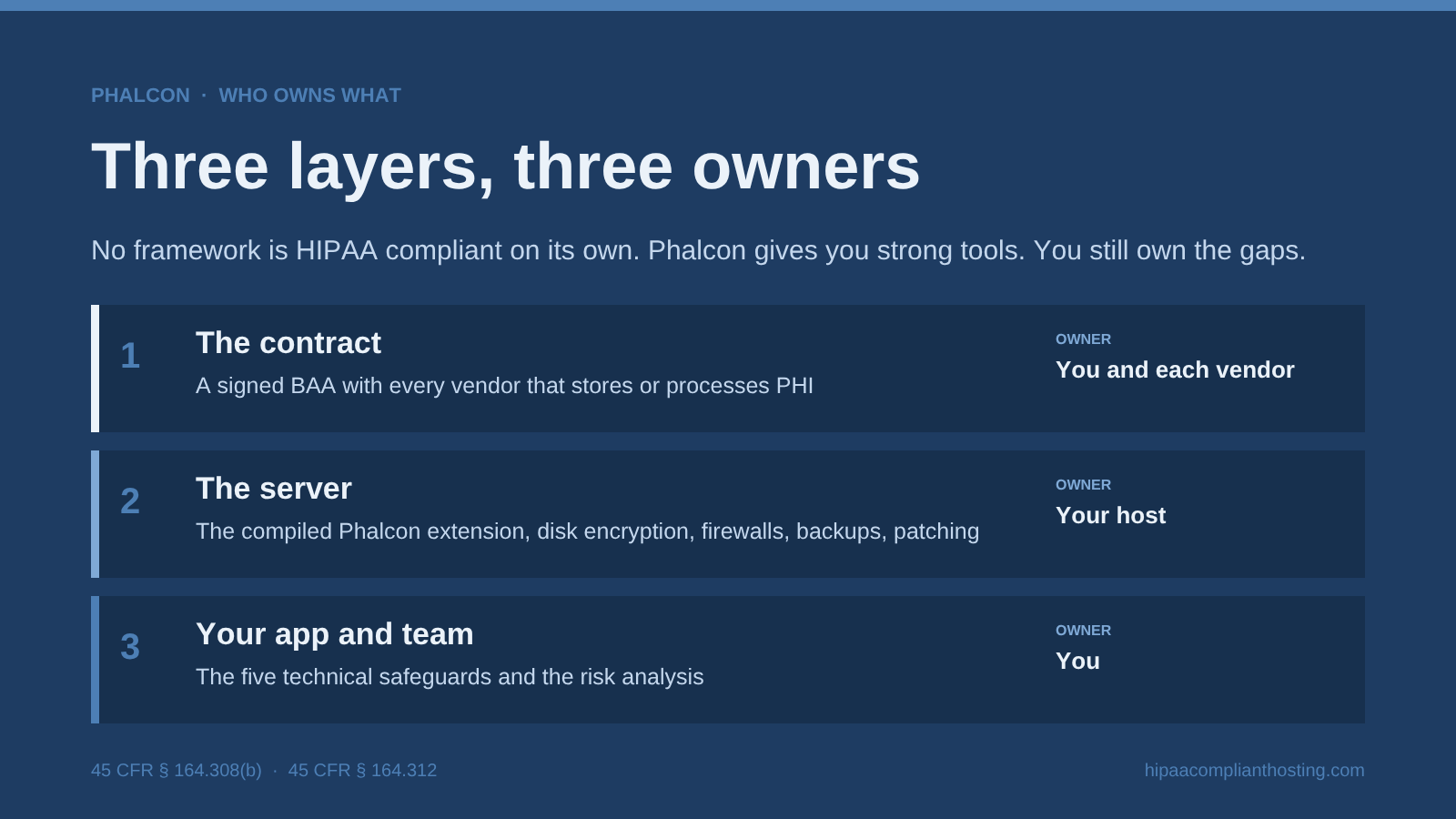
A Phalcon HIPAA compliant system has three layers, and each one needs an owner. The first is the contract. Any vendor that stores or processes protected health information (PHI) for a covered entity is a business associate under 45 CFR § 160.103. Under 45 CFR § 164.308(b), you need a signed BAA with that vendor first. Our HIPAA business associate agreement guide explains what it must cover. The second layer is the server. Phalcon 5 adds a twist here, because the host must install and update a compiled PHP extension, which takes root or sudo access. The host also runs the physical safeguards, disk encryption, firewalls, backups, and patching. What a server needs is covered in HIPAA compliant server. The third layer is your app and your team. The HIPAA Security Rule lists five technical safeguards in 45 CFR § 164.312. They are access control, audit controls, integrity, person or entity authentication, and transmission security. You also run a risk analysis under 45 CFR § 164.308(a)(1).
What does Phalcon 5 give you for the HIPAA technical safeguards?
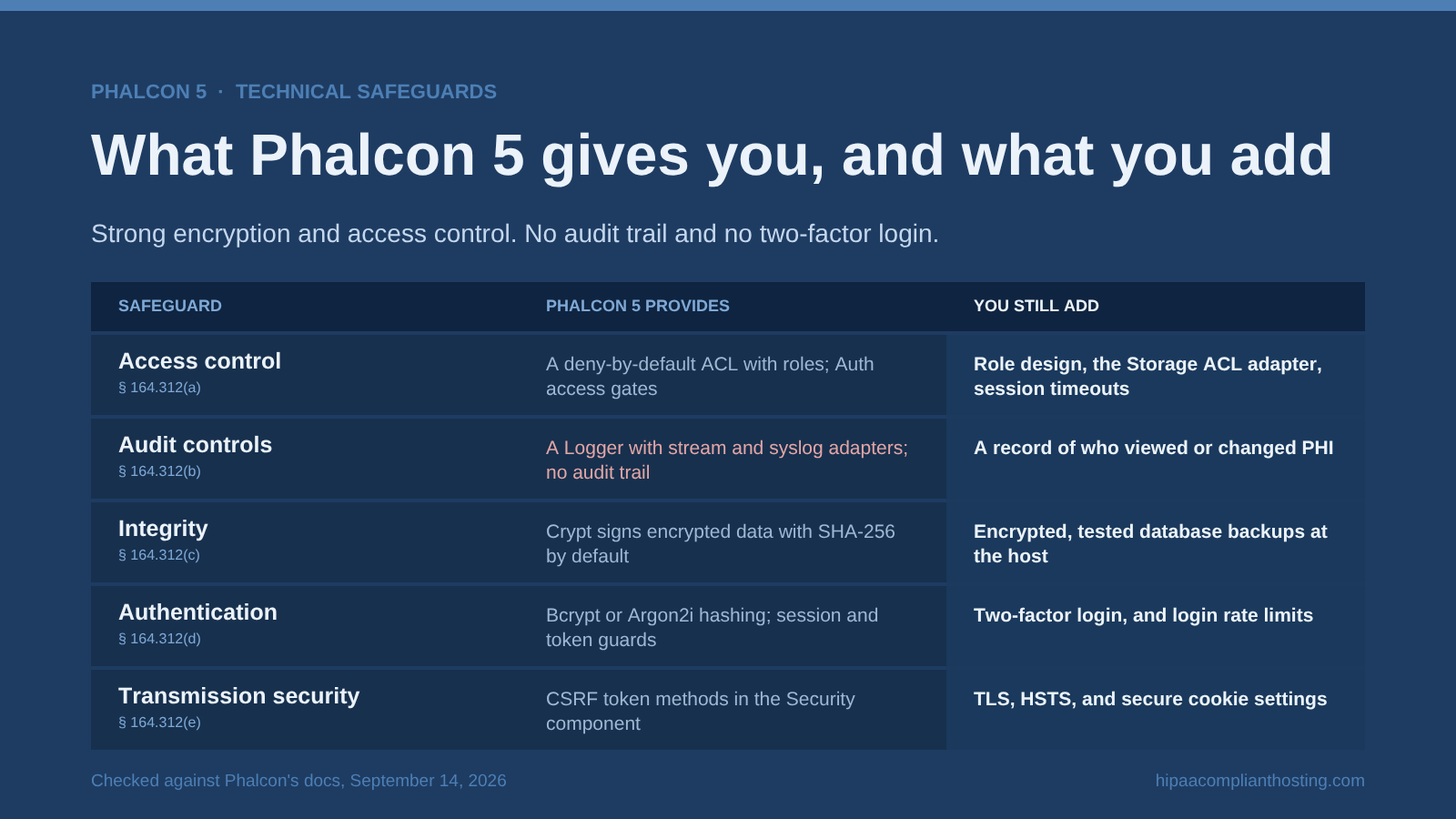
Here is how Phalcon 5 maps to each rule in 45 CFR § 164.312. The last column is what a Phalcon HIPAA compliant app still needs from you or your host.
Safeguard (45 CFR § 164.312) | What Phalcon 5 provides | What you still add |
|---|---|---|
Access control, (a) | An ACL with roles and components that denies by default; Auth access gates | Role design, the Storage ACL adapter in production, and session timeouts |
Audit controls, (b) | A Logger with stream and syslog adapters; no audit trail | A record of who viewed or changed PHI, plus server and database logs from the host |
Integrity, (c) | Crypt signs encrypted data with SHA-256 by default | Encrypted, tested database backups at the host |
Person or entity authentication, (d) | Bcrypt (work factor 4 to 31) or Argon2i hashing; session and token guards | Two-factor login, and login rate limits at the proxy or firewall |
Transmission security, (e) | CSRF token methods in the Security component | TLS, HSTS, and secure cookie settings at the host and in your config |
Encryption is a Phalcon HIPAA compliant strength, with one setting to change. Phalcon's Crypt defaults to AES-256-CFB with signing turned on. The docs say AES-256-GCM is preferable, so set that cipher. Nothing encrypts model fields for you, so your code must encrypt each PHI field. The Auth docs also give good token advice. Store a hash of each remember-me token, never the plain value, and keep API tokens out of URLs. Those details decide how Phalcon HIPAA compliant data handling works in practice.
Which Phalcon version should a HIPAA app run?
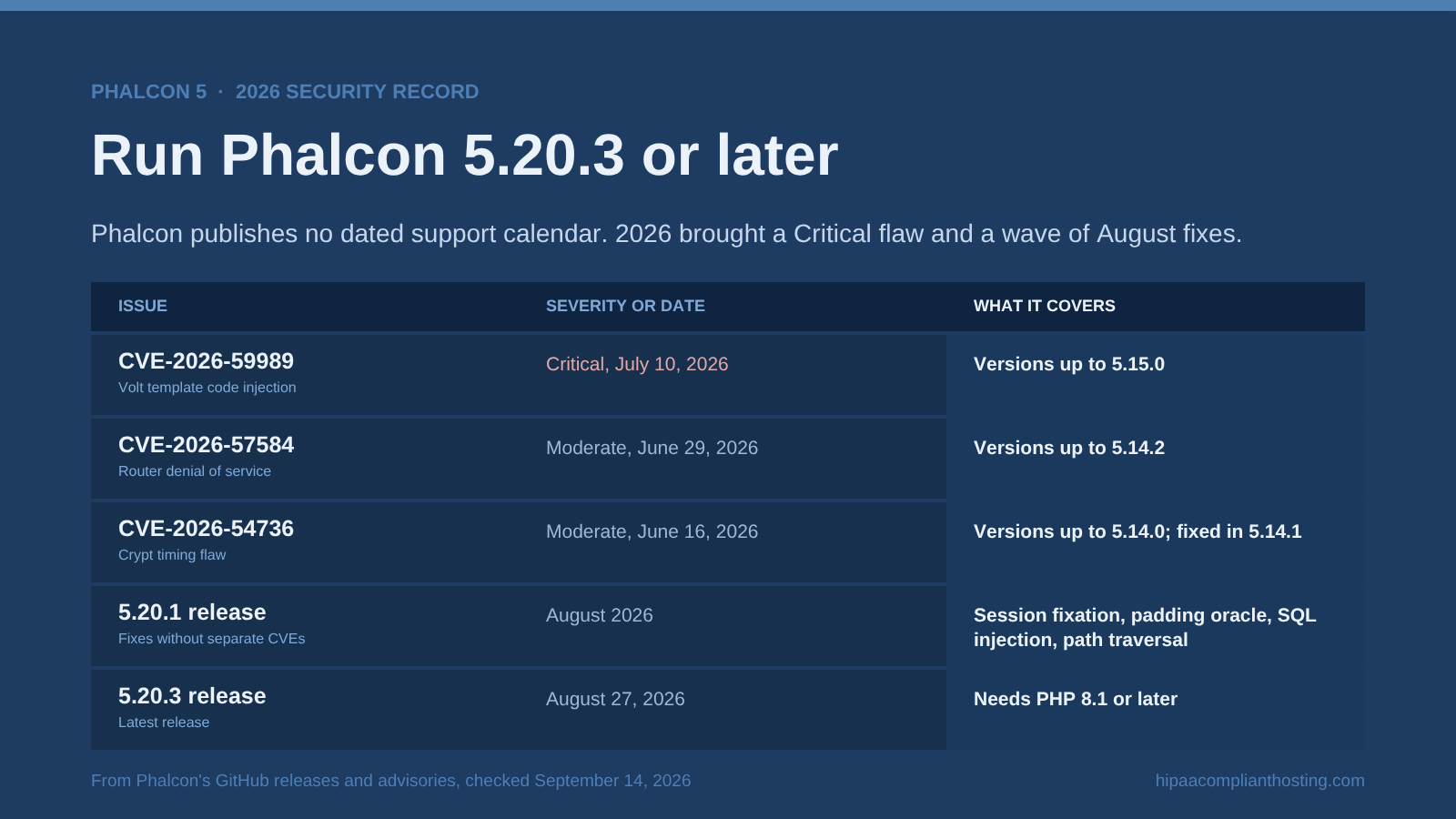
The latest Phalcon 5 release, applied promptly. As of October 20, 2026, that is 5.23.0, released October 15, 2026. Phalcon's release history marks 5.20 as still maintained but gives no end dates. Its 2021 roadmap post estimated that version 5 would last two years and more. Current releases support PHP 8.1 to 8.5. The install docs say PHP 8.1 no longer gets security updates, so run a newer PHP.
The PHP runtime needs its own patches, because a Phalcon update alone does not fix flaws in PHP itself. On October 21, 2026, the PHP project released 8.5.12, 8.4.27, 8.3.36, and 8.2.35 to fix CVE-2026-109618 and CVE-2026-109619. Both are critical flaws that can allow unauthenticated remote code execution, so run one of those releases or a later patch on the same branch. If your PHP comes from a Linux distribution, check your vendor for an updated package, since vendors received the patches in advance. The 2026 security record is why patching speed matters for any Phalcon HIPAA compliant app.
Advisory | Severity and date | What it affected |
|---|---|---|
CVE-2026-54736, Crypt timing flaw | Moderate, June 16, 2026 | Versions up to 5.14.0; fixed in 5.14.1 |
CVE-2026-57584, router denial of service | Moderate, June 29, 2026 | Versions up to 5.14.2 |
CVE-2026-59989, Volt template code injection | Critical, July 10, 2026 | Versions up to 5.15.0 |
August added more work for Phalcon HIPAA compliant teams. The 5.20.1 release fixed a long list of issues without separate CVEs. They include session fixation in the Auth login, a padding oracle in Crypt decryption, and SQL injection in database dialect methods. They also include path traversal in views, cache, and sessions, and unsafe unserialize calls. Version 5.20.3 closed a remaining Crypt timing gap and fixed remember-me cookie handling in Auth. Releases 5.21.0 to 5.23.0 followed from September 18 to October 15, 2026, with no new advisories. Record your version and patch cadence in your HIPAA risk analysis.
The 8 settings that make a Phalcon app HIPAA-ready
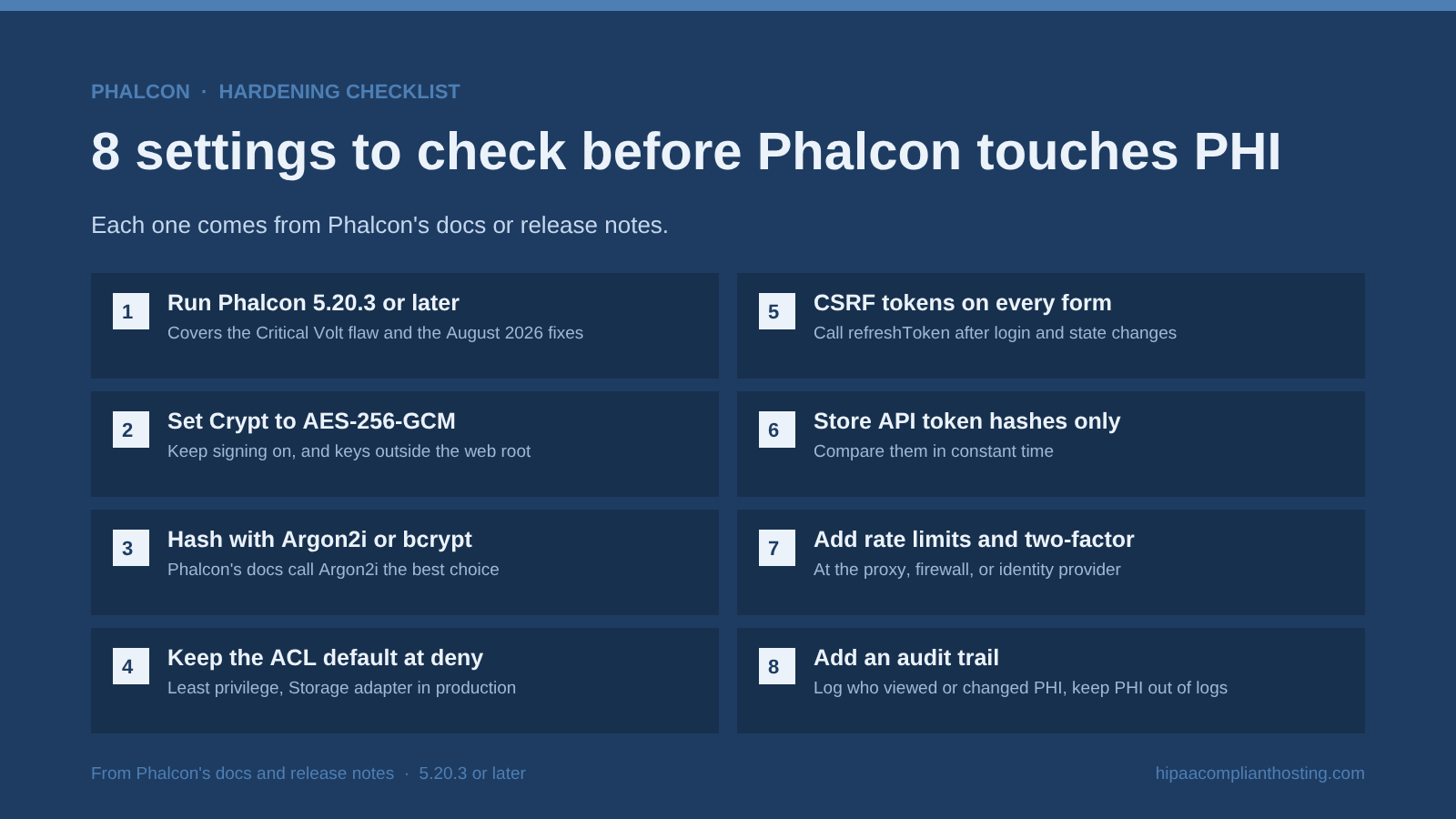
These eight settings come first in any Phalcon HIPAA compliant build. Each one comes from Phalcon's docs or release notes.
Run Phalcon 5.20.3 or later. That covers the Critical Volt flaw and the August 2026 fixes. Better still, run the latest release, 5.23.0 as of October 20, 2026.
Set the Crypt cipher to AES-256-GCM. Supply the auth data GCM requires, keep signing on, and store keys outside the web root.
Hash passwords with Argon2i or bcrypt. Phalcon's docs call Argon2i the best choice for password hashing.
Keep the ACL default at deny. Grant each role only what it needs, and use the Storage adapter in production.
Use CSRF tokens on every form. Call refreshToken after login and other state changes.
Store API token hashes only. Hash each token before saving it, and compare in constant time. The Auth docs give the same advice for remember-me tokens, and say to send API tokens in a header, never a URL.
Add rate limits and two-factor login. Phalcon's docs show no rate limiter or two-factor feature, so add them at the proxy, firewall, or identity provider.
Add an audit trail. The Logger writes messages, not audit records. Log who viewed or changed PHI, and keep PHI out of the log text. Our guide to HIPAA audit logs covers what to record and how long to keep it.
Login timeouts tie to HIPAA automatic logoff. Two-factor login ties to HIPAA MFA requirements. With all eight in place, most Phalcon HIPAA compliant work inside the app is done.
Where do Phalcon apps leak PHI?
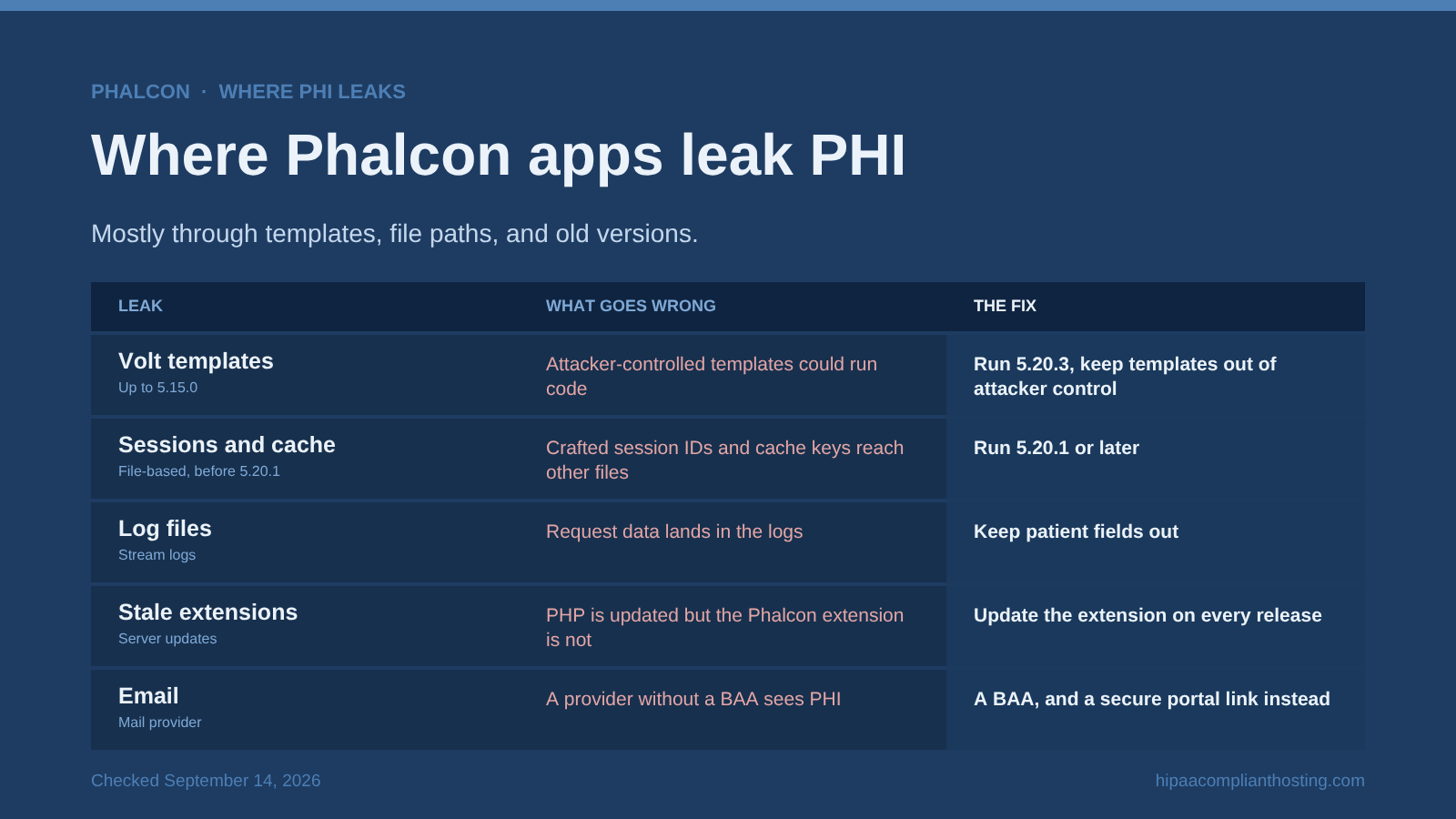
Mostly through templates, file paths, and old versions. A Phalcon HIPAA compliant setup closes each path below. The first two come straight from Phalcon's 2026 advisories and release notes.
Volt templates. On versions up to 5.15.0, attacker-controlled templates could run code on the server.
File-based sessions and cache. Before 5.20.1, crafted session IDs and cache keys could reach other files.
Log files. Server and stream logs often capture request data, including any token placed in a URL. Keep patient fields out. Release 5.20.1 also fixed log injection through control characters in the Logger's line formatter.
Stale extensions. A server that updates PHP but not the Phalcon extension stays exposed. Phalcon's official Docker images keep the two in step, since each tag pins one Phalcon release to one PHP version.
Email. Your mail provider needs a BAA. Keep PHI out of email bodies and link to a secure portal instead.
Who signs the BAA for a Phalcon app, and what does it cost?
Your host does. Phalcon's hosting page names AWS EC2, DigitalOcean, Linode, and Microsoft Azure as examples of servers where you can install the extension. It also lists KingHost, a Brazilian host that installs Phalcon for you. It never mentions HIPAA or a BAA. A Phalcon HIPAA compliant budget starts with a host that signs and can run the extension. As of October 20, 2026, AWS lets you accept its BAA in AWS Artifact. DigitalOcean offers a BAA through Sales for new customers and through Support for existing ones. Our guide to whether AWS is HIPAA compliant explains what the AWS BAA covers.
Route | Published starting point | Who signs the BAA | What you still own |
|---|---|---|---|
Your own AWS or DigitalOcean server | Pay per resource | The cloud provider | Building the extension, PHP and database patching, logs, backups, and the engineer's hours |
HIPAA compliant Phalcon hosting from us | From $259 per month on the Performance tier, with 4 hours of migration and configuration in the first month | Us, within 24 hours of signup | Your Phalcon code, app settings, and risk analysis; confirm in writing who patches PHP, the database, and the Phalcon extension |
HIPAA compliant Docker hosting from us | From $259 per month on the Performance tier, with the same 4 hours in the first month | Us, within 24 hours of signup | Your container image with PHP and Phalcon built in, app settings, and risk analysis; confirm in writing who patches the database |
We sell the last two rows, so weigh them as a disclosure.
If you would rather not run the server layer yourself
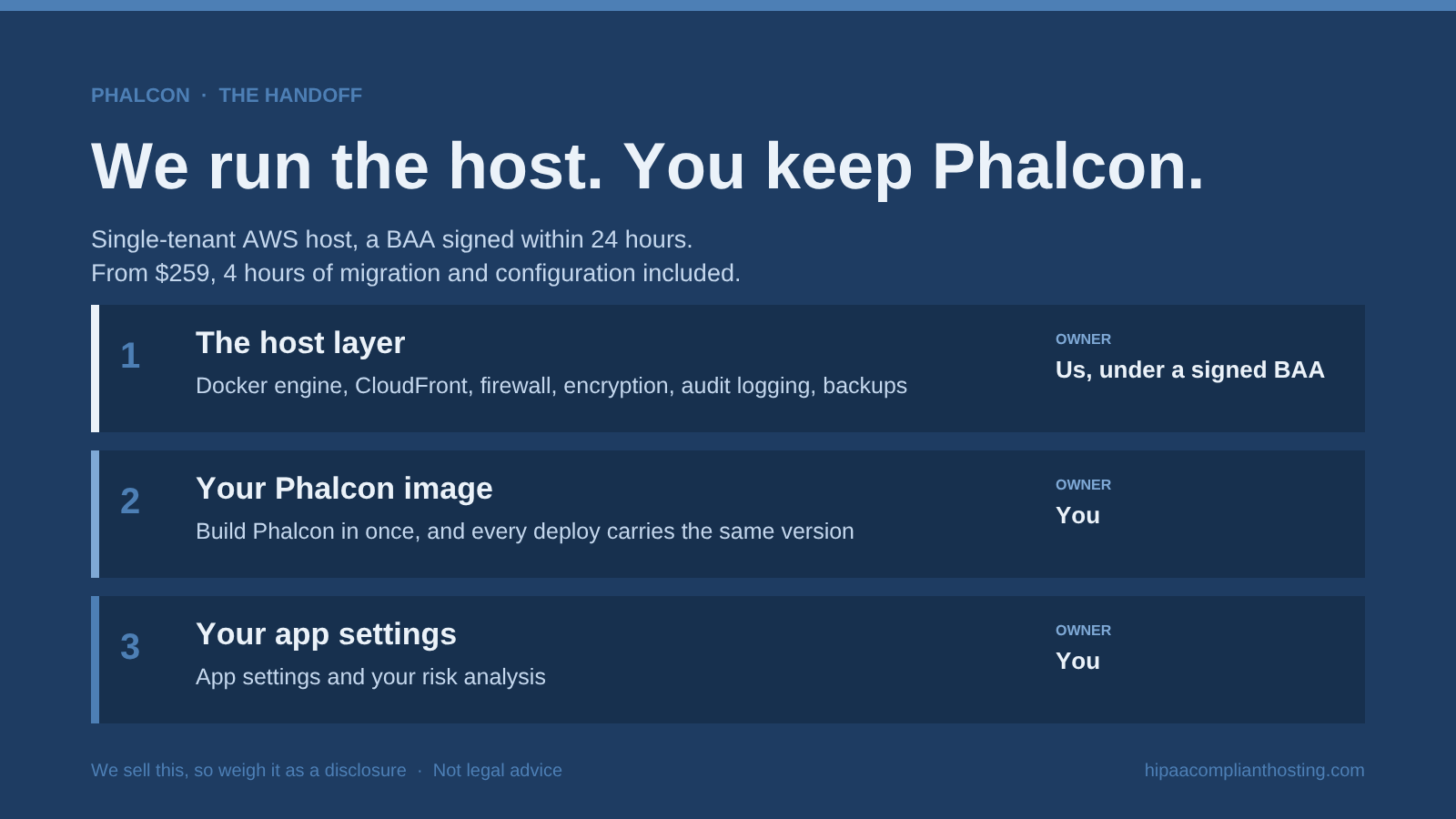
Most teams would rather ship their app than run the server under it. Our HIPAA compliant Phalcon hosting runs on single-tenant AWS, on the Performance tier from $259 a month. Phalcon is one of the 17 platforms we support. Before you sign up, ask who updates PHP and the Phalcon extension, and get the answer in writing. Every plan includes CloudFront CDN, a web application firewall, and EBS storage with 7-day snapshot retention. It also includes encryption at rest and in transit, six-year audit logging, and tested encrypted backups. We sign the BAA within 24 hours of signup, before patient data moves. Our BAA covers the servers and services we run, so your email and SMS vendors need their own.
Prefer containers? Phalcon's compiled extension makes them a clean fit for a Phalcon HIPAA compliant build. You build Phalcon into your image once, and every deploy carries the same version. Our HIPAA compliant Docker hosting runs those containers on the same Performance tier. Our Docker HIPAA compliant guide covers the host settings a container stack needs.
On either plan, the first month includes 4 hours of migration and configuration. After that, work is $175 an hour, quoted before work starts. Monthly plans have no long-term contract. Moving a live Phalcon HIPAA compliant app from another host? Our HIPAA hosting migration guide walks through the switch. We sell this, so weigh it as a disclosure.
Here is the honest inverse. If your Phalcon app never handles PHI for a covered entity, HIPAA does not apply, and you do not need us. If your team already runs AWS under AWS's BAA and patches the extension on every release, that works and costs less in cash. Need root on the server to build your own extensions? Root access comes only with an Enterprise engagement. For everyone else, our HIPAA compliant hosting plans are public. You can request an infrastructure quote or tell us what your app does.
Frequently asked questions
Is Phalcon HIPAA compliant?
No framework is HIPAA compliant by itself. A Phalcon HIPAA compliant app needs a host that signs a BAA and can run the extension. It also needs AES-256-GCM encryption, strong hashing, a deny-by-default ACL, rate limits, two-factor login, and an audit trail. This answer covers the PHP framework, not other products named Phalcon.
Is Phalcon still maintained in 2026?
Yes. Phalcon shipped 5.21.0, 5.22.0, 5.22.1, and 5.23.0 between September 18 and October 15, 2026. Its release history marks 5.20 as still maintained but gives no end dates. A Phalcon HIPAA compliant app should follow its GitHub releases and patch quickly.
Which Phalcon version fixes the 2026 Volt flaw?
The Critical Volt template flaw, CVE-2026-59989, affected versions up to 5.15.0. Its advisory lists no patched version, but every later release falls outside that range. Run 5.20.3 or later for the August 2026 fixes too, ideally the latest, 5.23.0.
Does Phalcon have built-in authentication and encryption?
Yes. Since 5.14.0, Phalcon 5 has an Auth component with session and token guards. Its Crypt component signs encrypted data by default. It documents no two-factor login. Set the cipher to AES-256-GCM, which its docs call preferable.
Do I need a BAA for a Phalcon app?
Yes, if the app stores or sends PHI for a clinic, health plan, or other covered entity. Every vendor that touches that data needs one, starting with your host. Phalcon has no official host, so your hosting provider must sign. We sign ours within 24 hours of signup, before patient data moves.
Does Phalcon 6 change the HIPAA answer?
Only one part of it. Phalcon 6 is a pure PHP edition installed with Composer, so there is no C extension to patch. As of October 20, 2026, it is still a release candidate. Its hosting page says v6 runs on shared hosting, but any host holding PHI must sign a BAA. A Phalcon HIPAA compliant app on either version still needs the safeguards in 45 CFR § 164.312.
Recap: Phalcon HIPAA compliant
To recap, a Phalcon HIPAA compliant app needs a host that signs a BAA and can run the Phalcon extension. Phalcon 5 gives you signed encryption, bcrypt and Argon2i hashing, a deny-by-default ACL, CSRF tokens, and an Auth component. You set AES-256-GCM, add rate limits, two-factor login, and an audit trail. Run 5.20.3 or later, ideally the latest release, keep Volt templates out of attacker control, and keep PHI out of logs and email. Want a managed host that signs the BAA? Compare our current plans.
This article is general information, not legal advice. Versions, defaults, and advisories change often. The details here reflect Phalcon's documentation, hosting page, blog, and GitHub releases and advisories as read on October 20, 2026. AWS and DigitalOcean BAA details come from their own pages, read the same day. PHP release details come from php.net, read October 22, 2026. Confirm current terms with each vendor, consult qualified counsel, and base your safeguards on a documented risk analysis. We sell HIPAA compliant hosting. Reviewed October 2026.
Sources
Phalcon docs: Installation, Release history, and Docker images.
Phalcon: Hosting page and Roadmap post (May 4, 2021).
GitHub: Phalcon releases, 5.20.1 release notes, and 5.20.3 release notes.
GitHub: 5.23.0 release notes and Phalcon 6 releases.
GitHub advisories: CVE-2026-59989, CVE-2026-57584, and CVE-2026-54736.
PHP: Security advisory for PHP 8.5.12, 8.4.27, 8.3.36, and 8.2.35 (October 21, 2026).
45 CFR § 164.312 (technical safeguards): law.cornell.edu.
45 CFR § 164.308 (administrative safeguards, BAA requirement): law.cornell.edu.
45 CFR § 160.103 (definitions): law.cornell.edu.
BAA terms: AWS HIPAA compliance and DigitalOcean HIPAA.
Other products named Phalcon: Phalcon, LLC and BlockSec Phalcon Compliance.