


HIPAA MFA Requirements: What Applies Now and What Changes in 2027
HIPAA Compliant Hosting · https://hipaacomplianthosting.com/blog/hipaa-mfa-requirements
Last updated: October 20, 2026
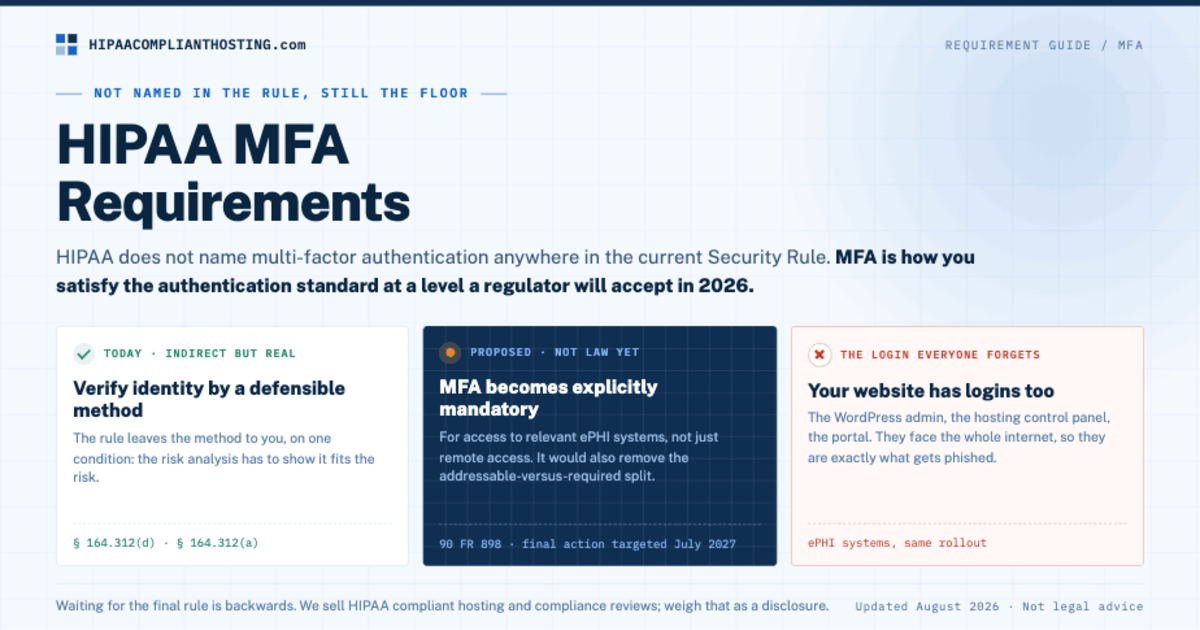
HIPAA does not name multi-factor authentication anywhere in the current Security Rule. But the HIPAA MFA requirements still exist in practice. MFA is how you meet the authentication standard (45 CFR § 164.312(d)) and the access control standard (§ 164.312(a)) in a way you can defend. And the ground is moving. HHS proposed a rule on January 6, 2025 that would make MFA explicitly required for relevant ePHI systems, with limited exceptions. It is still a proposal, and the federal regulatory agenda now targets a final rule in July 2027. This guide gives the two-part answer: what the law requires today, what the proposal would change, and how to roll MFA out before anyone makes you.
TL;DR: Quick answer
Today, MFA is not literally named in the Security Rule. The HIPAA MFA requirements come from the authentication standard (§ 164.312(d)): you must verify identity, and your risk analysis must justify how.
In 2026, single passwords on ePHI systems are close to indefensible in a risk analysis. By our October 20, 2026 count of OCR's breach portal, hacking and IT incidents caused 85% of large breaches reported January through September 2026.
The proposed Security Rule update (90 FR 898, January 6, 2025) would require MFA for access to relevant ePHI systems. It is still a proposal; the federal regulatory agenda targets a final rule in July 2027.
A bill, S. 3315, would order HHS to require MFA. It passed the Senate on September 30, 2026, now waits in the House, and is not law.
Roll it out in this order: admin accounts, remote access, email, the EHR and portal, then everything else.
Your website's admin and portal logins are ePHI systems too. They belong in the same rollout.
Does HIPAA require MFA today?
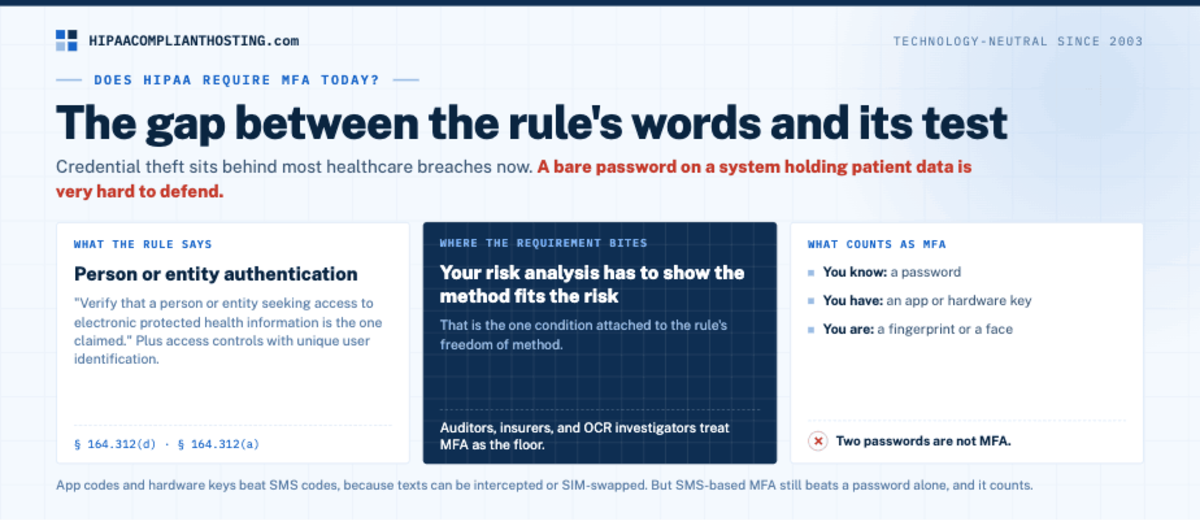
Not by name, and that surprises people who go looking for the HIPAA MFA requirements in the rule text. The Security Rule was written in 2003 to be technology-neutral. It requires person or entity authentication: "verify that a person or entity seeking access to electronic protected health information is the one claimed" (§ 164.312(d)). It also requires access controls with unique user identification (§ 164.312(a)). The rule leaves the method to you, on one condition. Your HIPAA risk analysis has to show the method fits the risk. That condition is where the HIPAA MFA requirements bite.
OCR's breach portal lists 592 breaches of 500 or more records reported from January through September 2026 (our count on October 20, 2026). Hacking and IT incidents caused 85% of them. With MFA in place, a stolen password alone does not open the account. So a bare password on a system holding patient data is very hard to defend. HHS's voluntary cybersecurity goals for healthcare already list multifactor authentication as an essential goal, even though the current rule never names it. The HIPAA MFA requirements live in that gap between the rule's words and the rule's test. Staff can also misuse their own logins, and our guide to HIPAA violation penalties for employees covers real cases.
What counts as MFA
Multi-factor authentication means two or more different kinds of proof. Something you know: a password. Something you have: an authenticator app, a hardware key, a code sent to a device. Something you are: a fingerprint or a face. Two passwords are not MFA. A password plus a code from an app is. App codes and hardware keys beat SMS codes, because texts can be intercepted or SIM-swapped. But SMS-based MFA still beats a password alone, and it counts toward the HIPAA MFA requirements. The MFA glossary entry covers the factor types in more depth. Offering strong factors is not the same as requiring them. Joomla core supports authenticator app codes and WebAuthn security keys, yet by default it forces MFA on no one. Our guide to building a Joomla HIPAA compliant site names the setting that enforces it.
What could change by 2027: MFA made explicit
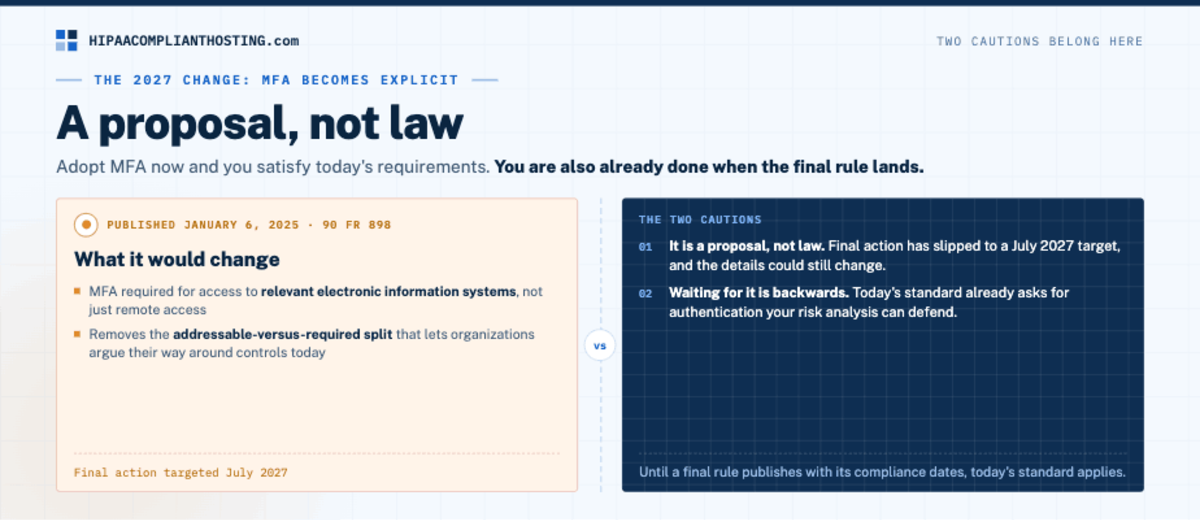
The proposed Security Rule update would end the debate. HHS proposed it on January 6, 2025 (90 FR 898), the first major Security Rule update since 2013. It would require MFA for access to relevant electronic information systems, not just remote access. It would also remove the addressable-versus-required split that lets organizations argue their way around controls today. Two cautions belong next to that sentence. First, it is still a proposal. The federal regulatory agenda now targets a final rule in July 2027. An earlier May 2026 target passed with no final rule, and the details could still change. Proposed requirements are not law yet; the current Security Rule still applies. Second, waiting for it is backwards. Adopt MFA now and you satisfy today's HIPAA MFA requirements. You will also be well ahead if a final rule lands. We track the rulemaking's status in our new HIPAA Security Rule tracker.
Congress is pushing the same way, from a different direction. S. 3315, the Health Care Cybersecurity and Resiliency Act, passed the Senate by unanimous consent on September 30, 2026. If enacted as passed, it would order HHS to require "multifactor authentication, or a successor technology", taking effect 36 months after enactment. The House received the bill on October 5, 2026 and is holding it at the desk. It is not law, and the House has not voted on it. Its text is also looser than the proposal's, because it never says which systems MFA must cover. Our guide to what S. 3315 would mean for HIPAA sets the two side by side.
Where the HIPAA MFA requirements reach, in rollout order
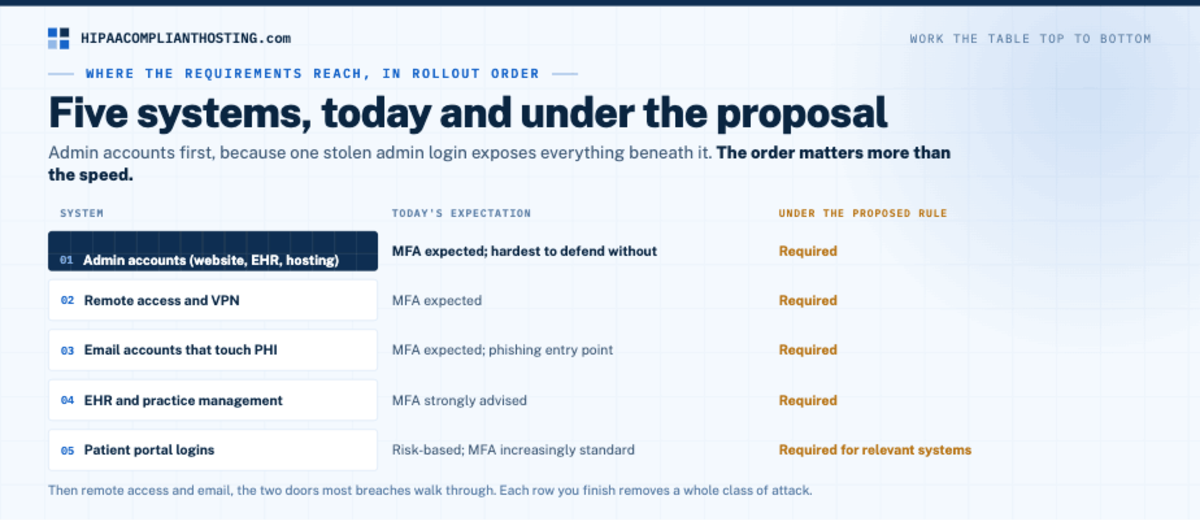
System | Today's expectation | Under the proposed rule |
|---|---|---|
Admin accounts (website, EHR, hosting) | MFA expected; hardest to defend without | Required |
Remote access and VPN | MFA expected | Required |
Email accounts that touch PHI | MFA expected; phishing entry point | Required |
EHR and practice management | MFA strongly advised | Required |
Patient portal logins | Risk-based; MFA increasingly standard | Required for relevant systems |
Work the table top to bottom. Admin accounts first, because one stolen admin login exposes everything beneath it. Then remote access and email, two common ways in. In September 2026, OCR announced a $700,000 settlement with Ambry Genetics after a phishing attack affected 225,370 people. The order matters more than the speed. Each row you finish removes a whole class of attack. If one of those rows is your website or patient portal, the server and hosting panel logins need MFA too. When you compare HIPAA compliant web hosting, ask each provider how those logins are protected.
MFA alone is not the whole login story
Authentication has a sibling: session control. MFA proves who logged in. Automatic logoff limits how long that proof stays live on an idle screen. The Security Rule names automatic logoff at § 164.312(a)(2)(iii), and some platforms leave it off by default. The two controls work as a pair. The timeout side is covered in HIPAA automatic logoff requirements. MFA and logoff sit side by side as items 6 and 7 on our HIPAA compliance checklist. Audit logs are the third piece. The audit controls standard (§ 164.312(b)) requires mechanisms that "record and examine activity" in systems holding ePHI. Our guide to HIPAA audit logs covers what to record and how long to keep them.
Yii 2 starts with neither MFA nor automatic logoff: its idle timeout, authTimeout, is off by default, and its core has no two-factor login. For a Yii HIPAA compliant build, set the timeout, keep auto-login off, and add two-factor login through an extension or SSO.
How to roll out MFA without a revolt
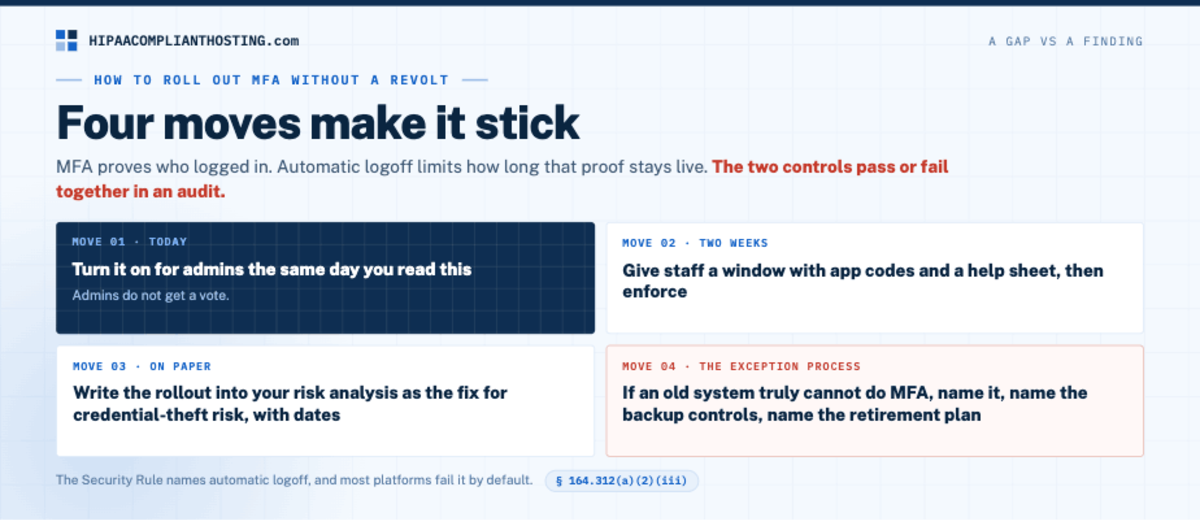
Four moves make the rollout stick. Turn it on for admins the same day you read this. Admins do not get a vote. Give staff a two-week window with app codes and a help sheet, then enforce. Write the rollout into your risk analysis as the fix for credential-theft risk, with dates. And write the exception process down. If an old system truly cannot do MFA, the risk analysis must name it, name the backup controls, and name the retirement plan. That paper trail is the difference between a gap and a finding. Some frameworks ship two-factor login turned off. CodeIgniter's Shield is one, as our guide to whether CodeIgniter HIPAA compliant apps are possible shows. Drupal core has no two-factor login at all; our guide to whether Drupal HIPAA compliant sites are possible covers the TFA module.
The website is the login everyone forgets
Here is the honest pain point. Practices secure the EHR and forget the website has logins too. The WordPress admin. The hosting control panel. The portal. Each one is an ePHI system under the HIPAA MFA requirements the moment patient data flows through the site. Those logins face the whole internet, so anyone holding a phished password can try them. If the portal runs on CakePHP, note that the framework has no two-factor login in core. A CakePHP HIPAA compliant portal adds it with a plugin, and our guide points to one that supports authenticator app codes and WebAuthn keys. Unlike CakePHP, ExpressionEngine 7 has two-factor login built in, even in the free Core edition. MFA stays optional until a role requires it. The ExpressionEngine HIPAA compliant checklist makes it mandatory for every role with control panel access, Super Admin first.
Our healthcare hosting covers the infrastructure your site runs on. Every plan runs on single-tenant AWS, with a web application firewall, encryption at rest and in transit, and six-year audit logging. We sign a BAA within 24 hours of signup, before patient data moves. Our BAA covers the servers and services we run. MFA on your CMS, portal and EHR logins is set up inside each app, so it stays on your rollout list. Managed plans start at $229 a month, billed monthly with no long-term contract. Your first month includes 4 hours of migration and configuration; after that, work is $175 an hour, quoted before work starts. We sell this hosting, so weigh our view with that in mind. If your only ePHI system is an EHR your vendor already protects with MFA, you may need nothing from us. Tell us which logins guard your patient data when you ask for a quote.
Frequently asked questions
Does HIPAA require multi-factor authentication?
Not by name in the current Security Rule. HIPAA requires verifying identity (45 CFR § 164.312(d)) by a method your risk analysis can defend, and in 2026 MFA is the defensible method. A proposed rule (90 FR 898) would make MFA explicitly required. It is still a proposal, and the federal regulatory agenda targets a final rule in July 2027.
Is a password plus security questions MFA?
No. Both are things you know, so they are one factor twice. MFA needs two different kinds: knowledge plus a possessed device or a biometric. A password plus an authenticator-app code is the common compliant pairing.
Is SMS-based MFA acceptable for HIPAA?
It is better than a password alone and widely used, but app-based codes or hardware keys are stronger because SMS can be intercepted or SIM-swapped. Pick the strongest factor your systems support and record the choice in your risk analysis. That record is what the HIPAA MFA requirements really ask of you today.
Do patient portals need MFA?
Increasingly yes. Today it is a risk-based call your risk analysis must justify; the proposed rule would require MFA for access to relevant ePHI systems. Many portals now offer optional MFA for patients and required MFA for staff views.
When does the new MFA rule take effect?
It has not taken effect, and no date is set. The January 2025 proposal would make MFA required, but it is still a proposal. The federal regulatory agenda targets a final rule in July 2027. A separate bill, S. 3315, would have HHS require MFA, with the new rules taking effect 36 months after enactment. It passed the Senate on September 30, 2026, now waits in the House, and is not law. Until a final rule publishes with its compliance dates, today's standard applies: authentication your risk analysis can defend.
Recap: HIPAA MFA requirements
To recap, the HIPAA MFA requirements today are indirect but real: the Security Rule demands defensible authentication, and MFA is what defensible looks like in 2026. The proposed update would make it explicit, with a final rule now targeted for July 2027. S. 3315, which passed the Senate and now waits in the House, points the same way. Roll it out now, admins first, then remote access, email, the EHR, and the portal. Pair it with automatic logoff, write it into the risk analysis, and include the website logins everyone forgets. If your website or portal holds patient data, request a quote for your practice.
This article is general information, not legal advice. Regulatory citations reflect 45 CFR Part 164 as read on October 20, 2026. The proposed Security Rule changes (90 FR 898) are not final, and their requirements and timing may change. The S. 3315 status reflects official Congress.gov data as read on October 20, 2026. Confirm your obligations with qualified counsel and base your safeguards on a written risk analysis. We sell HIPAA compliant hosting. Reviewed October 2026.
Sources
45 CFR § 164.312 (technical safeguards: access control, automatic logoff, person or entity authentication): ecfr.gov
HIPAA Security Rule NPRM, 90 FR 898 (January 6, 2025): federalregister.gov
Unified Agenda: RIN 0945-AA22, HIPAA Security Rule, final action July 2027
Congress.gov: S. 3315, Health Care Cybersecurity and Resiliency Act
HHS OCR: The HIPAA Security Rule
HHS OCR: Breach portal (our count of reports submitted January through September 2026, read October 20, 2026)
HHS OCR: Ambry Genetics settlement (announced September 17, 2026)
HHS 405(d): Healthcare and Public Health Cybersecurity Performance Goals