


Client-Level Isolation: Why Healthcare Hosting Cannot Treat Every Customer Like a Tenant
HIPAA Compliant Hosting · https://hipaacomplianthosting.com/blog/client-level-isolation-hipaa-hosting
Last updated: August 2, 2026
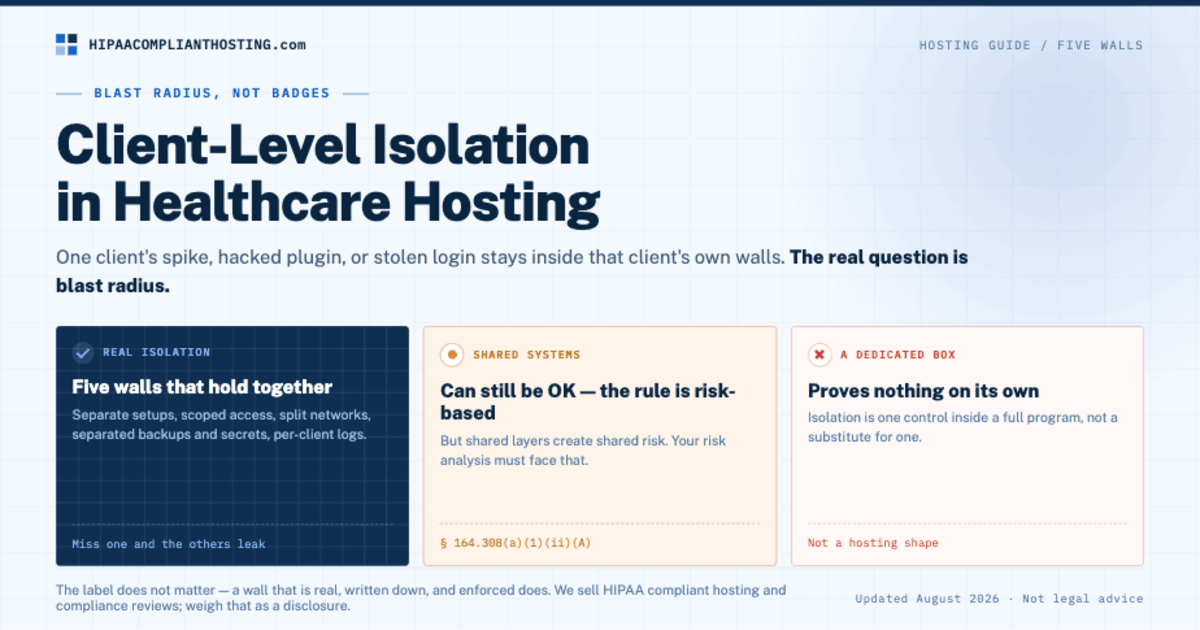
Client-level isolation means your hosting is built so another customer's problem cannot become yours. One client's traffic spike, hacked plugin, stolen login, or bad deploy stays inside that client's own walls. Most hosting is not built this way. Shared platforms put many customers on the same systems. Logical walls keep their apps apart. For a plain marketing site, that trade is fine. Healthcare is different. When a site holds electronic protected health information (ePHI), the real question is blast radius. How far can one bad event travel? That is what client-level isolation controls. This guide explains the five boundaries behind it, why healthcare needs it more, and the questions that show whether a provider really has it.
TL;DR: Quick answer
Real client-level isolation is five walls: separate setups, scoped access, split networks, separated backups and secrets, and per-client logs.
Shared systems can still be OK under HIPAA. The rule is risk-based (45 CFR § 164.308(a)(1)(ii)(A)). But shared layers create shared risk. Your risk analysis must face that.
A dedicated server alone does not make you compliant either. Isolation is one control inside a full program, not a substitute for one.
The label does not matter. What matters is a wall that is real, written down, and enforced.
Eight questions at the end will show you fast whether a provider has real walls or a brochure.
What is client-level isolation?
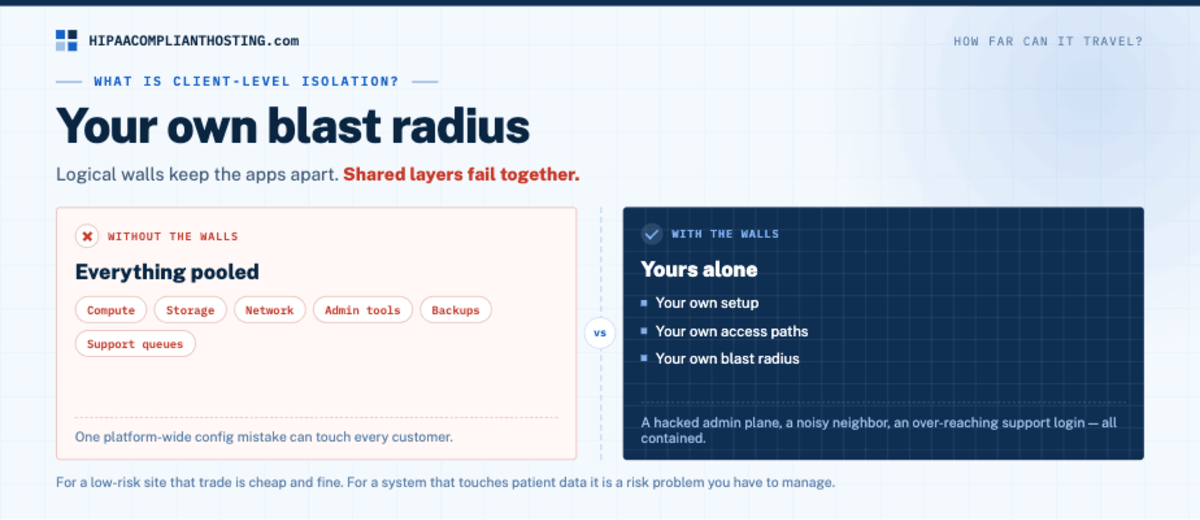
In plain terms, client-level isolation gives each customer its own walls. Your own setup. Your own access paths. Your own blast radius. A provider without it runs many customers through shared compute, storage, network, admin tools, backups, and support queues. Logical walls keep the apps apart. But shared layers fail together. One platform-wide config mistake can touch every customer. So can a hacked admin plane, a noisy neighbor, or a support login with too much reach. For a low-risk site, that trade is cheap and fine. For a system that touches patient data, it is a risk problem you have to manage.
Is shared hosting non-compliant then? No, and that matters
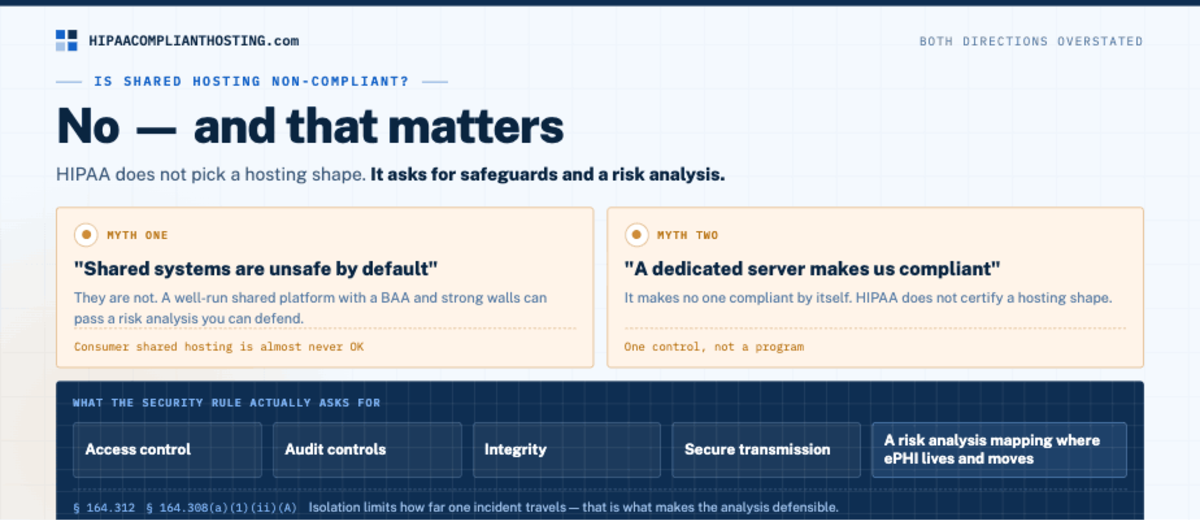
Vendors overstate this in both directions, so be precise. Shared systems are not unsafe by default. And a dedicated server by itself makes no one HIPAA compliant. HIPAA does not pick a hosting shape. The Security Rule asks for safeguards: access control, audit controls, integrity, and secure transmission (45 CFR § 164.312). It also asks for a risk analysis that maps where ePHI lives and moves (45 CFR § 164.308(a)(1)(ii)(A)). This is where client-level isolation earns its place. It limits how far one incident can travel. That makes your whole risk analysis easier to defend. What the server itself must provide is covered in our guide to a HIPAA compliant server.
The five walls that make isolation real
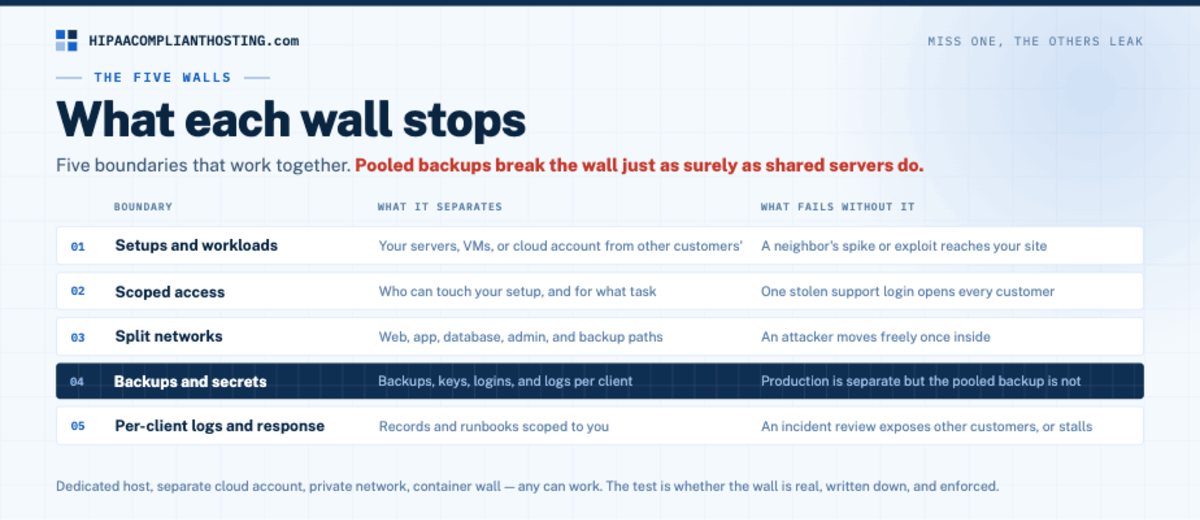
True client-level isolation is five walls that work together. Miss one and the others leak.
Boundary | What it separates | What fails without it |
|---|---|---|
Setups and workloads | Your servers, VMs, or cloud account from other customers' | A neighbor's spike or exploit reaches your site |
Scoped access | Who can touch your setup, and for what task | One stolen support login opens every customer |
Split networks | Web, app, database, admin, and backup paths | An attacker moves freely once inside |
Backups and secrets | Backups, keys, logins, and logs per client | Production is separate but the pooled backup is not |
Per-client logs and response | Records and runbooks scoped to you | An incident review exposes other customers, or stalls |
The label matters less than whether it holds. A dedicated host, a separate cloud account, a private network, a container wall: any can work. The test is whether the wall is real, written down, and enforced. That includes the parts you cannot see. Pooled backups break the wall just as surely as shared servers do. So does a client password list in a shared spreadsheet. What a tested recovery plan looks like is covered in HIPAA backup and disaster recovery.
Why does isolation matter more in healthcare?
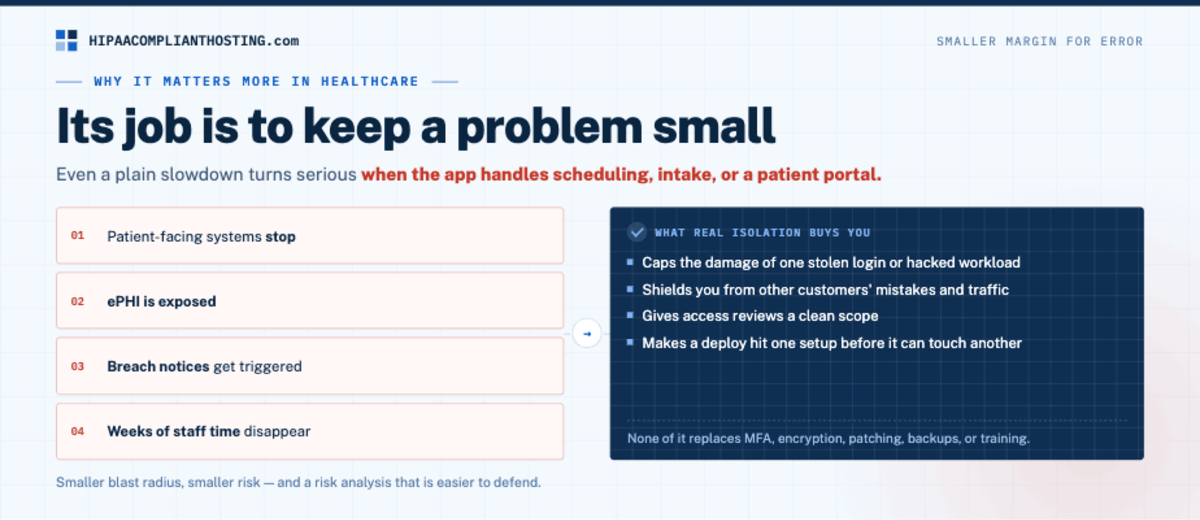
Healthcare runs with a smaller margin for error. One incident can stop patient-facing systems, expose ePHI, trigger breach notices, and eat weeks of staff time. Even a plain slowdown turns serious when the app handles scheduling, intake, or a patient portal. The numbers behind that risk are in our healthcare data breach statistics. Here is what real client-level isolation buys you. It caps the damage of one stolen login or hacked workload. It shields you from other customers' mistakes and traffic. It gives access reviews a clean scope. It makes your risk analysis easier to defend. The walls are easy to describe. And it makes change safer, because a deploy hits one setup before it can touch another. None of that replaces MFA, encryption, patching, backups, or training. It is one control in a larger program. Its job is to keep a problem small.
"We host healthcare" versus healthcare-ready hosting
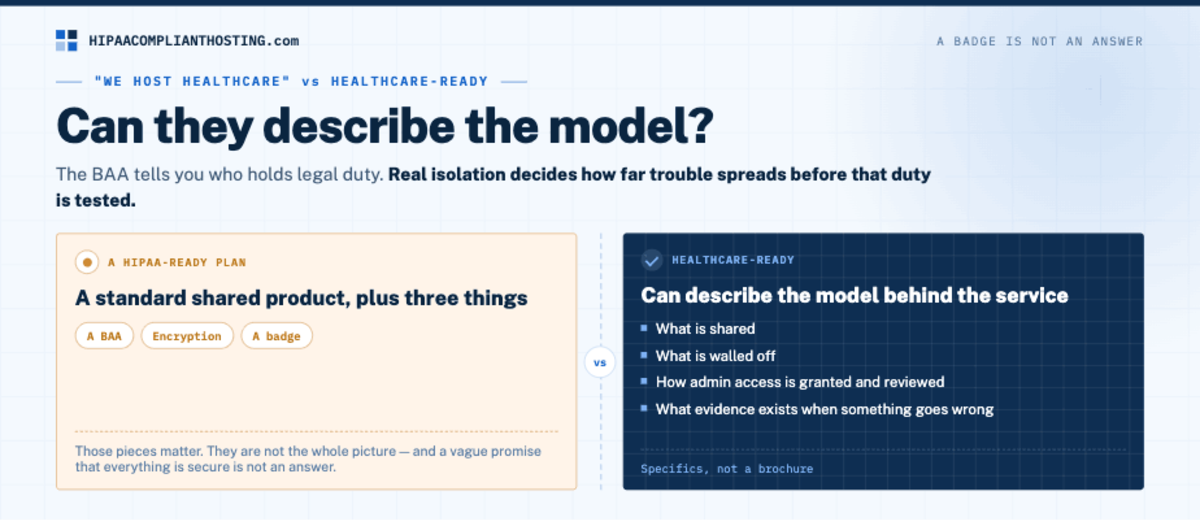
Some providers market a HIPAA-ready plan by adding a BAA, encryption, and a badge to a standard shared product. Those pieces matter. They are not the whole picture. A healthcare-ready provider can describe the model behind the service. What is shared. What is walled off. How admin access is granted and reviewed. What evidence exists when something goes wrong. A vague promise that everything is secure is not an answer. We flag the same gap in our best HIPAA compliant hosting providers guide. The BAA tells you who holds legal duty. Real isolation decides how far trouble spreads before that duty is tested.
Eight questions to ask any healthcare hosting provider
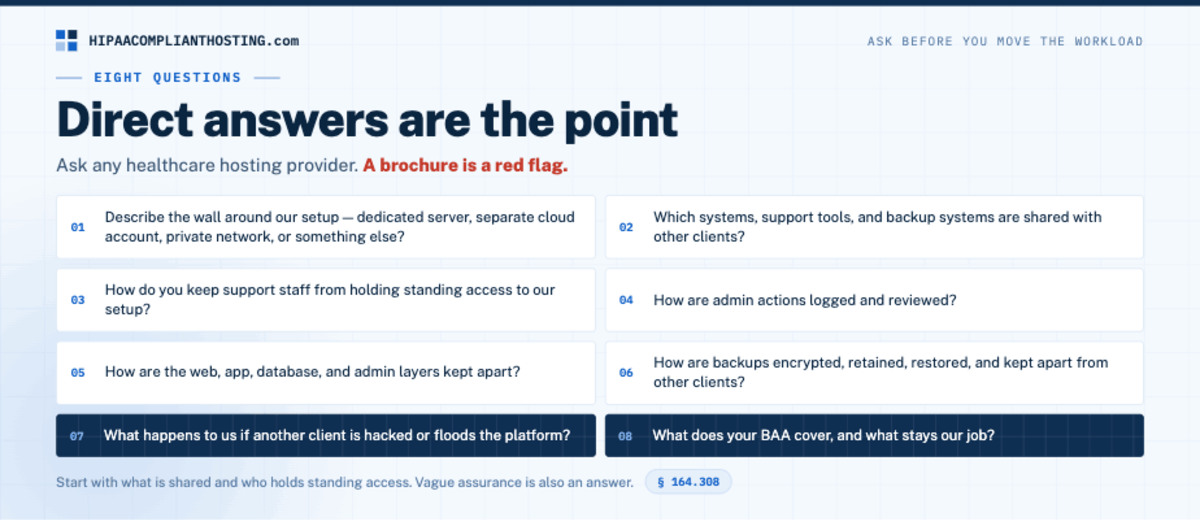
Ask these before you move a sensitive workload. Direct answers are the point. A brochure is a red flag.
Describe the wall around our setup. A dedicated server, a separate cloud account, a private network, or something else?
Which systems, support tools, and backup systems are shared with other clients?
How do you keep support staff from holding standing access to our setup?
How are admin actions logged and reviewed?
How are the web, app, database, and admin layers kept apart?
How are backups encrypted, retained, restored, and kept apart from other clients?
What happens to us if another client is hacked or floods the platform?
What does your BAA cover, and what stays our job?
How we approach it
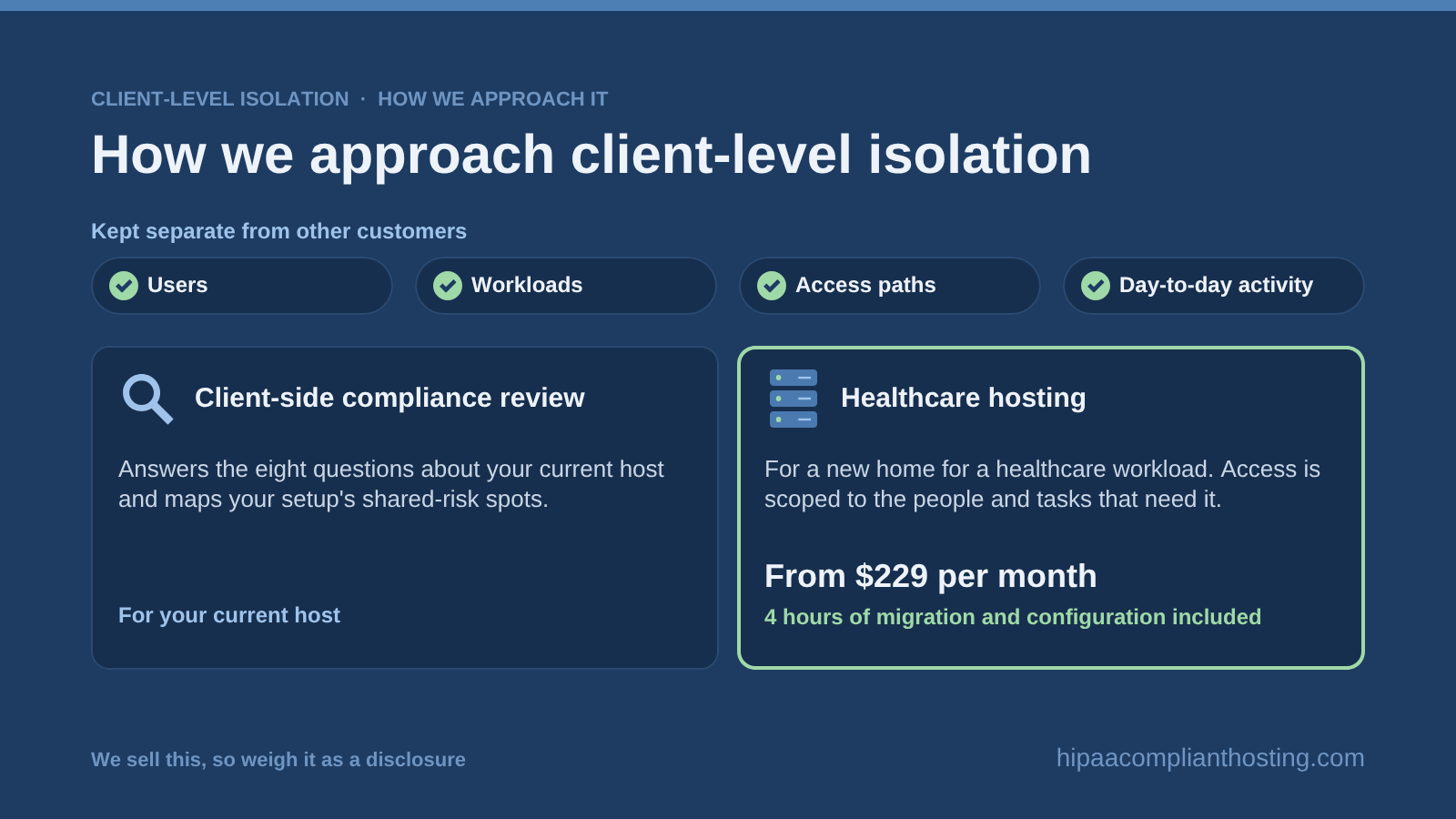
We build for teams that need more control than a general shared plan gives. Read this section as the vendor talking. Our plans are designed around client-level isolation. Your users, workloads, access paths, and day-to-day activity stay separate from other customers'. Access is scoped to the people and tasks that need it. An incident gets a small space to live in. The exact design depends on your app, your data, and your duties as a covered entity or business associate. There is no honest one-size-fits-all setup, and we will not pretend otherwise. If you want the eight questions above answered about your current host, our client-side compliance review maps your setup and its shared-risk spots. If you are choosing a home for a healthcare workload, our healthcare hosting starts at $229 per month, with 4 hours of migration and configuration included. We sell this, so weigh that as a disclosure. Tell us what you run and you will get straight answers, not a pitch.
Frequently asked questions
What is client-level isolation in hosting?
Real client-level isolation means each customer gets its own enforced walls: a separate setup, scoped access, split networks, separated backups and secrets, and per-client logs. One customer's incident cannot reach another customer.
Does HIPAA require a dedicated server?
No. HIPAA asks for safeguards and a risk analysis, not a hosting shape. Shared systems can pass a risk analysis you can defend. Strong walls make that analysis easier because the risks are clearer.
Is shared hosting ever OK for PHI?
Consumer shared hosting is almost never OK. No BAA is offered and nothing is walled off. A well-run shared platform with a BAA and strong walls can be OK when your risk analysis supports it.
Does isolation replace encryption and MFA?
No. Isolation limits how far a problem spreads. Encryption, MFA, patching, and training reduce how often problems start. A compliant setup needs both layers.
How do I know if my host has real isolation?
Ask the eight questions in this guide. Start with what is shared and who holds standing access. A provider with real client-level isolation answers in specifics. Vague assurance is also an answer.
Recap: client-level isolation
To recap, client-level isolation keeps one customer's problem from becoming yours. Five walls do the work: separate setups, scoped access, split networks, separated backups and secrets, and per-client logs. Shared systems can still be OK. A dedicated box alone proves nothing. HIPAA asks you to understand and manage risk. Smaller blast radius, smaller risk. Ask the eight questions. Keep the provider that answers in specifics.
This article is general information, not legal advice. HIPAA is risk-based; hosting shape alone does not create or prevent compliance. Confirm your duties with qualified counsel and base your safeguards on a written risk analysis. We sell HIPAA compliant hosting and compliance reviews. Reviewed August 2026.
Sources
45 CFR § 164.312 (technical safeguards): ecfr.gov
45 CFR § 164.308 (administrative safeguards, risk analysis): ecfr.gov