


HIPAA Certified Hosting Does Not Exist: What to Ask Instead (2026)
HIPAA Compliant Hosting · https://hipaacomplianthosting.com/blog/hipaa-certified-hosting
Last updated: August 31, 2026
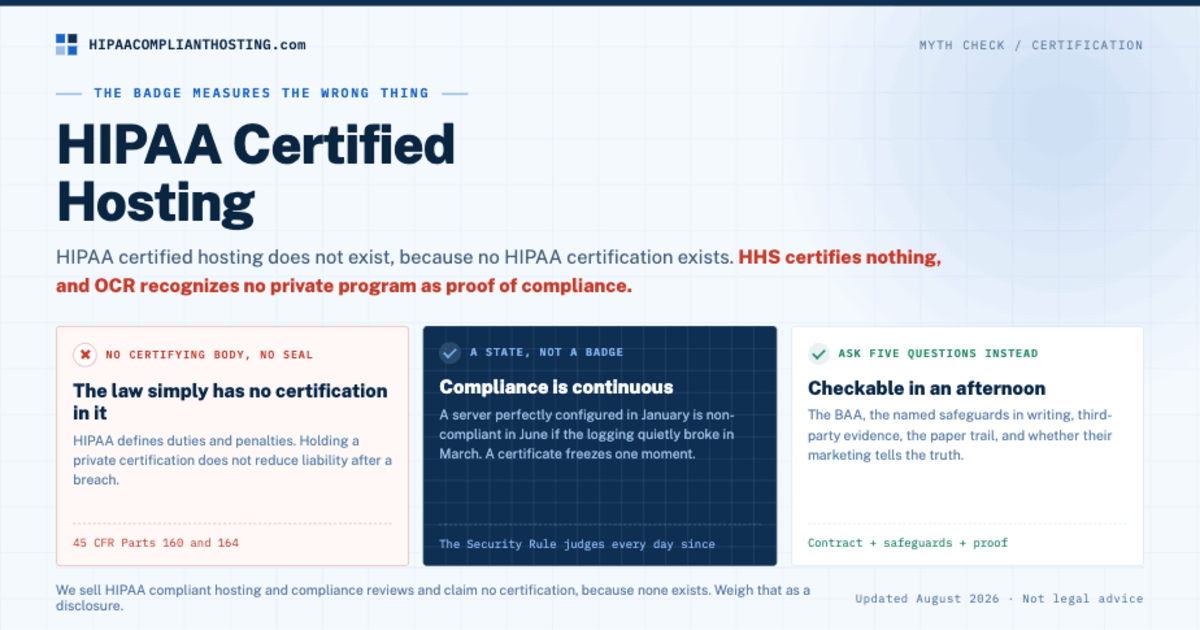
HIPAA certified hosting does not exist, because no HIPAA certification exists. HHS certifies nothing, and the Office for Civil Rights (OCR) does not endorse or recognize any private certification program. So every search for HIPAA certified hosting ends at a badge that is marketing, not law. That does not mean all hosts are equal. It means the badge measures the wrong thing. Buyers who know what to ask instead make better choices in five minutes than a badge could prove in a year. This guide explains where the myth comes from, what SOC 2 and HITRUST really are, and the five questions that separate real HIPAA hosting from a seal on a footer.
TL;DR: Quick answer
There is no official HIPAA certification, for hosting or anything else. HHS issues none, and OCR recognizes no private program as proof of compliance.
Compliance is a state you maintain, not a badge you earn once. It is demonstrated through a signed BAA, working safeguards, and documentation, and it can be lost the day a safeguard lapses.
SOC 2 is an attestation report about security controls, issued under AICPA standards. Useful evidence, not a HIPAA certification.
HITRUST CSF certification is real and respected, but it is a private framework certification, voluntary, and still not a government HIPAA certification.
Judge a host on five checkable things instead: the BAA, the named safeguards in writing, third-party evidence, the paper trail, and whether their marketing tells the truth about certification.
Why there is no such thing as HIPAA certified hosting
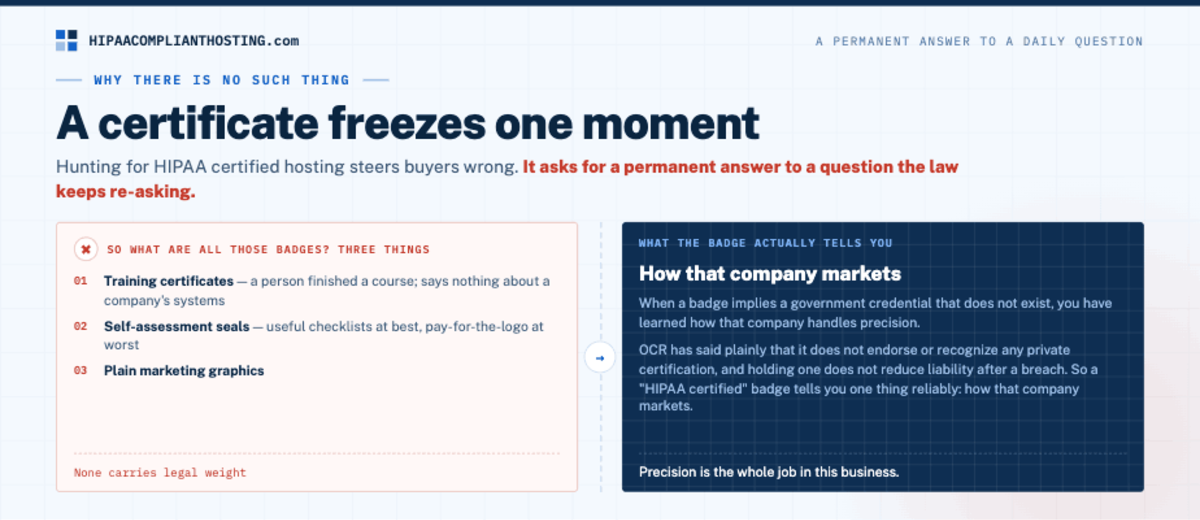
The law simply has no certification in it. HIPAA defines duties and penalties. It created no certifying body, no seal, and no audit that graduates you. OCR has said plainly that it does not endorse or recognize any private certification, and holding one does not reduce liability after a breach. There is a deeper reason HIPAA certified hosting cannot work as an idea. Compliance is continuous. A server that was perfectly configured in January is non-compliant in June if the logging quietly broke in March. A certificate freezes one moment. The Security Rule judges every day since. That is why hunting for HIPAA certified hosting steers buyers wrong. It asks for a permanent answer to a question the law keeps re-asking.
So what are all those badges?
Three things, usually. Training certificates, which show a person finished a course and say nothing about a company's systems. Self-assessment seals sold by compliance vendors, which range from useful checklists to pay-for-the-logo programs. And plain marketing graphics. None carries legal weight, and OCR treats none as proof. A "HIPAA certified" badge on a hosting site therefore tells you one thing reliably: how that company markets. When a HIPAA certified hosting badge implies a government credential that does not exist, you have learned how that company handles precision. Precision is the whole job in this business.
Certification, attestation, compliance: the three terms untangled
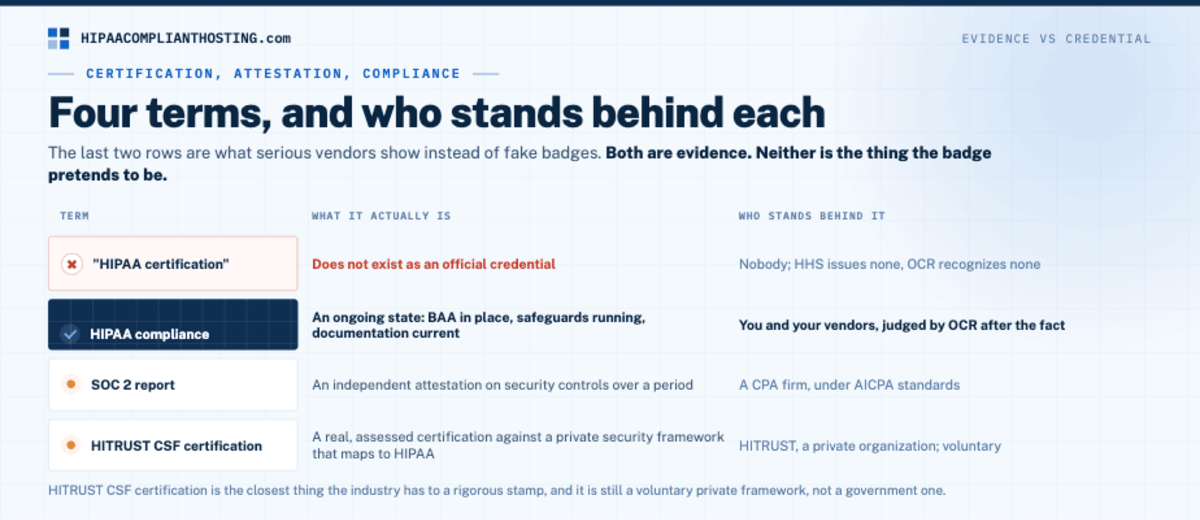
Term | What it actually is | Who stands behind it |
|---|---|---|
"HIPAA certification" | Does not exist as an official credential | Nobody; HHS issues none, OCR recognizes none |
HIPAA compliance | An ongoing state: BAA in place, safeguards running, documentation current | You and your vendors, judged by OCR after the fact |
SOC 2 report | An independent attestation on security controls over a period | A CPA firm, under AICPA standards |
HITRUST CSF certification | A real, assessed certification against a private security framework that maps to HIPAA | HITRUST, a private organization; voluntary |
The last two rows matter, because they are what serious vendors show instead of fake badges. A SOC 2 report is genuine third-party evidence that security controls exist and operate; it is just not a HIPAA credential. HITRUST CSF certification is the closest thing the industry has to a rigorous stamp, and it is still a voluntary private framework, not a government one. Both are evidence. Neither is the thing the badge pretends to be. Strapi shows the gap in practice: it holds a SOC 2 Type 2 report but lists no BAA, as our Strapi HIPAA compliant guide explains. Upsun, the host behind Symfony Cloud, says the same on its own HIPAA page, as our Symfony HIPAA compliant guide notes.
The five questions that replace the badge
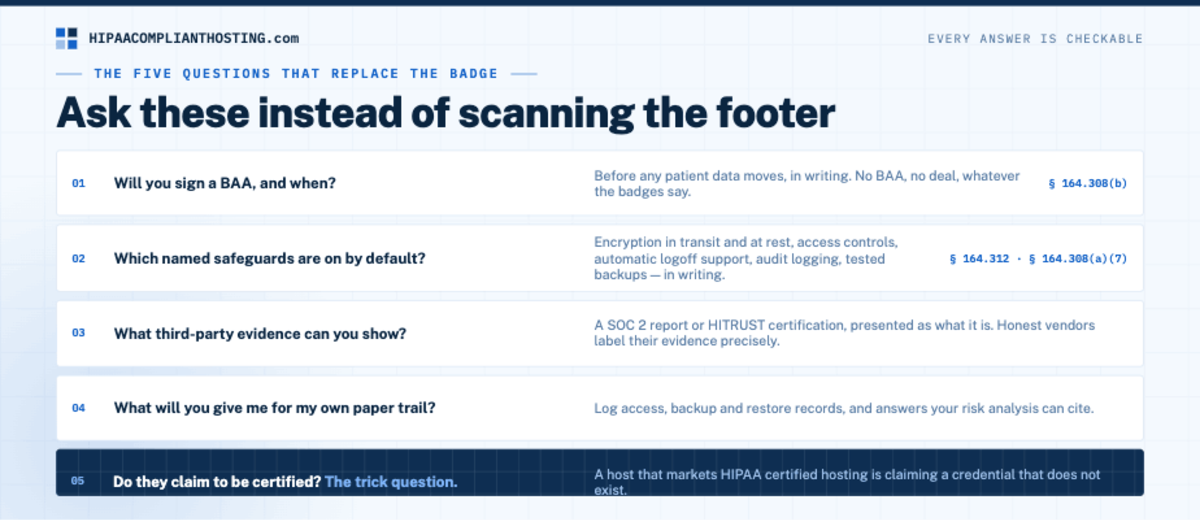
Here is what to ask any host instead of scanning the footer for a HIPAA certified hosting seal. Each question has a checkable answer.
Will you sign a BAA, and when? Before any patient data moves, in writing (45 CFR § 164.308(b)). No BAA, no deal, whatever the badges say. What the contract must contain is in our HIPAA business associate agreement guide.
Which named safeguards are on by default? Encryption in transit and at rest, access controls, automatic logoff support, audit logging, tested backups, mapped to § 164.312 and § 164.308(a)(7), in writing. The full requirements list is in our complete guide to HIPAA compliant hosting.
What third-party evidence can you show? A SOC 2 report or HITRUST certification, presented as what it is. Honest vendors label their evidence precisely.
What will you give me for my own paper trail? Log access, backup and restore records, and answers your HIPAA risk analysis can cite. Your compliance documentation depends on their cooperation.
Do they claim to be certified? The trick question. A host that markets HIPAA certified hosting is claiming a credential that does not exist. Treat it the way you would treat any other claim that cannot survive a check.
Why the myth will not die
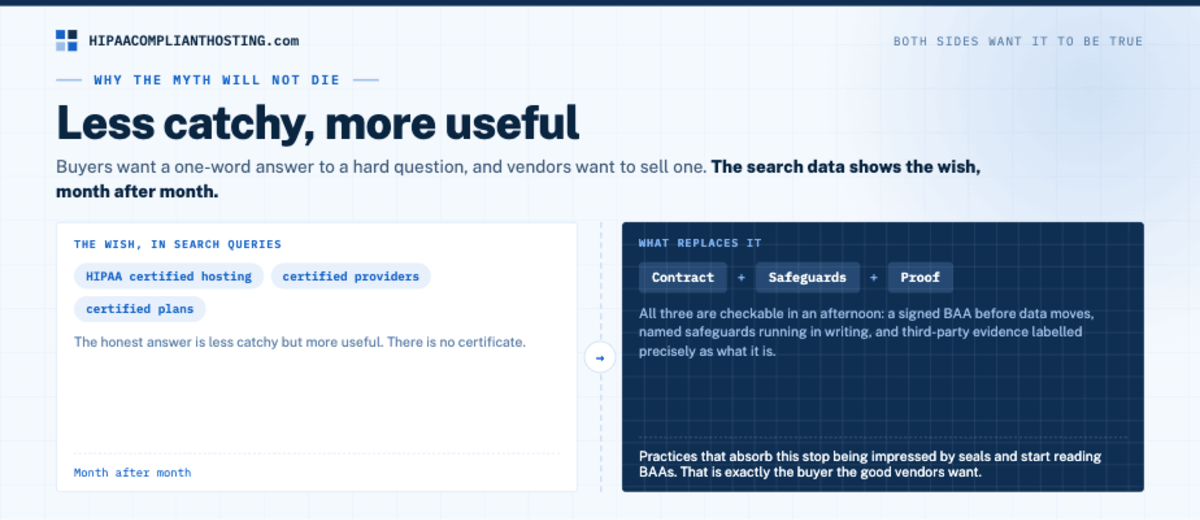
Because both sides want it to be true. Buyers want a one-word answer to a hard question, and vendors want to sell one. The search data shows the wish: HIPAA certified hosting, certified providers, certified plans, month after month. The honest answer is less catchy but more useful. There is no certificate. There is a contract plus safeguards plus proof, and all three are checkable in an afternoon. Practices that absorb this stop being impressed by seals and start reading BAAs. That is exactly the buyer the good vendors want.
Our answers to the five questions
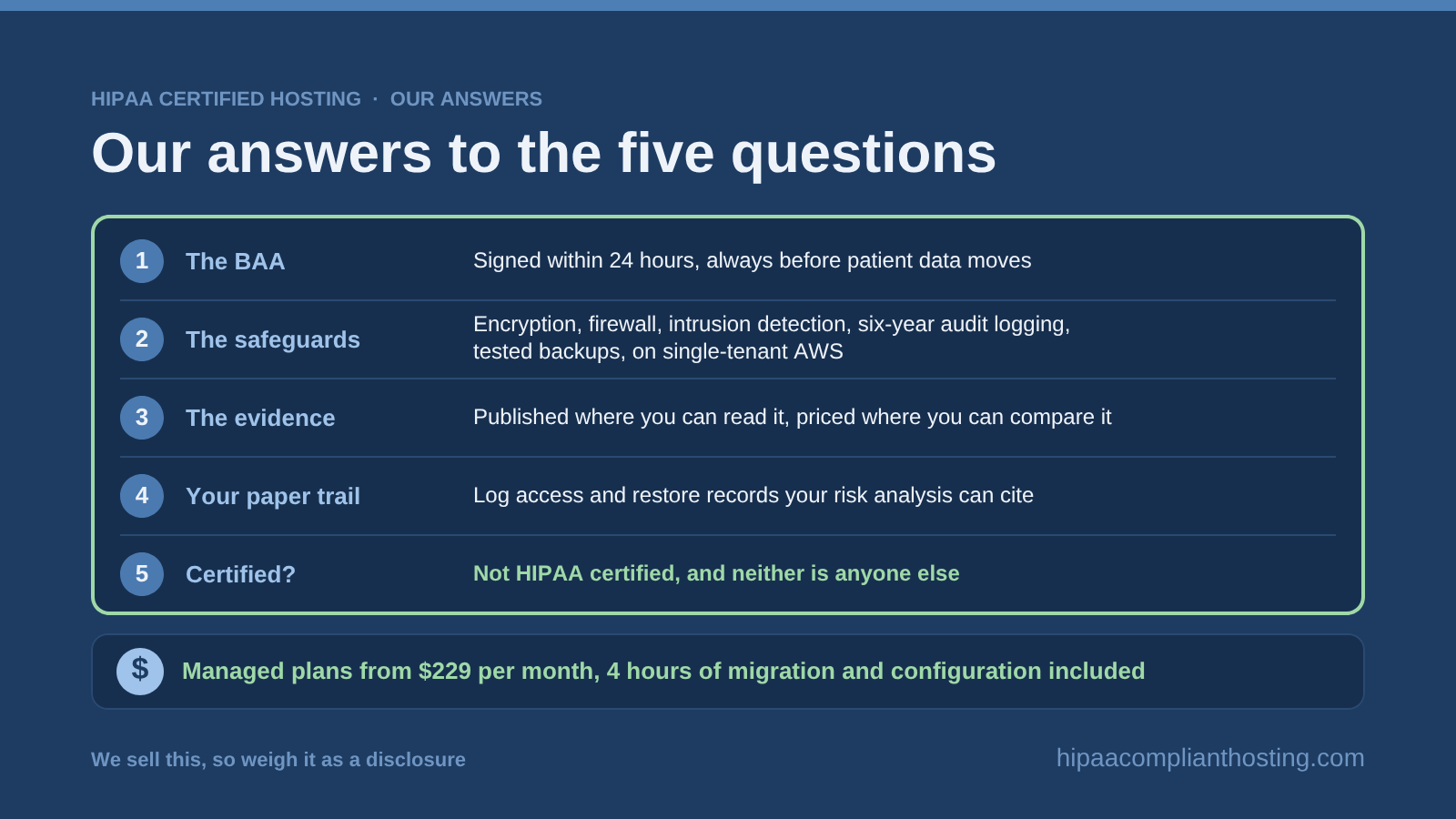
We sell HIPAA compliant hosting, so weigh this section as a disclosure, and notice what we will not claim: we are not "HIPAA certified," and neither is anyone else. Our answers, checkable. The BAA is signed within 24 hours of signup and always before patient data moves. The safeguards ship on by default: encryption, firewall, intrusion detection, six-year audit logging, and tested backups, on single-tenant AWS. Managed plans start at $229 per month, with 4 hours of migration and configuration included. Your paper trail gets log access and restore records your risk analysis can cite. And our evidence is published where you can read it, priced where you can compare it. Healthcare hosting is the product; ask us the five questions and grade the answers yourself. If another vendor answers them better, hire them. A badge should not make that decision for you either way.
Frequently asked questions
Is there an official HIPAA certification?
No. HHS issues no HIPAA certification and OCR does not endorse or recognize any private certification program as proof of compliance. Compliance is demonstrated through the BAA, working safeguards, and documentation, and it is judged after the fact, not certified in advance.
What does "HIPAA certified hosting" mean when a host advertises it?
It is a marketing phrase, not a credential. At best it points to a third-party seal or self-assessment; at worst it implies a government certification that does not exist. Ask for the BAA and the named safeguards instead.
Is a SOC 2 report a HIPAA certification?
No. SOC 2 is an independent attestation on security controls under AICPA standards. It is genuinely useful evidence that a vendor's controls exist and operate, but it certifies nothing about HIPAA itself.
Is HITRUST certification the same as being HIPAA certified?
No, though it is the closest real thing. HITRUST CSF certification is an assessed, respected private framework that maps to HIPAA requirements. It is voluntary and private; it is not a government HIPAA credential, because none exists.
How do I verify a host without a certification to check?
Five questions: will they sign a BAA before data moves, which safeguards are on by default and in writing, what third-party evidence they hold, what records they give your paper trail, and whether their marketing claims a certification that does not exist. Every answer is checkable.
Recap: HIPAA certified hosting
To recap, HIPAA certified hosting is a phrase without a credential behind it: HHS certifies nothing and OCR recognizes no program. Compliance is a maintained state proven by the BAA, the safeguards, and the paper trail. SOC 2 and HITRUST are real evidence with precise names, not HIPAA certificates. Ask the five questions, grade the answers, and let any vendor's "certified" badge count against them, not for them.
This article is general information, not legal advice. Regulatory statements reflect HIPAA (45 CFR Parts 160 and 164) and published HHS/OCR positions as of August 2026; SOC 2 and HITRUST descriptions reflect the issuing organizations' published materials. Confirm your obligations with qualified counsel. We sell HIPAA compliant hosting and compliance reviews and claim no certification, because none exists. Reviewed August 2026.
Sources
HHS: The HIPAA Security Rule (no certification provision exists in the rule)
HHS OCR: Enforcement process and results
AICPA: SOC 2 reporting framework
HITRUST: HITRUST CSF and certification
45 CFR § 164.308 (administrative safeguards, BAA requirement): ecfr.gov