


HIPAA Compliant Hosting: The Complete Guide for 2026
HIPAA Compliant Hosting · https://hipaacomplianthosting.com/blog/hipaa-compliant-hosting-guide
Last updated: October 29, 2026
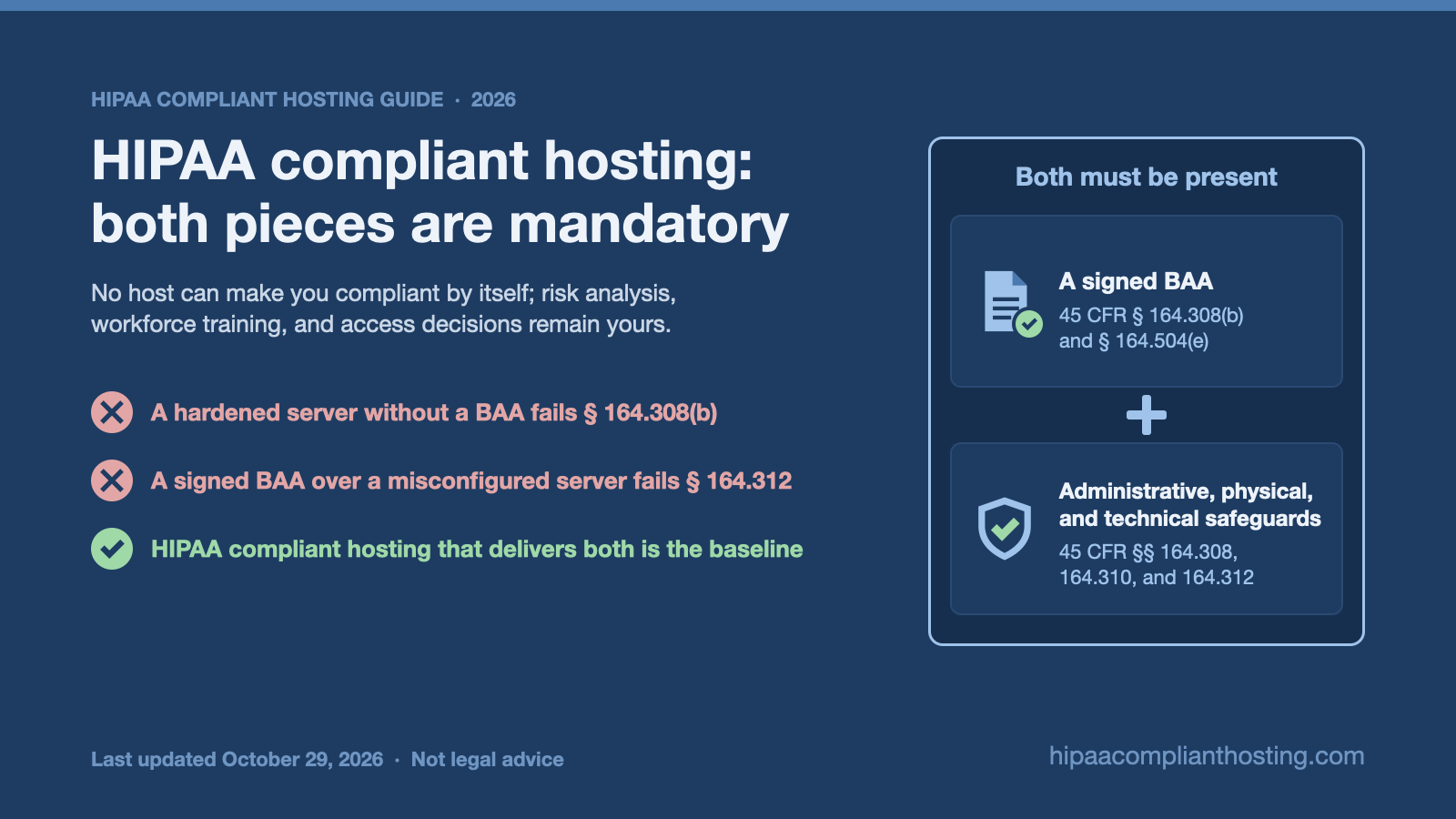
HIPAA compliant hosting is server and cloud infrastructure that protects electronic protected health information (ePHI) under the HIPAA Security Rule (45 CFR Part 164, Subpart C). It is also backed by a signed Business Associate Agreement (BAA) between you and the hosting provider. This HIPAA compliant hosting guide starts from one fact: both pieces are mandatory. A hardened server without a BAA fails the Business Associate provisions at 45 CFR § 164.308(b). A signed BAA over a misconfigured server fails the technical safeguards at § 164.312. Choosing HIPAA compliant hosting that delivers both is the baseline this guide builds on. This guide covers who needs it and what the Security Rule actually requires, section by section. It then covers how responsibility splits between you and the host, what hosting costs, what violations cost, and what changed recently in the regulatory landscape.
TL;DR: Quick answer
- HIPAA compliant hosting requires a signed BAA under 45 CFR § 164.308(b) and § 164.504(e). It also requires the administrative, physical, and technical safeguards of 45 CFR §§ 164.308, 164.310, and 164.312.
- The core technical safeguards are unique user IDs (§ 164.312(a)(2)(i)), automatic logoff (§ 164.312(a)(2)(iii)), and encryption at rest (§ 164.312(a)(2)(iv)). Audit controls (§ 164.312(b)) and transmission security (§ 164.312(e)(1)) complete the core set.
- No host can make you compliant by itself; risk analysis under § 164.308(a)(1)(ii)(A), workforce training, and access decisions remain yours under the shared responsibility model.
- As of January 28, 2026, HHS OCR civil penalties range from $145 per violation (Tier 1 minimum) to $2,190,294 (Tier 4 annual cap per provision).
- A proposed Security Rule update, published January 6, 2025, would make encryption and MFA explicitly mandatory. It drew about 4,700 comments and is not final. The federal agenda now targets a final rule in July 2027.
What is HIPAA compliant hosting?
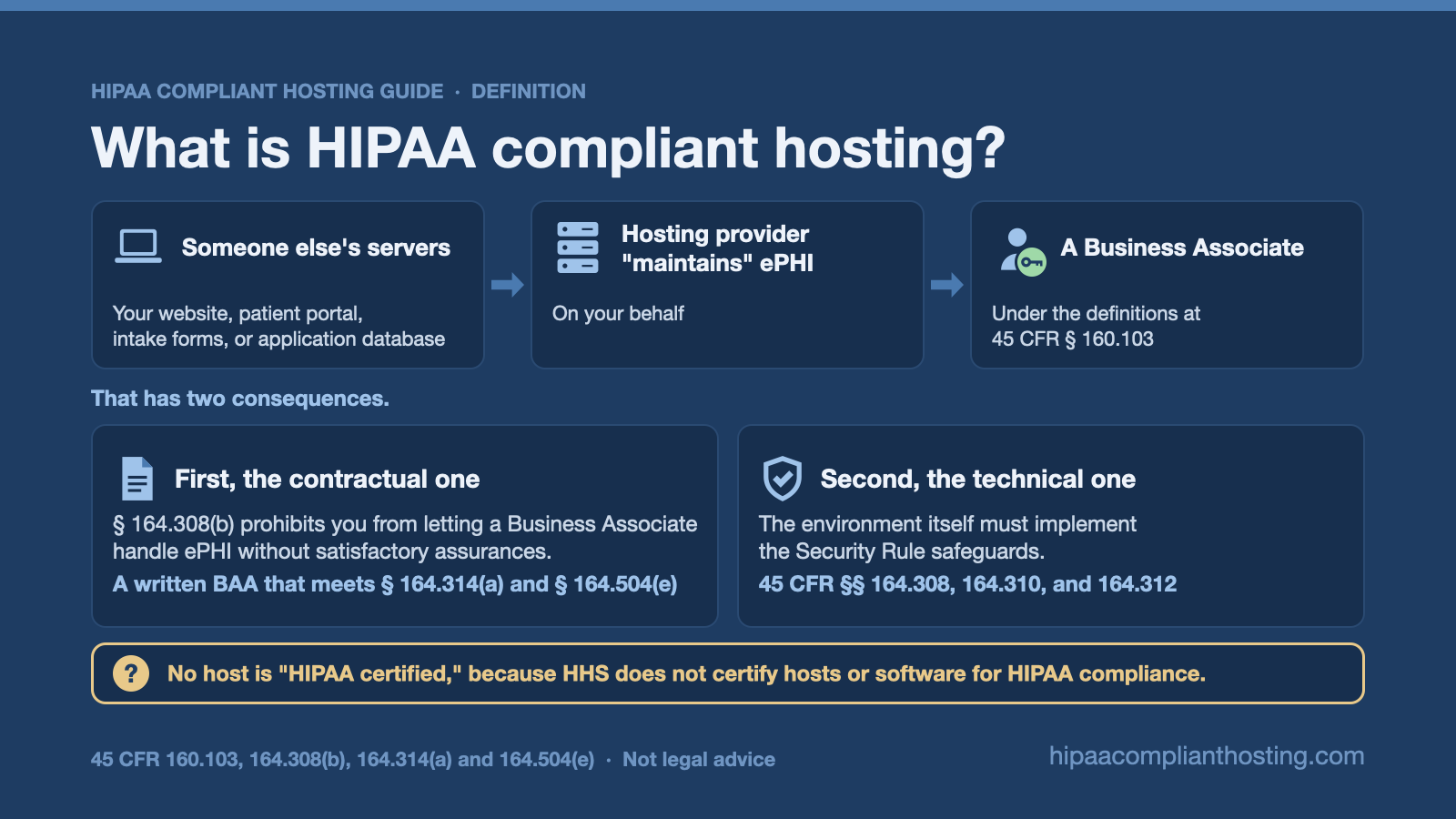
HIPAA itself never mentions web hosting. It regulates how Covered Entities and Business Associates protect PHI. The Security Rule translates that duty into safeguards for any electronic system that creates, receives, maintains, or transmits ePHI. When your website, patient portal, intake forms, or application database run on someone else's servers, that hosting provider "maintains" ePHI on your behalf. It then becomes a Business Associate under the definitions at 45 CFR § 160.103.
That has two consequences. First, the contractual one: § 164.308(b) prohibits you from letting a Business Associate handle ePHI without satisfactory assurances. Those assurances take the form of a written BAA that meets § 164.314(a) and § 164.504(e). Second, the technical one: the environment itself must implement the Security Rule safeguards. "HIPAA compliant hosting" is the industry shorthand for a provider that delivers both. Note the careful wording: a provider can be BAA-covered and compliance-ready. Still, no host is "HIPAA certified," because HHS does not certify hosts or software for HIPAA compliance. For the broader landscape of frameworks a host might claim, see what compliant hosting services actually are. HIPAA is not the only framework that maps to hosting; if you also process payment cards, see PCI compliant hosting for how that standard differs.
Who needs HIPAA compliant hosting?
HIPAA applies to two groups defined in 45 CFR § 160.103. The first group is Covered Entities: health plans, clearinghouses, and healthcare providers who transmit health information electronically in standard transactions. The second is their Business Associates, meaning vendors that create, receive, maintain, or transmit PHI for a Covered Entity. In hosting terms, that means:
- Medical, dental, and behavioral health practices whose websites collect intake forms, appointment requests with health details, or run patient portals.
- Health plans and billing companies processing claims data. See HIPAA compliant hosting for medical billing.
- Healthcare SaaS and app companies that store patient data for provider customers; these are Business Associates and need their own downstream BAAs.
- Marketing agencies and developers who host or manage sites containing PHI for healthcare clients.
The flip side matters too. A purely informational site with no PHI does not need HIPAA hosting. Many wellness professionals are not regulated at all unless they bill insurance electronically or work for a Covered Entity. Our detailed breakdown of who needs HIPAA compliant hosting covers the edge cases, including coaches and alternative health practitioners. If you serve patients in Canada, HIPAA Canada PIPEDA explains where HIPAA stops and PIPEDA starts. For a wider map of how HIPAA compares abroad, see HIPAA vs international privacy laws.
Which Security Rule safeguards must the hosting environment meet?
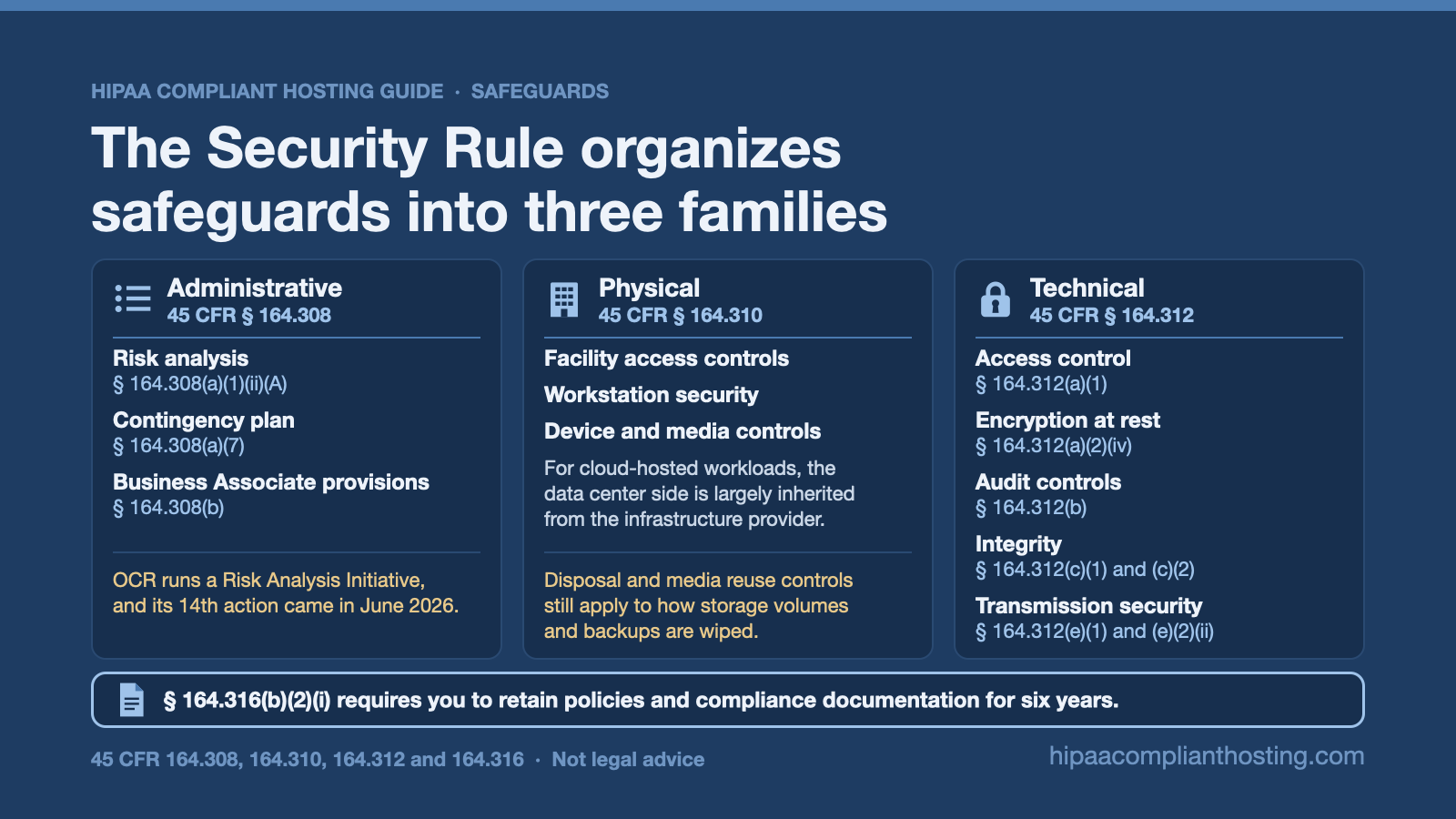
The Security Rule organizes safeguards into three families. The full conceptual breakdown lives in our guide to administrative, physical, and technical safeguards. This HIPAA compliant hosting guide shows what each one means for your servers.
Administrative safeguards (45 CFR § 164.308)
- Risk analysis, § 164.308(a)(1)(ii)(A). You must document an accurate assessment of risks to ePHI. Your host's architecture, isolation model, and BAA scope are inputs to that analysis, but the analysis itself is your obligation. OCR runs a Risk Analysis Initiative focused on this duty, and its 14th action came in June 2026.
- Contingency plan, § 164.308(a)(7). Data backup, disaster recovery, and emergency mode operation. In hosting terms: encrypted backups, documented restore procedures, and tested recovery times.
- Business Associate provisions, § 164.308(b). The BAA requirement that makes a non-signing host a dealbreaker. What that contract must say is covered in our HIPAA business associate agreement guide.
Physical safeguards (45 CFR § 164.310)
Facility access controls, workstation security, and device and media controls. For cloud-hosted workloads, the data center side of these obligations is largely inherited from the infrastructure provider. AWS data centers, for example, carry independent attestations (SOC 2, ISO 27001) that your host and you rely on. Disposal and media reuse controls still apply to how storage volumes and backups are wiped.
Technical safeguards (45 CFR § 164.312)
- Access control, § 164.312(a)(1), with unique user identification (§ 164.312(a)(2)(i)) and automatic logoff (§ 164.312(a)(2)(iii)). No shared admin accounts; idle sessions terminate.
- Encryption at rest, § 164.312(a)(2)(iv). Encryption is an "addressable" implementation specification under § 164.306(d)(3). You implement it if it is reasonable and appropriate. If it is not, you document why and adopt an equivalent alternative measure if that is reasonable and appropriate. For hosted ePHI, no credible alternative exists, so treat it as required in practice. Encrypted data that is breached may also qualify for the breach notification safe harbor.
- Audit controls, § 164.312(b). Hardware, software, or procedural mechanisms that record activity in systems containing ePHI. In hosting terms: server logs, application logs, admin access logs, retained and reviewable.
- Integrity, § 164.312(c)(1) and (c)(2). Policies and procedures that protect ePHI from improper alteration or destruction, plus electronic mechanisms that confirm it was not altered or destroyed without authorization. Examples include checksummed backups and file integrity monitoring.
- Transmission security, § 164.312(e)(1) and (e)(2)(ii). Guard ePHI against unauthorized access while it travels over a network. Encryption here is addressable. In practice, use TLS for every connection that carries ePHI: browser to server, server to database, server to backup target.
Documentation ties all of it together: § 164.316(b)(2)(i) requires you to retain policies and compliance documentation for six years. This HIPAA compliant hosting guide cites the rule; our companion piece on HIPAA hosting security measures turns those citations into a concrete control checklist.
How does shared responsibility work between you and the host?
Every hosting arrangement divides the Security Rule. A typical split for managed HIPAA hosting:
| Safeguard area | Host's side | Your side |
|---|---|---|
| BAA and contracts | Signs the BAA, flows obligations to its own subcontractors | Signs BAAs with every other PHI-touching vendor (forms, email, analytics) |
| Encryption | TLS termination, encrypted volumes and backups | Not weakening it; no exporting PHI to unencrypted spreadsheets |
| Access control | Infrastructure-level IAM and server access controls | Application user accounts, role assignments, offboarding departed staff |
| Audit logging | Server and platform logs, retention | Reviewing application-level access, investigating anomalies |
| Patching | Varies by host and plan; get OS, web server and runtime patch duties in writing | Application code, plugin choices, custom integrations |
| Risk analysis and training | Shares its BAA scope and plan safeguards as inputs | Conducts the § 164.308(a)(1)(ii)(A) risk analysis, trains workforce |
The single most common buyer mistake is assuming a signed BAA transfers compliance wholesale. It transfers specific obligations for specific services, nothing more. Ask any prospective host for a written responsibility matrix. Under HIPAA managed hosting, the host takes on more of the server rows in that matrix, so confirm each row. Our guide to HIPAA hosting for small businesses compares six hosting routes by who signs the BAA and what you still own.
Where does AWS fit in?
HIPAA Compliant Hosting runs every plan on single-tenant AWS. AWS customers accept the AWS BAA self-service in AWS Artifact. AWS lists 174 HIPAA eligible services as of its October 15, 2026 update. Two constraints matter. First, PHI may only be processed, stored, or transmitted in services on that eligibility list. Second, under the AWS shared responsibility model, the customer manages IAM permissions and encryption options, plus guest OS patching and configuration on EC2. Running ePHI on AWS without that work is the cloud equivalent of leaving the clinic unlocked. The full analysis is in is AWS HIPAA compliant, and for the broader cloud picture see our HIPAA cloud hosting guide. A managed provider takes on part of that work, so ask which parts in writing. Every plan in our managed HIPAA cloud hosting includes encryption at rest and in transit, a web application firewall and six-year audit logging. We sell this service, and we say so plainly.
How do you choose a HIPAA hosting provider?
- BAA before PHI. Signed, with scope you have read: compute, storage, backups, CDN, support access.
- Isolation. Single-tenant or strongly isolated environments rather than dense shared servers.
- Evidence. SOC 2 Type II or HITRUST CSF attestations; remember these are third-party attestations, not HIPAA certifications. HIPAA Compliant Hosting does not hold SOC 2 or HITRUST certification.
- Managed operations. Patching cadence, monitoring, incident response, and a stated security incident notification window that leaves you room to meet the breach deadlines in 45 CFR §§ 164.400-414.
- Healthcare track record. A host that already serves Covered Entities will not be surprised by your audit questionnaire.
- Platform fit. If you run WordPress, the requirements get more specific; see our buyer's guide to HIPAA WordPress hosting.
To see how named vendors stack up against these criteria, compare them in our roundup of the best HIPAA compliant hosting providers. Ignore any certified badge along the way; the reasons are in HIPAA certified hosting. Once you have picked a host, follow our 8-step migration plan to move the site safely.
What does HIPAA compliant hosting cost?
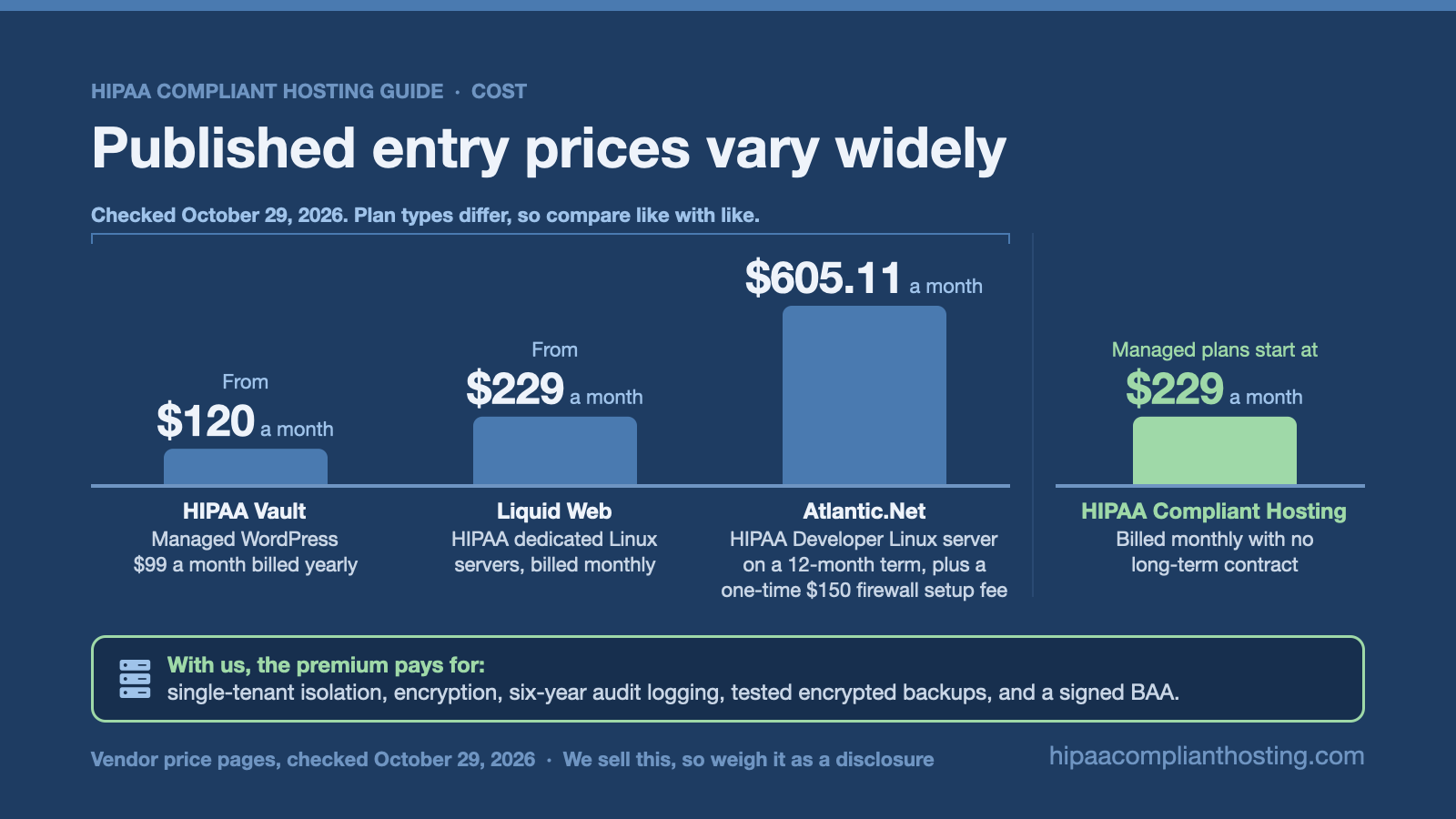
Expect a meaningful premium over general hosting. Published entry prices vary widely, and plan types differ, so compare like with like. On October 29, 2026, HIPAA Vault listed managed WordPress from $120 a month ($99 a month billed yearly). Liquid Web listed HIPAA dedicated Linux servers from $229 a month, billed monthly. Atlantic.Net listed its HIPAA Developer Linux server at $605.11 a month on a 12-month term, plus a one-time $150 firewall setup fee. For the lowest-priced options that still sign a BAA, and what each one leaves to you, see our guide to affordable HIPAA compliant hosting.
HIPAA Compliant Hosting managed plans start at $229 a month, billed monthly with no long-term contract. See our pricing to compare platforms; each comes in six plan sizes, Starter to Network. Costs scale up with traffic, environments, and managed services, and DIY cloud builds trade subscription cost for engineering time. With us, the premium pays for single-tenant isolation, encryption, six-year audit logging, tested encrypted backups, and a signed BAA. Line items and ways to cut cost, such as splitting PHI workflows from a public marketing site, are in our 2026 HIPAA hosting cost guide. To see what a general host leaves out, read HIPAA hosting vs regular hosting, line by line.
What happens if you get this wrong?
HHS OCR enforces HIPAA with civil monetary penalties that adjust annually for inflation. HHS announced no 2026 adjustment, so the amounts effective January 28, 2026 still apply (45 CFR § 102.3):
- Tier 1 (unknowing): $145 to $73,011 per violation.
- Tier 2 (reasonable cause): $1,461 to $73,011 per violation.
- Tier 3 (willful neglect, corrected): $14,602 to $73,011 per violation.
- Tier 4 (willful neglect, uncorrected): $73,011 to $2,190,294 per violation, with an annual cap of $2,190,294 per provision.
OCR's 2019 Notice of Enforcement Discretion still caps annual maximums lower for Tiers 1 through 3. Beyond fines, a breach of unsecured PHI triggers individual notice within 60 days of discovery (§ 164.404) and a report to HHS (§ 164.408). If a breach involves more than 500 residents of a state or jurisdiction, the covered entity must also notify prominent media outlets there (§ 164.406). Full tier details and recent enforcement patterns are in our guide to HIPAA violation fines and penalties.
What changed recently: the proposed Security Rule update
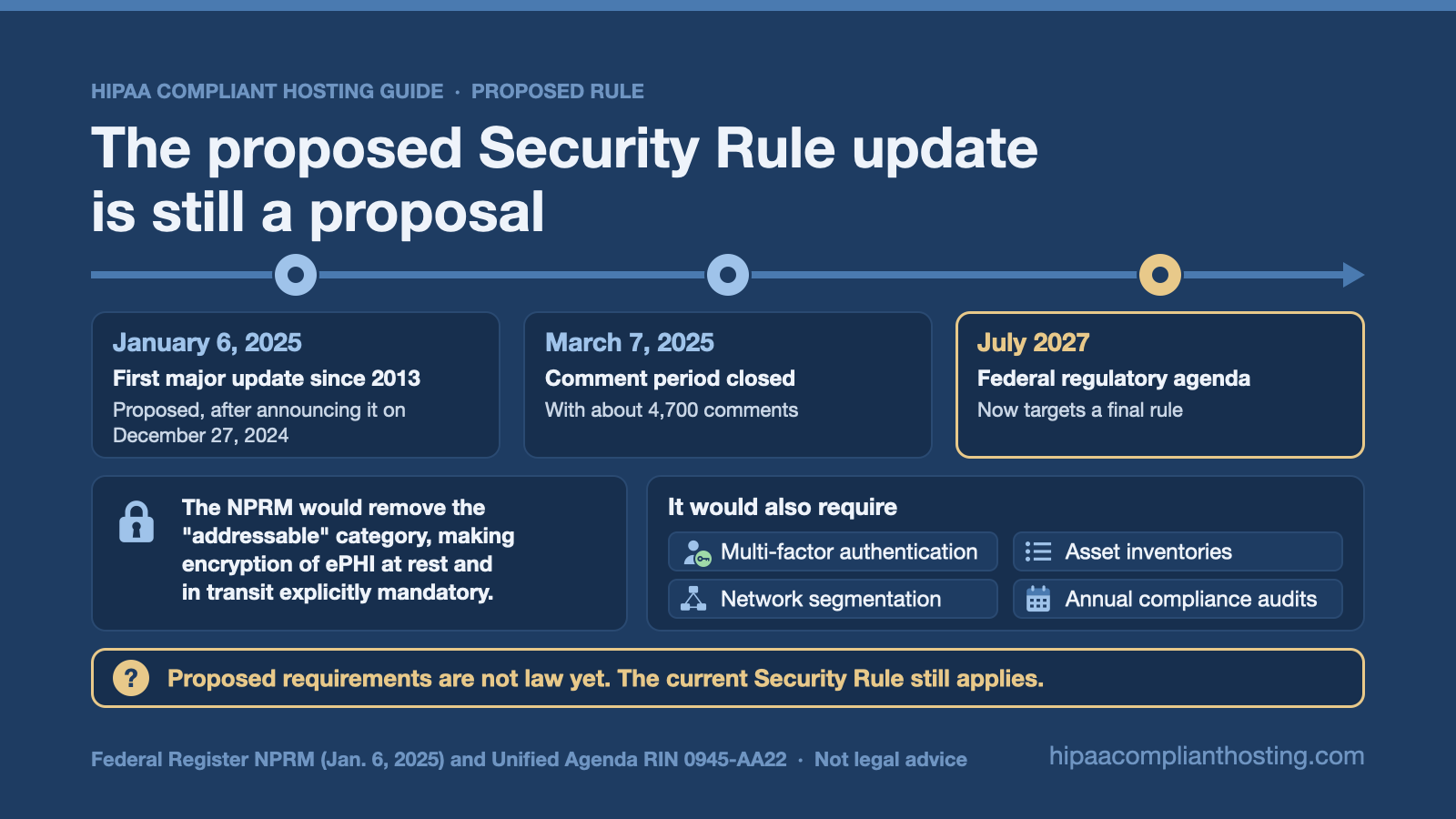
HHS proposed the first major Security Rule update since 2013 on January 6, 2025, after announcing it on December 27, 2024. The NPRM would remove the "addressable" category, making encryption of ePHI at rest and in transit explicitly mandatory. It would also require multi-factor authentication, asset inventories, network segmentation, and annual compliance audits. The comment period closed March 7, 2025, with about 4,700 comments. It is still a proposal, and the federal regulatory agenda now targets a final rule in July 2027. Proposed requirements are not law yet. The current Security Rule still applies, and this HIPAA compliant hosting guide is built on it. We track the status in our guide to the new HIPAA Security Rule. The practical takeaway for hosting buyers: every control the NPRM would mandate is already a best practice. That means an environment built to today's strong interpretation of § 164.312 will not be caught flat-footed if the rule finalizes.
Frequently asked questions
What makes hosting HIPAA compliant?
Hosting is HIPAA compliant when it pairs a signed BAA under 45 CFR § 164.504(e) with implemented Security Rule safeguards. Those include access controls, encryption at rest and in transit, audit logging, automatic logoff, backups, and breach response support. Both the contract and the controls must be present.
Is there an official HIPAA certification for hosting?
No. HHS does not certify hosts, software, or anyone else for HIPAA compliance. SOC 2 Type II and HITRUST CSF are credible third-party attestations. Any vendor claiming to be "HIPAA certified" is using language the law does not support.
Do I need HIPAA hosting if my site only has a contact form?
It depends on what the form collects. A name and "please call me" is low risk. A form asking about symptoms, conditions, or appointments collects PHI when you are a Covered Entity. The systems storing those submissions need BAA coverage.
Can I just use AWS, Google Cloud, or Azure directly?
Yes, all three offer a BAA. You then own configuration, hardening, logging, and incident response under the shared responsibility model. On AWS, keep PHI in its HIPAA eligible services, which number more than 170 (list updated October 15, 2026). A managed HIPAA host takes on part of that work; get the split in writing.
Does HIPAA hosting cover my email and forms too?
Only if those services run inside the BAA-covered environment. Third-party form tools, email providers, and schedulers each need their own BAA or must be kept away from PHI entirely.
Recap: the short version
This HIPAA compliant hosting guide rests on one point: you need both a signed BAA and working Security Rule safeguards. In a typical managed hosting split, the host covers encrypted volumes and backups, TLS termination, server access controls, and platform logs. You keep the risk analysis under § 164.308(a)(1)(ii)(A), workforce training, and application user access. Patching varies by host and plan, so get the responsibility matrix in writing. HHS does not certify hosts for HIPAA compliance, so judge providers on the signed BAA and the safeguards they document. The proposed Security Rule update is still a proposal, so the current rule applies.
Where to go from here
Confirm whether HIPAA applies to you, demand the BAA, then score providers against the safeguards in this HIPAA compliant hosting guide. If you would rather have the environment built and operated for you, hipaacomplianthosting.com provides managed HIPAA compliant WordPress hosting and managed cloud environments on single-tenant AWS. We sign the BAA within 24 hours of signup, before patient data moves. That is our business, so weigh our view with that in mind, and ask us whether a cheaper architecture fits your situation better.
This article is general information, not legal advice. Consult qualified counsel and base your safeguards on a documented risk analysis specific to your organization. Reviewed October 2026.
Sources
- 45 CFR Part 164, Subpart C (Security Rule): ecfr.gov
- 45 CFR § 160.103 (definitions): ecfr.gov
- HHS: The HIPAA Security Rule
- HHS: Breach Notification Rule
- Federal Register: HIPAA Security Rule NPRM (Jan. 6, 2025)
- AWS: HIPAA Eligible Services Reference (last updated October 15, 2026)
- AWS: HIPAA compliance and the AWS BAA
- 45 CFR § 164.406 (notification to the media): law.cornell.edu
- Federal Register: Annual Civil Monetary Penalties Inflation Adjustment (Jan. 28, 2026)
- Unified Agenda: RIN 0945-AA22, HIPAA Security Rule final action timetable
- HHS OCR: Newsroom, enforcement announcements
- HIPAA Vault: Managed WordPress hosting pricing (checked October 29, 2026)
- Liquid Web: HIPAA hosting (checked October 29, 2026)
- Atlantic.Net: HIPAA compliant hosting pricing (checked October 29, 2026)