


Is Symfony HIPAA Compliant? Upsun's BAA, the Security Component, and 8 Settings (2026)
HIPAA Compliant Hosting · https://hipaacomplianthosting.com/blog/is-symfony-hipaa-compliant
Last updated: October 22, 2026
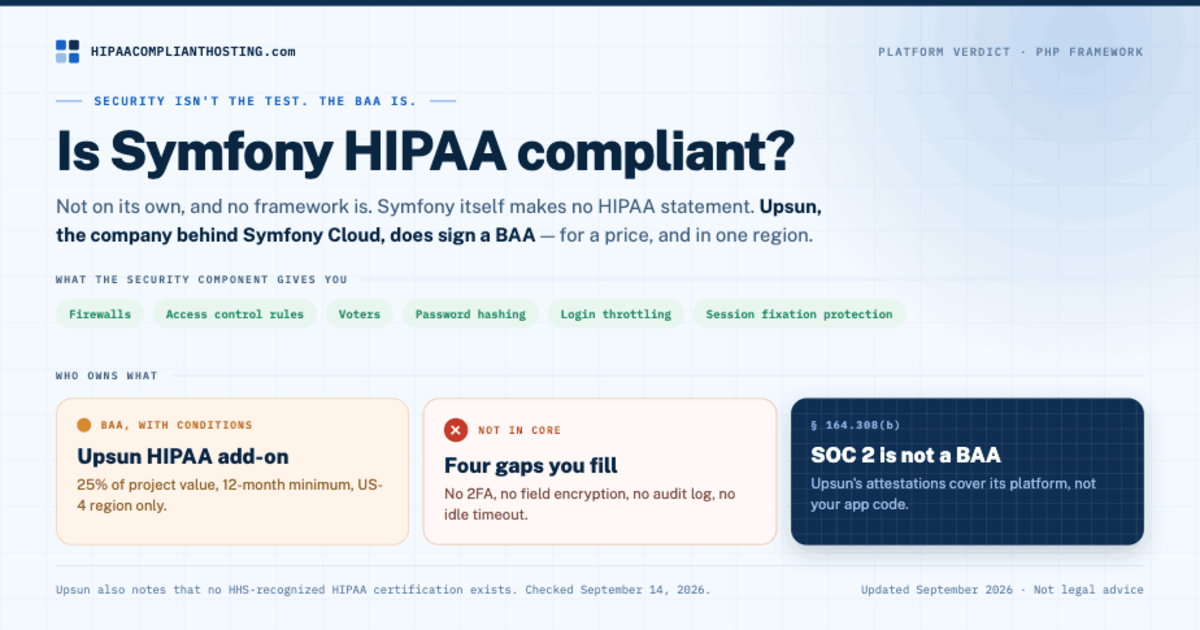
Symfony is not HIPAA compliant on its own, and no framework is. HIPAA regulates the organizations that handle patient data, not the code they use. A Symfony app becomes part of a compliant system when a host signs a Business Associate Agreement (BAA). The app must also use Symfony's security tools well, and your team must do the required paperwork. So the useful question behind "is Symfony HIPAA compliant" is who owns each layer. Symfony itself makes no HIPAA statement. Upsun, the company behind Symfony Cloud, does sign a BAA, for a price and in one region. This guide covers that route, the other options, and the settings that matter. Facts below were checked on their primary sources on October 20, 2026, including Symfony, Upsun, and Laravel pages, GitHub advisories, and the HIPAA rules. PHP release facts were checked on php.net on October 22, 2026.
TL;DR: Quick answer
Upsun, formerly Platform.sh, signs a BAA for HIPAA workloads. It costs an extra 25 percent of project value, with a 12-month minimum term. Workloads must run in its US-4 region.
Symfony's Security component gives you firewalls, access control rules, voters, password hashing, login throttling, and session fixation protection.
Symfony has no built-in two-factor login, no field encryption for your database, no audit log, and no automatic idle timeout. A Symfony HIPAA compliant app adds all four.
Symfony 7.4 is the current long-term support version, with security fixes until November 2029. Symfony 8.1 is supported until January 2027, and 8.2 is due in November 2026.
A May 2026 firewall bypass, CVE-2026-48489, was followed by three more High-severity advisories on October 15, 2026. Run 6.4.48, 7.4.21, 8.1.9, or a later patch. Also update PHP itself to 8.5.12, 8.4.27, 8.3.36, or 8.2.35, released October 21, 2026, to fix two critical flaws.
Is Symfony HIPAA compliant? The three-layer answer
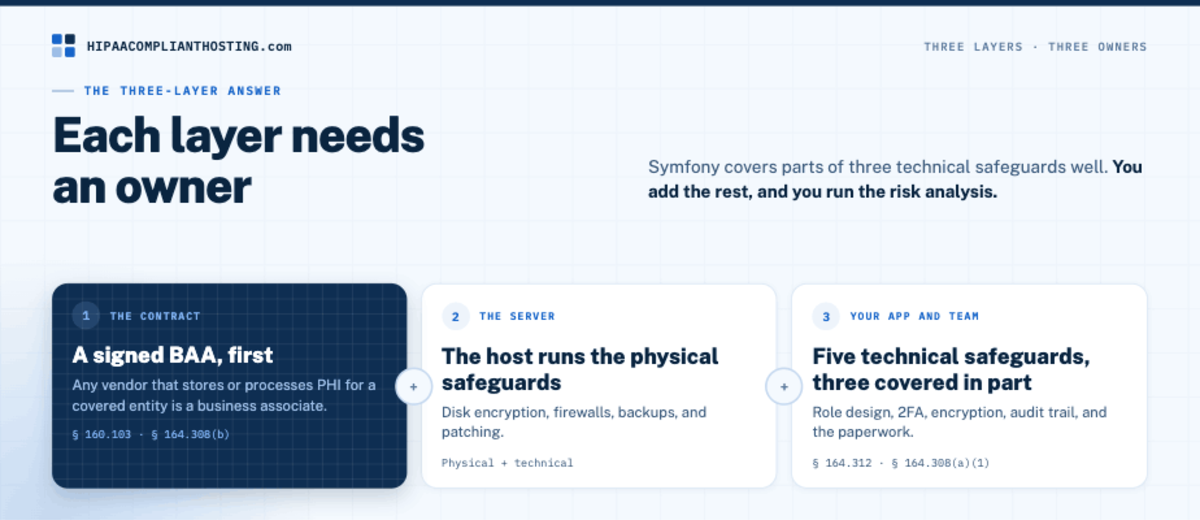
A Symfony HIPAA compliant system has three layers, and each one needs an owner. The first layer is the contract. Any vendor that stores or processes protected health information (PHI) for a covered entity is a business associate under 45 CFR § 160.103. Under 45 CFR § 164.308(b), you need a signed BAA with that vendor first. Our HIPAA business associate agreement guide explains what it must cover. The second layer is the server, run by your host or your own team. It covers the physical safeguards, disk encryption, firewalls, and backups. Who patches the operating system depends on the plan, so get it in writing. The third layer is your app and your team. The HIPAA Security Rule lists five technical safeguards in 45 CFR § 164.312. They are access control, audit controls, integrity, person or entity authentication, and transmission security. Symfony covers parts of three well. You add the rest, and you run a risk analysis under 45 CFR § 164.308(a)(1). If you sell software to hospitals or clinics, the full chain of duties is in HIPAA compliant hosting for healthcare SaaS. In short, a Symfony HIPAA compliant build is a contract, a hardened server, and a configured app.
What does Symfony give you for the HIPAA technical safeguards?
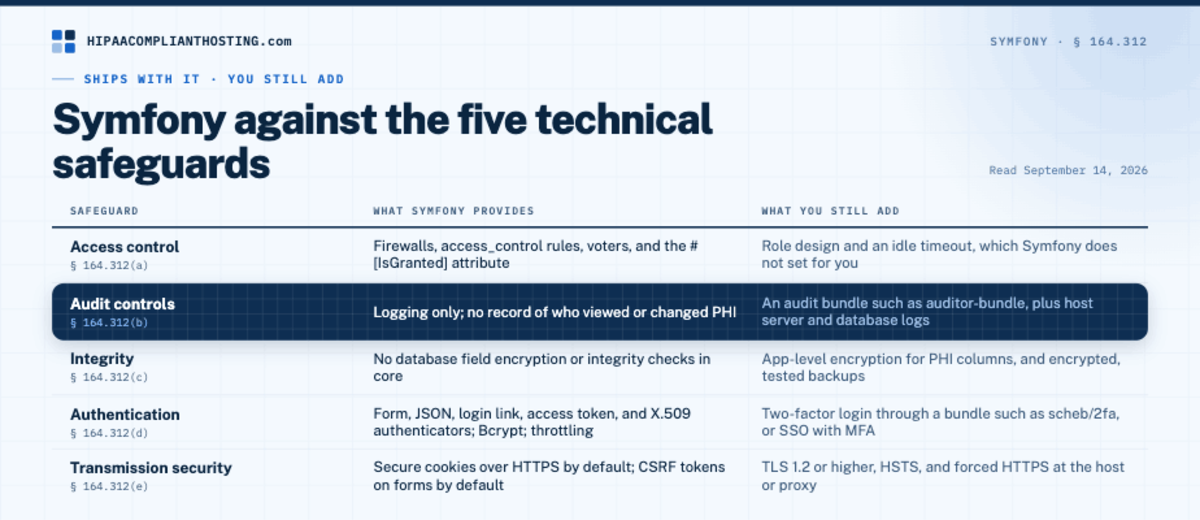
Here is how current Symfony maps to each rule in 45 CFR § 164.312. The middle column is what ships in Symfony. The last column is what a Symfony HIPAA compliant app still needs from you or your host.
Safeguard (45 CFR § 164.312) | What Symfony provides | What you still add |
|---|---|---|
Access control, (a) | Firewalls, access_control rules, voters, and the #[IsGranted] attribute | Role design and an idle timeout, which Symfony does not set for you |
Audit controls, (b) | Logging only; no record of who viewed or changed PHI | An audit bundle such as auditor-bundle, plus server and database logs from the host |
Integrity, (c) | No database field encryption or integrity checks in core | App-level encryption for PHI columns, and encrypted, tested backups at the host |
Person or entity authentication, (d) | Form, JSON, login link, access token, and X.509 authenticators; Bcrypt hashing; login throttling | Two-factor login through a bundle such as scheb/2fa, or SSO with multi-factor login |
Transmission security, (e) | Secure cookies over HTTPS by default; CSRF tokens on forms by default | TLS 1.2 or higher, HSTS, and forced HTTPS at the host or proxy |
Two details trip teams up. First, the Secrets vault is not data encryption. Symfony's docs say it stores sensitive config values, such as API keys, and it needs the Sodium PHP extension. It does nothing for patient records in your database. Second, sessions have no built-in idle timeout. Symfony records when a session was last used, so you check that value in an event listener and log the user out. Both gaps shape how a Symfony HIPAA compliant data layer looks. CakePHP covers the timeout gap in core, since its Session.timeout setting counts idle minutes. The encryption gap remains in CakePHP, whose ORM has no encrypted column type. A separate guide covers the timeout value and field encryption for a CakePHP HIPAA compliant app.
Does Symfony Cloud sign a BAA?
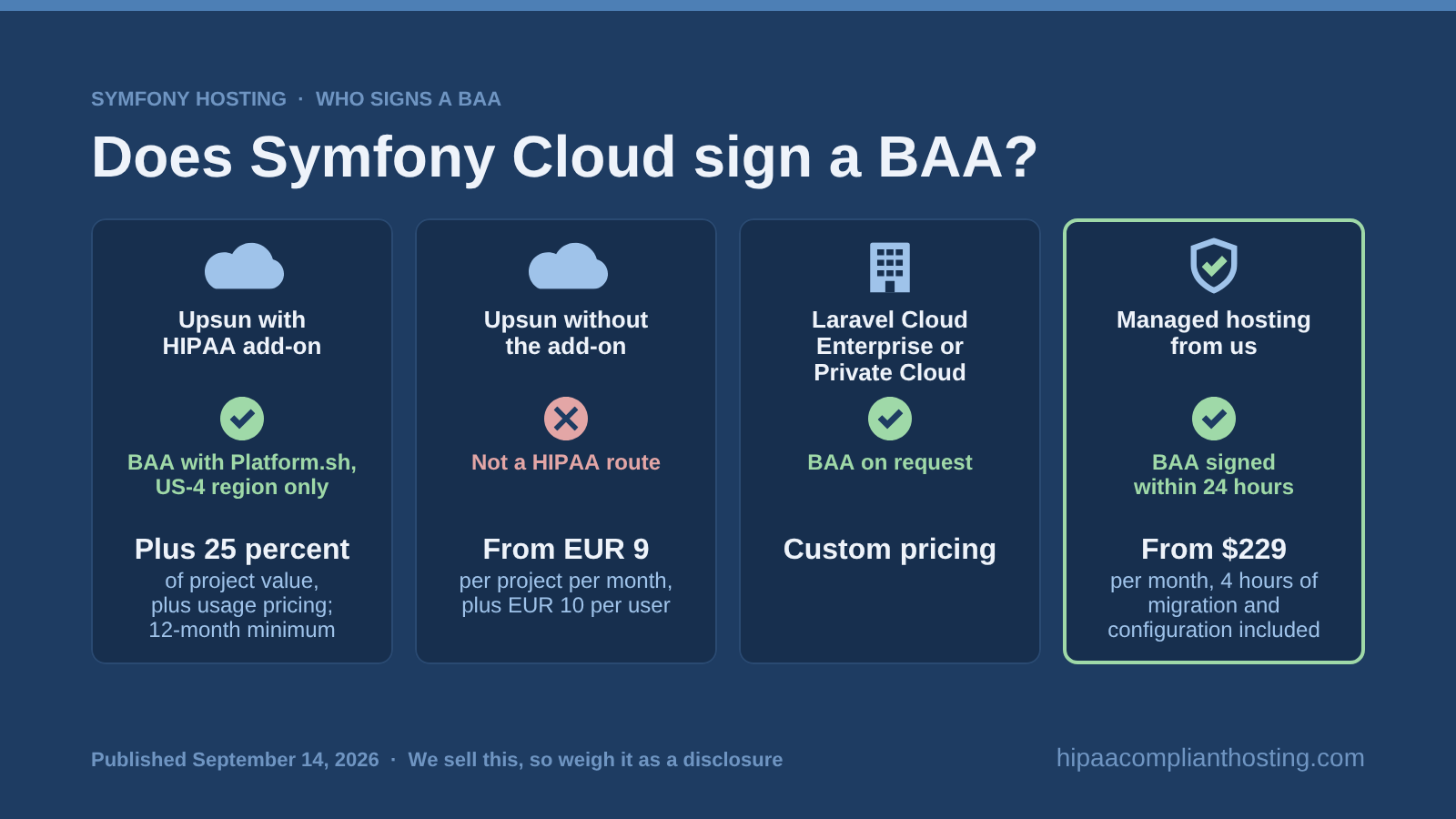
Yes, through Upsun, and it is not cheap. Symfony Cloud is now Upsun, formerly Platform.sh. Upsun's HIPAA page, last updated September 23, 2025, says the customer must sign a BAA with Platform.sh. You request it through your Upsun account manager. HIPAA workloads must run in the US-4 region. Upsun's pricing page lists HIPAA as an add-on at 25 percent of project value, with a 12-month minimum term. For many teams, that is the first Symfony HIPAA compliant decision. Laravel Cloud is a second route, because it auto-detects Symfony apps. Which Laravel plans include the BAA is in our guide to whether Laravel HIPAA compliant apps are possible. CodeIgniter apps, where CSRF ships off by default, are covered in our guide to whether CodeIgniter HIPAA compliant apps are possible. Here are the options as published on October 20, 2026.
Route for a Symfony app | Published price | BAA status |
|---|---|---|
Upsun (Symfony Cloud) with HIPAA add-on | Usage pricing plus 25 percent of project value; 12-month minimum | BAA with Platform.sh, US-4 region only |
Upsun without the add-on | From EUR 9 per project per month, plus EUR 10 per user | Not a HIPAA route |
Laravel Cloud Enterprise or Private Cloud | Custom pricing | BAA on request |
Laravel Forge on your own server | Flat monthly fee plus your server | No HIPAA statement; your server provider's BAA applies |
Managed HIPAA cloud hosting from us | From $229 per month, 4 hours of migration and configuration included | BAA signed within 24 hours of signup, before patient data moves |
Upsun is clear about the split. Its HIPAA page puts app security, environment setup, and regular redeploys for patches on the customer. It also asks customers to run yearly penetration tests and vulnerability scans. And it expects a Fastly web application firewall or an equivalent one. Upsun holds SOC 2 Type 2 and PCI attestations for its own layer. Those cover the platform, not your Symfony HIPAA compliant app code. It also notes that no HHS-recognized HIPAA certification exists. Why that matters is covered in HIPAA certified hosting. That is an honest page, and it is a real Symfony HIPAA compliant path for teams already on the platform. Upsun hosts Drupal too; our guide to whether Drupal HIPAA compliant sites are possible compares it with Acquia and Pantheon.
Which Symfony versions should a HIPAA app run?
A supported one, on its latest patch. Symfony ships minor versions every six months, in May and November. Major versions come every two years. Long-term support versions get three years of bug fixes and a year of security fixes after that. An unsupported branch cannot stay part of a Symfony HIPAA compliant system. Here are the dates from Symfony's release pages, checked October 20, 2026.
Version | Released | Security fixes until | Notes |
|---|---|---|---|
Symfony 6.4 LTS | November 2023 | November 2027 | Bug fixes end November 2026; latest patch 6.4.48 |
Symfony 7.4 LTS | November 2025 | November 2029 | Current LTS; latest patch 7.4.21; PHP 8.2 or higher |
Symfony 8.1 | May 2026 | January 2027 | Latest patch 8.1.9; PHP 8.4 or higher |
Symfony 8.2 | Due November 2026 | July 2027 | Under development; PHP 8.4 or higher |
For most Symfony HIPAA compliant apps, 7.4 LTS is the calm choice. Patching still matters on any branch. On May 27, 2026, Symfony disclosed CVE-2026-48489, a High-severity firewall bypass. It let unauthenticated users reach GET routes protected by access_control. It was fixed in 7.4.13, 6.4.41, and 8.0.13. A week earlier, CVE-2026-46626 let web requests switch APP_ENV and APP_DEBUG on servers with register_argc_argv enabled. It was fixed in 7.4.12, 6.4.40, and 8.0.12.
On October 15, 2026, Symfony published three more High-severity advisories. The most exposed is CVE-2026-108082 in HttpFoundation. A crafted Cache-Control header can tie up the CPU, with no login needed. The other two, CVE-2026-109413 and CVE-2026-109449, let untrusted YAML or expressions crash the PHP process. A Symfony HIPAA compliant app should run 7.4.21, 8.1.9, 6.4.48, or later, which contain all three fixes. Downtime matters here too, because the Security Rule covers the availability of electronic PHI, not just its confidentiality. Log your branch and patch cadence in your HIPAA risk analysis.
Symfony patches do not cover the PHP runtime, so also run PHP 8.5.12, 8.4.27, 8.3.36, 8.2.35, or a later patch on the same branch. PHP released those on October 21, 2026, to fix CVE-2026-109618 and CVE-2026-109619, two critical flaws that can allow unauthenticated remote code execution. If your PHP comes from a Linux distribution, check your vendor for an updated package, since vendors received the patches in advance. Symfony 6.4 also runs on PHP 8.1, which gets no fixed release from the PHP project, so move to PHP 8.3 or later. PHP 8.2 gets security fixes only until December 31, 2026. Who applies PHP updates depends on the host and plan, so get it in writing.
The 8 settings that make a Symfony app HIPAA-ready
These eight settings close the gaps above in a Symfony HIPAA compliant app. Each one comes from Symfony's own docs or a maintained bundle.
Run the latest patch. As of October 20, 2026, that is 7.4.21 or 6.4.48 on the LTS branches, or 8.1.9 on the current branch. All three include the October 15 security fixes. PHP itself also needs its October 21, 2026, security release, such as 8.4.27 on PHP 8.4.
Lock the environment. Set APP_ENV to prod and APP_DEBUG to 0 on the server. Keep PHP's register_argc_argv off for web requests.
Turn on login throttling. Add login_throttling to every firewall. It allows 5 attempts a minute by default and needs the symfony/rate-limiter package.
Keep strong hashing. The auto hasher picks Bcrypt today, with a default cost of 13. Use migrate_from to rehash legacy passwords at login.
Add an idle timeout. Check the session's last-used time in a listener and invalidate old sessions. Keep cookie_secure on auto or true.
Require two-factor login for staff. Use scheb/2fa, with about 600 GitHub stars, or SSO that enforces multi-factor login.
Add an audit trail. DamienHarper/auditor-bundle, with about 475 stars, records Doctrine entity changes. Configure it to skip or mask PHI columns. HIPAA's audit controls standard sets no retention period for the logs, and our guide to HIPAA audit logs covers what to record.
Encrypt PHI columns. Use a custom Doctrine type or app-level libsodium encryption. The Secrets vault does not cover database data.
Items 5 and 6 map to rules explained in HIPAA automatic logoff and HIPAA MFA requirements. Yii 2 ships the idle timeout from item 5 in core, as its authTimeout setting, but leaves it off by default. Turning on cookie auto-login quietly disables it, which is why the settings for a Yii HIPAA compliant app keep auto-login off. One more note on item 3. Symfony's docs say its rate limiter cannot stop denial-of-service attacks, because PHP must boot to run it. Put that protection at the proxy or firewall. With all eight in place, most Symfony HIPAA compliant work inside the app is done.
Where do Symfony apps leak PHI?
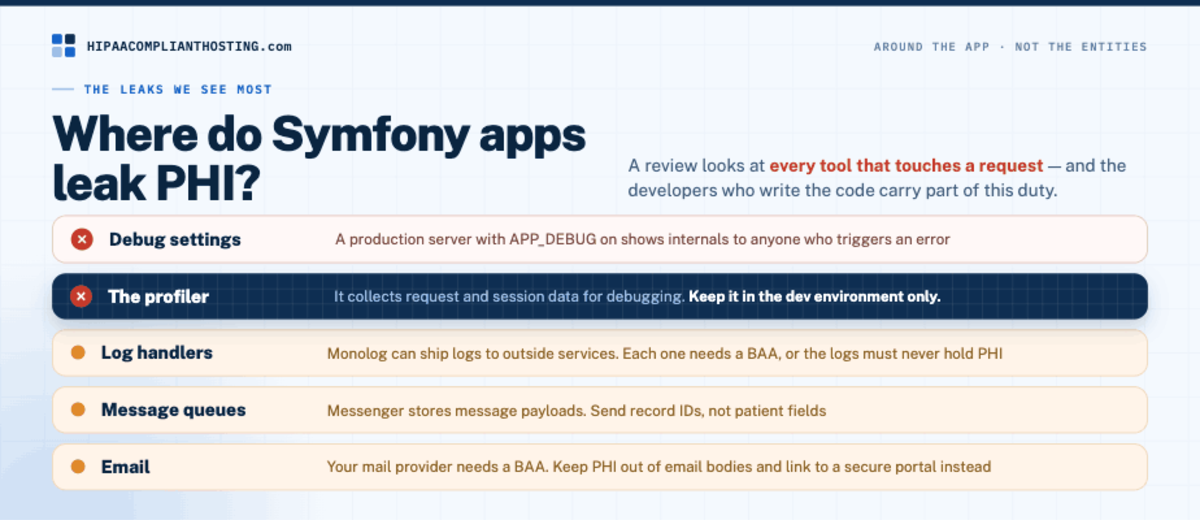
Mostly around the app, not in the entities. A Symfony HIPAA compliant review should cover every tool that touches a request. Each of these five can expose PHI if it is set up wrong.
Debug settings. A production server with APP_DEBUG on shows internals to anyone who triggers an error.
The profiler. Symfony's profiler collects request and session data for debugging. Keep it in the dev environment only.
Log handlers. Monolog can ship logs to outside services. Each one needs a BAA, or the logs must never hold PHI.
Message queues. Messenger stores message payloads. Send record IDs, not patient fields.
Email. Your mail provider needs a BAA. Keep PHI out of email bodies and link to a secure portal instead.
Developers who write the code carry part of this duty. The basics are in HIPAA training for web developers.
What does HIPAA hosting for Symfony cost in 2026?
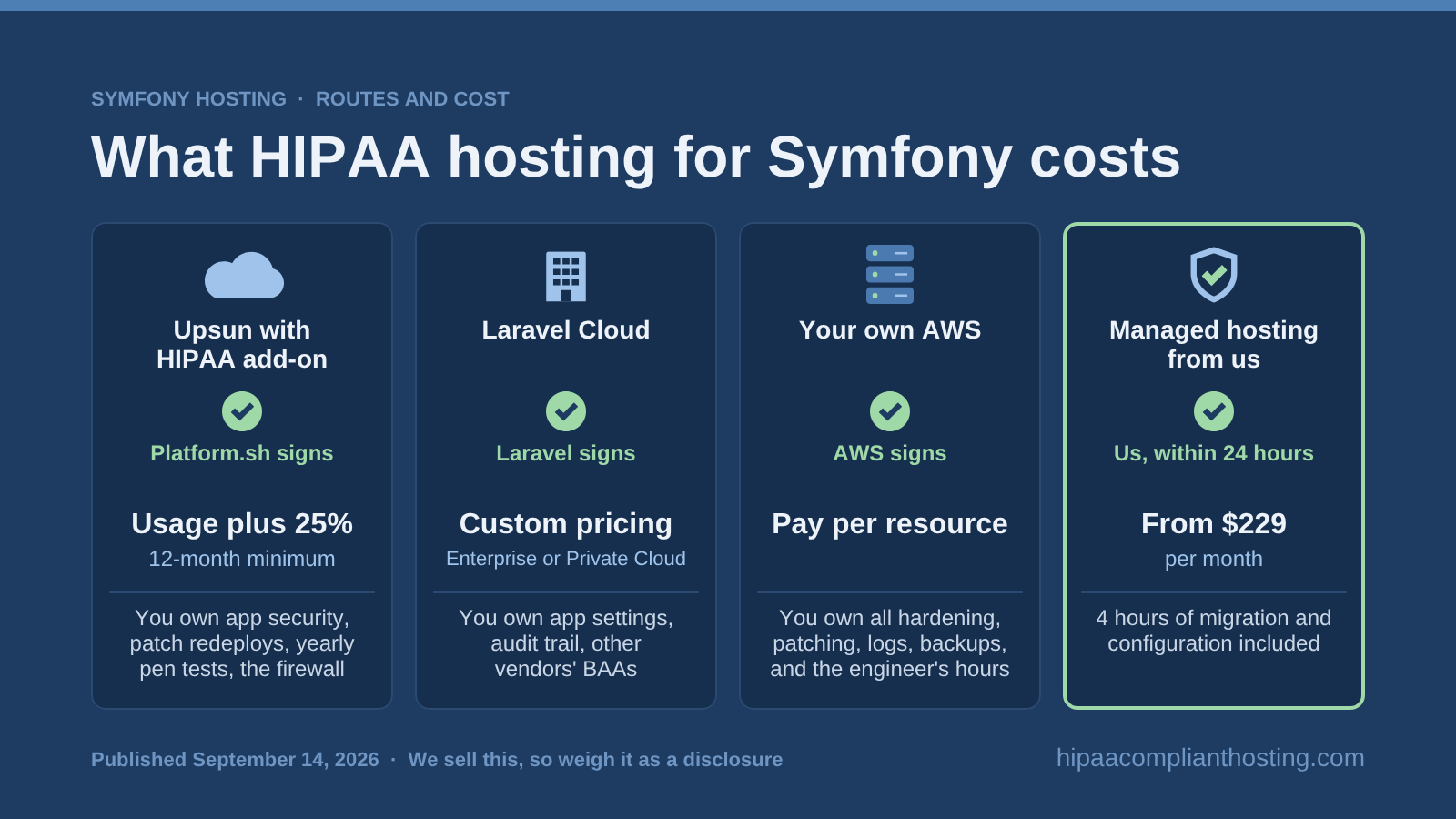
A Symfony HIPAA compliant budget starts with routes that can sign a BAA. Figures are as published on October 20, 2026.
Route | Published starting point | Who signs the BAA | What you still own |
|---|---|---|---|
Upsun with HIPAA add-on | Usage plus 25 percent; 12-month minimum | Platform.sh | App security, patch redeploys, yearly pen tests and scans, the firewall |
Laravel Cloud Enterprise or Private Cloud | Custom pricing | Laravel | App settings, audit trail, other vendors' BAAs |
Your own AWS | Pay per resource | AWS | All hardening, patching, logs, backups, and the engineer's hours |
Managed HIPAA cloud hosting from us | From $229 per month, no long-term contract; 4 hours of migration and configuration included | Us, within 24 hours | Symfony and app patches, app settings, risk analysis, other vendors' BAAs, and confirming in writing who applies PHP and OS updates |
We sell the last row, so weigh it as a disclosure. The DIY row looks cheapest until you price the monthly hardening work. Your database needs the same care, as covered in HIPAA compliant database hosting. If you are weighing Heroku, Render, or Fly.io instead, we compare them plan by plan in HIPAA compliant app hosting.
Is your app smaller than a full-stack framework calls for? The same three layers on a micro-framework are in our guide to whether Flight PHP HIPAA compliant apps are possible. For a PSR-15 API, maintained middleware drops in, but nothing ships by default. That walkthrough is in our guide to whether Slim Framework HIPAA compliant APIs are possible.
If you would rather not run the server layer yourself
Your team may want to build features, not run a platform, and get a BAA without a 12-month add-on contract. Our HIPAA compliant Symfony hosting runs your app on single-tenant AWS servers, with encryption at rest and in transit. Every plan includes CloudFront CDN, a web application firewall, tested encrypted backups, and six-year audit logging. We sign the BAA within 24 hours of signup, before patient data moves. Plans start from $229 per month, with no long-term contract. The first month has 4 hours of migration and configuration included; after that, work is $175 an hour, quoted before work starts.
Symfony is one of 17 platforms we support on our managed HIPAA cloud hosting. If your app ships in containers, HIPAA compliant Docker hosting starts from $259 per month. You keep Symfony, your code, and your deploy process. We run the server layer, and our BAA covers the servers and services we run. We sell this, so weigh it as a disclosure.
Here is the honest inverse. If you already run on Upsun and the add-on and US-4 region fit, stay there, and you do not need us. If your team runs AWS under AWS's BAA with an engineer who owns patching and logs, that works and costs less in cash. If a hospital buyer requires a SOC 2 report from your host, Upsun has one. HIPAA Compliant Hosting does not hold SOC 2 or HITRUST certification. And if your app never touches PHI for a covered entity, HIPAA does not apply at all. For everyone else, our HIPAA compliant hosting plans are public. You can request a quote or tell us what you are building and get a straight answer.
Frequently asked questions
Is Symfony HIPAA compliant?
No framework is HIPAA compliant by itself. A Symfony HIPAA compliant system needs a host that signs a BAA. The app also needs login throttling, two-factor login, an idle timeout, field encryption, and an audit trail. Your organization completes the risk analysis. Symfony makes no HIPAA statement of its own.
Is Upsun or Platform.sh HIPAA compliant?
Upsun, formerly Platform.sh, signs a BAA for HIPAA workloads in its US-4 region. The HIPAA add-on costs 25 percent of project value, with a 12-month minimum, as of October 20, 2026. Upsun's shared responsibility matrix leaves app security, patching, and yearly testing to you.
Does Symfony encrypt data at rest?
Not your database data. The Secrets vault encrypts config values such as API keys, using the Sodium extension. PHI columns need a custom Doctrine type or app-level encryption. Disk and backup encryption come from your host.
Does Symfony have two-factor login or an audit log?
Not in core. Symfony's Security docs cover login methods and access control, but not two-factor login. Most teams add scheb/2fa for two-factor and auditor-bundle for entity change logs, plus server and database logs from the host.
Should a HIPAA app run Symfony 7.4 LTS or 8.1?
Either works if you patch it. Symfony 7.4 LTS gets security fixes until November 2029, which suits most healthcare apps. Symfony 8.1 is supported until January 2027, so you would move to 8.2 within months. Record the choice in your risk analysis.
Can I get a BAA for a Symfony app without a 12-month contract?
Yes. Upsun's HIPAA add-on carries a 12-month minimum term, as of October 20, 2026. Our managed plans for Symfony HIPAA compliant apps start from $229 a month, with no long-term contract. We sign the BAA within 24 hours of signup, before patient data moves. It covers the servers and services we run, not your app code.
Recap: Symfony HIPAA compliant
To recap, a Symfony HIPAA compliant app needs a host that signs a BAA, a hardened server, and a configured app. Upsun signs a BAA as a 25 percent add-on in its US-4 region. Laravel Cloud's Enterprise and Private Cloud plans are another route. Symfony gives you strong access control, login throttling, Bcrypt hashing, CSRF tokens, and session fixation protection. You add two-factor login, an idle timeout, field encryption, and an audit trail. Run 7.4 LTS or 8.1 on the latest patch, keep PHP patched too, and keep debug tools, logs, queues, and email free of PHI.
This article is general information, not legal advice. Plans, prices, BAA terms, and support dates change often. The details here reflect Symfony's release and documentation pages, Upsun's HIPAA and pricing pages, and GitHub advisories as read on October 20, 2026. PHP release details reflect php.net as read on October 22, 2026. Confirm current terms with each vendor, consult qualified counsel, and base your safeguards on a documented risk analysis. We sell HIPAA compliant hosting. Reviewed October 2026.
Sources
Symfony: Release process, Symfony 7.4, and Symfony 8.1.
Symfony: Symfony 8.2 and Symfony 6.4.
Symfony docs: Security, Password hashing, CSRF protection.
Symfony docs: Sessions and Security configuration reference.
Symfony docs: Rate limiter and Secrets.
Symfony: Symfony Cloud.
Laravel Cloud: Pricing and Symfony support and Compliance.
GitHub advisories: CVE-2026-48489 and CVE-2026-46626.
GitHub advisories, October 15, 2026: CVE-2026-108082, CVE-2026-109413, and CVE-2026-109449.
PHP: Security advisory, October 21, 2026 (CVE-2026-109618 and CVE-2026-109619) and Supported versions.
Bundles: scheb/2fa and DamienHarper/auditor-bundle.
45 CFR § 164.312 (technical safeguards): law.cornell.edu.
45 CFR § 164.306 (security standards, including availability): law.cornell.edu.
45 CFR § 164.308 (administrative safeguards, BAA requirement): ecfr.gov.
45 CFR § 160.103 (definitions): ecfr.gov.