


Is WooCommerce HIPAA Compliant? The Layer-by-Layer Verdict for 2026
HIPAA Compliant Hosting · https://hipaacomplianthosting.com/blog/is-woocommerce-hipaa-compliant
Last updated: August 24, 2026
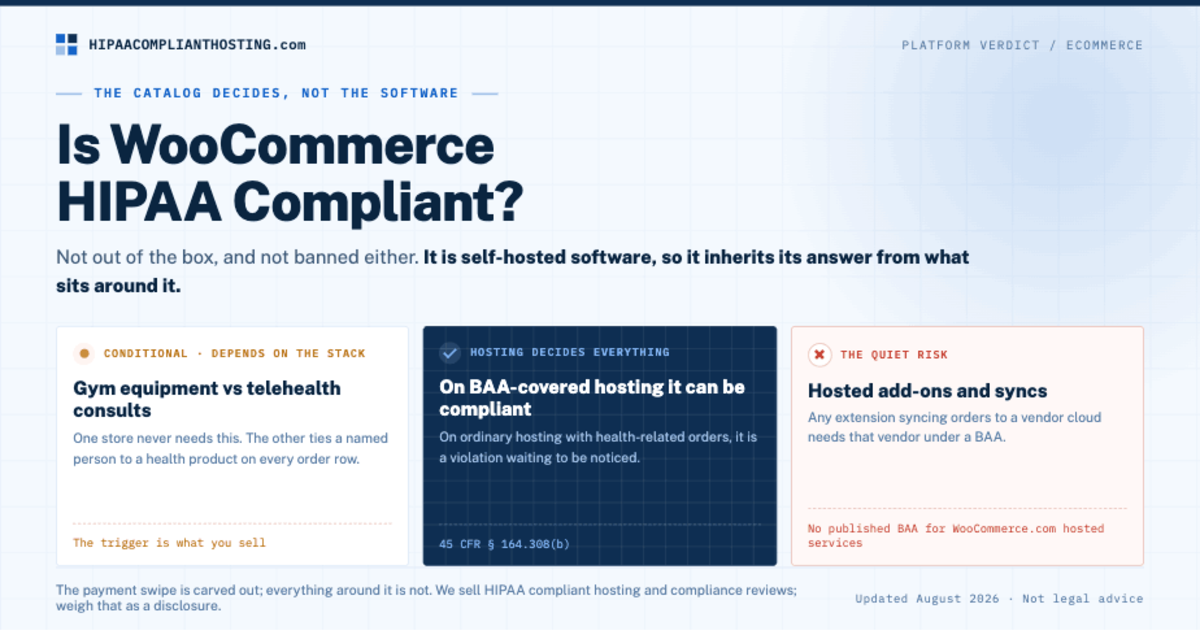
WooCommerce is not HIPAA compliant out of the box, and it is not banned either. It is self-hosted software, so it inherits its answer from what sits around it: the hosting under the store, the vendors connected to it, and whether what you sell turns order data into protected health information (PHI). A store selling gym equipment never needs to make WooCommerce HIPAA compliant. A store selling telehealth consults, prescription refills, or lab kits absolutely does. Every one of its order rows ties a named person to a health product. This verdict walks the line between those two stores, layer by layer, including the payment nuance most guides get wrong.
TL;DR: Quick answer
WooCommerce core is software you host yourself. On BAA-covered hosting it can be part of a compliant build; on ordinary hosting with health-related orders it is a violation waiting to be noticed.
The trigger is what you sell. Health-adjacent products plus a customer identity make order data PHI, and the whole stack around that data must be covered.
The payment transaction itself sits in a HIPAA carve-out: banks and payment processors acting as such are not business associates. Your order database gets no such carve-out.
Hosted add-ons are the quiet risk: any extension that syncs orders to a vendor cloud needs that vendor under a BAA, and as of August 2026 we found no published BAA offering for WooCommerce.com's own hosted services.
The compliant build: covered hosting, minimal PHI in orders, clean checkout trackers, and extensions that keep data on your server.
When does a WooCommerce order become PHI?
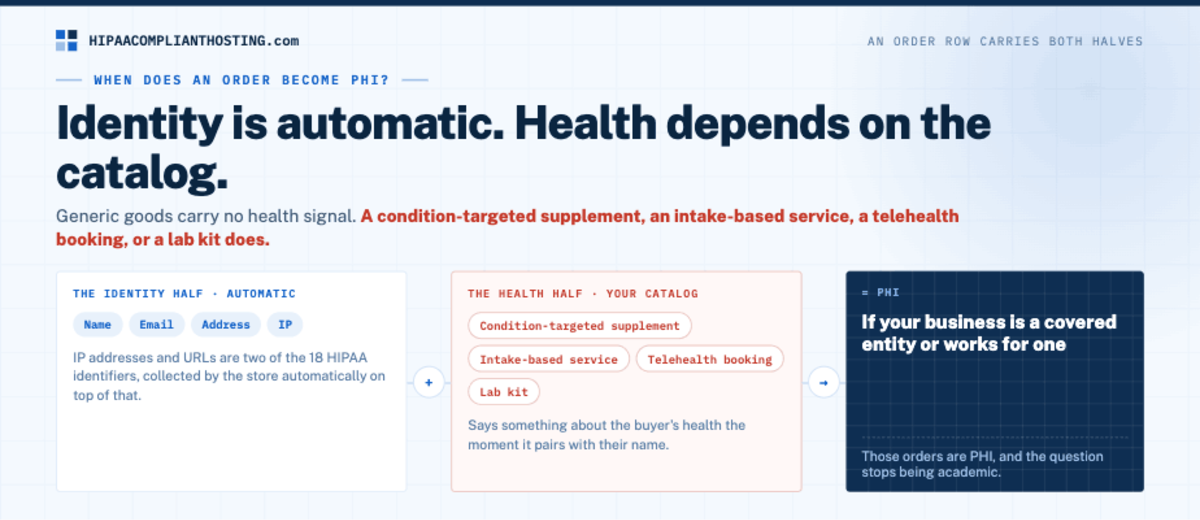
The WooCommerce HIPAA compliant question starts here, because PHI is health information tied to something that identifies a person, and an order row carries both halves. The identity half is automatic: name, email, address, IP. The health half depends on the catalog. Generic goods carry no health signal. But a supplement targeted at a condition, an intake-based service, a telehealth booking, or a lab kit says something about the buyer's health the moment it pairs with their name. Two of the 18 HIPAA identifiers, IP addresses and URLs, are collected by the store automatically on top of that. If your business is a covered entity or works for one, those orders are PHI, and the question stops being academic. Whether HIPAA reaches your business at all is settled in who needs HIPAA-compliant hosting.
The WooCommerce HIPAA compliant verdict, layer by layer
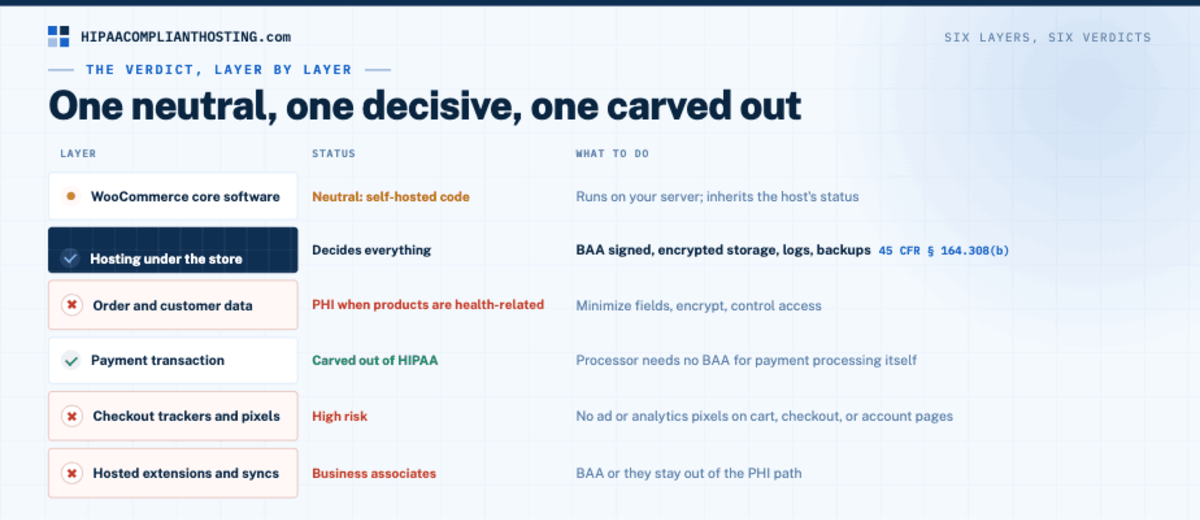
Layer | Status | What to do |
|---|---|---|
WooCommerce core software | Neutral: self-hosted code | Runs on your server; inherits the host's status |
Hosting under the store | Decides everything | BAA signed, encrypted storage, logs, backups (45 CFR § 164.308(b)) |
Order and customer data | PHI when products are health-related | Minimize fields, encrypt, control access |
Payment transaction | Carved out of HIPAA | Processor needs no BAA for payment processing itself |
Checkout trackers and pixels | High risk | No ad or analytics pixels on cart, checkout, or account pages |
Hosted extensions and syncs | Business associates | BAA or they stay out of the PHI path |
The payment nuance most guides get wrong
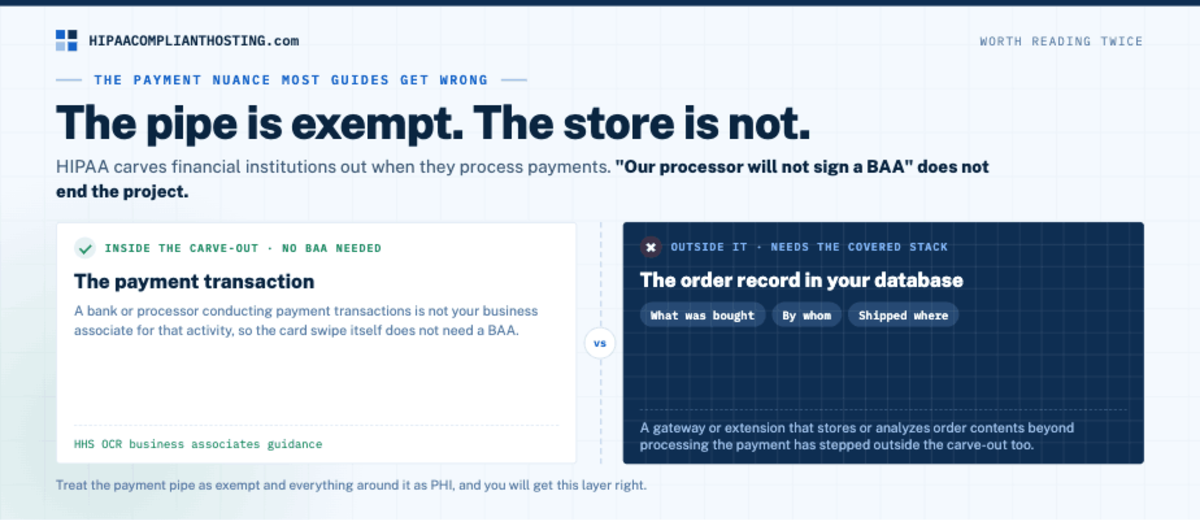
Here is the part worth reading twice, because it decides whether a WooCommerce HIPAA compliant build is even possible with mainstream processors. HIPAA carves financial institutions out when they process payments. A bank or processor conducting payment transactions is not your business associate for that activity, so the card swipe itself does not need a BAA. That is why "our processor will not sign a BAA" does not end the project. But the carve-out is narrow. It covers the payment transaction, not your store. The order record in your WooCommerce database, what was bought, by whom, shipped where, is yours, sits outside the carve-out, and needs the covered stack. And a gateway or extension that stores or analyzes order contents beyond processing the payment has stepped outside the carve-out too. Treat the payment pipe as exempt and everything around it as PHI, and you will get this layer right. Card payments bring PCI DSS into the picture as well; see PCI compliant hosting.
The build: how to make WooCommerce HIPAA compliant
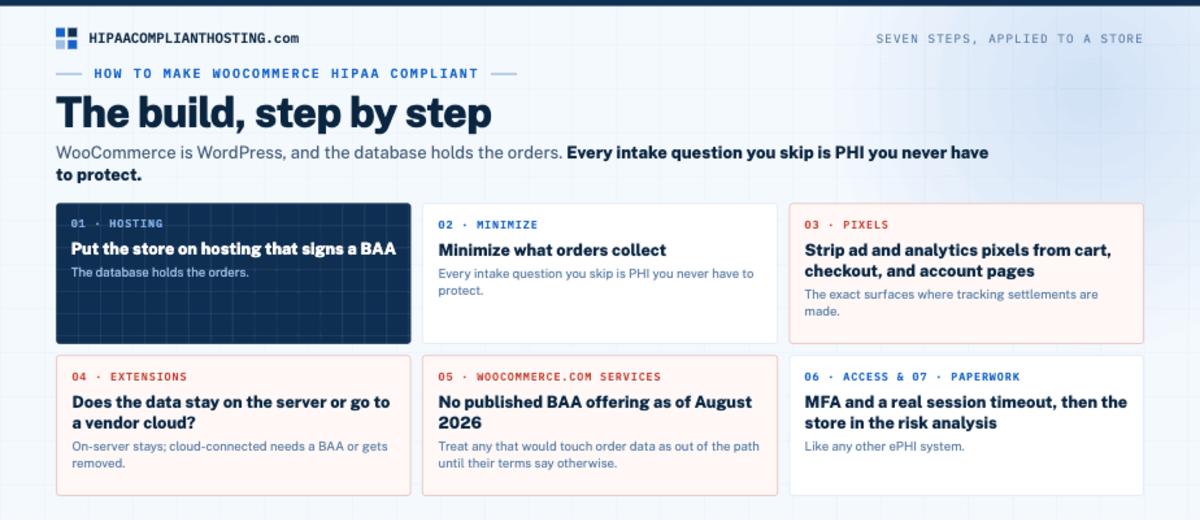
A WooCommerce HIPAA compliant build follows the same seven-step path as any PHI-handling site, applied to a store. Put the store on hosting that signs a BAA, since WooCommerce is WordPress and the database holds the orders. The WordPress specifics are in how to make WordPress HIPAA compliant. Minimize what orders collect: every intake question you skip is PHI you never have to protect. Strip ad and analytics pixels from cart, checkout, and account pages. Those are the exact surfaces where tracking settlements are made, per HIPAA tracking technologies. Audit every extension with the one test from our HIPAA compliant WordPress forms guide: does the data stay on the server or go to a vendor cloud? On-server stays; cloud-connected needs a BAA or gets removed. As of August 2026 we found no published BAA offering for WooCommerce.com's own hosted services, so treat any of them that would touch order data as out of the path until their terms say otherwise. Lock down admin logins with MFA and a real session timeout. Then write the store into the risk analysis like any other ePHI system.
When you do not need any of this
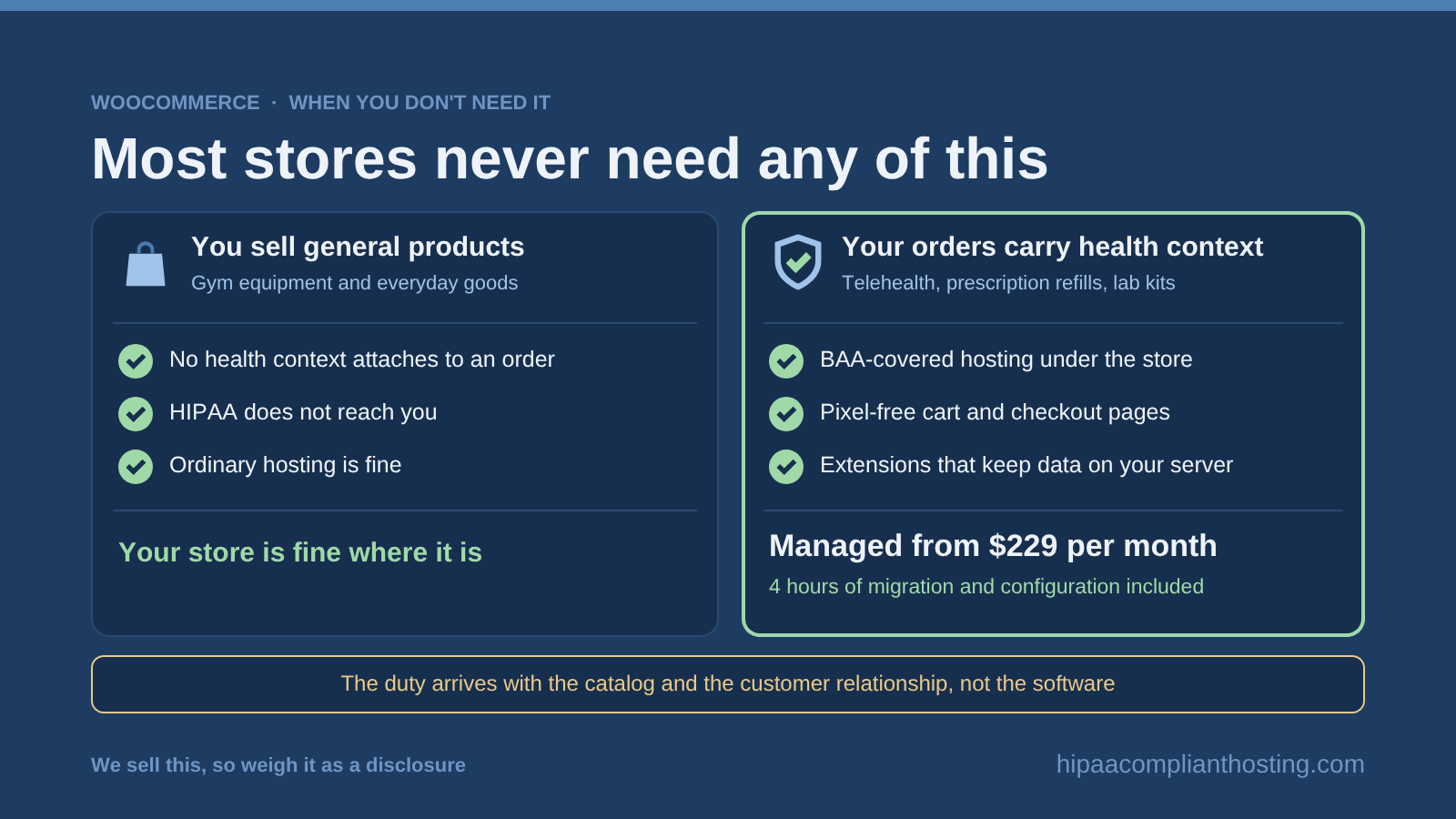
Honesty first: most stores never need a WooCommerce HIPAA compliant build at all. If you sell general products and no health context attaches to an order, HIPAA does not reach you, and ordinary hosting is fine. The duty arrives with the catalog and the customer relationship, not the software. Unsure which side of the line your store sits on? The WooCommerce HIPAA compliant question is a five-minute conversation, not a five-thousand-dollar one. Describe what you sell and how orders flow and we will tell you plainly, including "your store is fine where it is."
The covered stack, if you need it
If your store does handle health orders, a WooCommerce HIPAA compliant stack is the same layer we build for every PHI path, so weigh this as a disclosure. Our HIPAA compliant WordPress hosting puts the store, database included, under a signed BAA with encrypted storage, six-year audit logs, a firewall, and tested backups. Managed plans start at $229 per month, with 4 hours of migration and configuration included. And our client-side compliance review audits the checkout the way OCR would: every pixel, script, and extension on the money pages, mapped with fixes. The store keeps selling the whole time. The store still needs a qualifying host; the options are in best HIPAA WordPress hosting.
Frequently asked questions
Is WooCommerce HIPAA compliant?
Not by itself, and not banned either. WooCommerce is self-hosted software, so its status comes from the stack: BAA-covered hosting, minimized order data, clean checkout pages, and extensions that keep data on your server. On that stack, a WooCommerce store can handle health orders lawfully.
Do payment processors need to sign a BAA?
Generally no, for payment processing itself. HIPAA carves out financial institutions conducting payment transactions. The carve-out does not cover your order database or any service that stores or analyzes order contents beyond the payment, so the rest of the stack still needs coverage.
Can I sell supplements without HIPAA compliance?
Usually yes. Selling general wellness products to the public does not make you a covered entity. The duty appears when a covered entity or its business associate runs the store, or when orders carry real health information such as intake answers or clinician-directed products.
What makes a WooCommerce order PHI?
Identity plus health context. Name, email, address, and IP are identifiers; a health-revealing product, service, or intake question supplies the health half. Together, held by a covered entity or business associate, the order row is PHI.
Can I run Google Analytics on my health store?
Not on cart, checkout, or account pages. Those pages pair identity with health-revealing purchases, which is the exact pattern in OCR's tracking guidance and the large pixel settlements. Measure with self-hosted or BAA-covered analytics instead.
Recap: WooCommerce HIPAA compliant
To recap, the way to make WooCommerce HIPAA compliant is to fix the stack, not the software: BAA-covered hosting under the database, minimal order data, a pixel-free checkout, extensions that keep data on-server, MFA and timeouts on admin, and the store named in the risk analysis. The payment swipe is carved out; everything around it is not. And if no health context ever touches your orders, you need none of it.
This article is general information, not legal advice. Regulatory citations reflect 45 CFR Parts 160 and 164 and HHS guidance as of August 2026. Vendor terms, including BAA availability, change; confirm current terms with each vendor before relying on them. Confirm your obligations with qualified counsel and base your safeguards on a written risk analysis. We sell HIPAA compliant hosting and compliance reviews. Reviewed August 2026.
Sources
45 CFR § 164.308 (administrative safeguards, BAA requirement): ecfr.gov
HHS OCR: Business Associates guidance (incl. the payment-processing exception)
HHS OCR: Use of online tracking technologies
WooCommerce: Official documentation (self-hosted architecture)