


HIPAA Compliant Hosting for Healthcare SaaS and Healthtech Companies in 2026
HIPAA Compliant Hosting · https://hipaacomplianthosting.com/blog/hipaa-compliant-hosting-for-healthcare-saas
Last updated: June 18, 2026
HIPAA compliant hosting for healthcare SaaS is cloud infrastructure that runs a healthtech product the right way. It uses a full chain of Business Associate Agreements (BAAs). It keeps patient data on HIPAA-eligible services. And it adds tenant isolation, encryption, audit logging, and tested backups. Does your software handle patient data for provider customers? Then you are a Business Associate under 45 CFR § 160.103. You have direct liability to the HHS Office for Civil Rights (OCR). That means a BAA with your cloud provider, a BAA with each customer, and infrastructure that meets the HIPAA Security Rule. This guide covers what healthtech companies need from their hosting, and the proof their buyers will ask for.
TL;DR: Quick answer
- A SaaS product that handles PHI for provider customers is a Business Associate under 45 CFR § 160.103 and is directly liable to OCR.
- HIPAA compliant hosting for healthcare SaaS needs a full BAA chain: your cloud provider signs one with you, and you sign one with each customer.
- PHI must stay inside HIPAA-eligible services, with encryption at rest and in transit, strong access control, and audit logging under 45 CFR § 164.312.
- Multi-tenant products need strong isolation so one customer's data never reaches another.
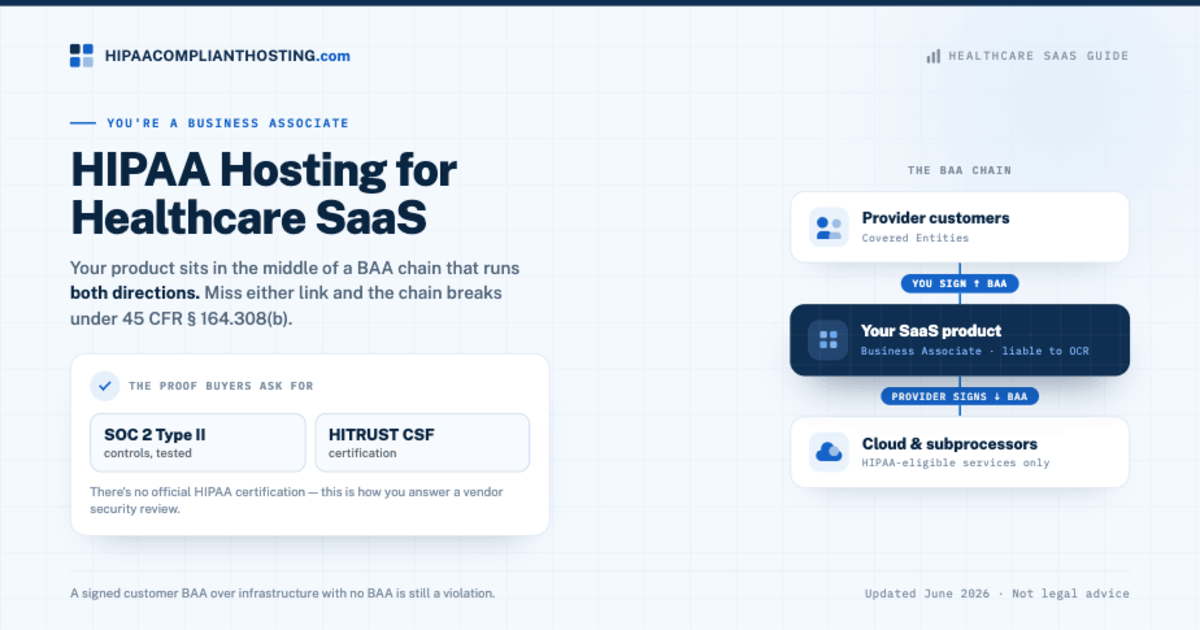
- Buyers will ask for proof. A SOC 2 Type II report or HITRUST certification is how you answer, since there is no official HIPAA certification.
Is a healthcare SaaS company covered by HIPAA?
Almost always, if patient data is involved. HIPAA reaches Covered Entities, like providers and health plans. It also reaches their Business Associates, the vendors that handle PHI for them. A scheduling tool, an EHR add-on, a patient app, a remote monitoring dashboard, or an AI scribe all receive PHI for provider customers. Billing and revenue cycle platforms do the same, as covered in HIPAA compliant hosting for medical billing. That makes the company a Business Associate under 45 CFR § 160.103. Since the 2013 Omnibus Rule, Business Associates are directly liable, not just liable to the customer. OCR settles enforcement actions with software vendors often. So HIPAA compliant hosting for healthcare SaaS is not optional for these companies. It is the baseline. Whether your specific product is in scope is covered in our guide to who needs HIPAA-compliant hosting.
The BAA chain runs in both directions
This is the part that catches new healthtech teams. You sit in the middle of a chain. Your provider customers are Covered Entities, so you sign a BAA with each of them. Below you, your cloud provider and any subprocessor that touches PHI must sign a BAA with you. If any link is missing, the chain breaks. A signed customer BAA over infrastructure with no BAA is still a violation under 45 CFR § 164.308(b). So HIPAA compliant hosting for healthcare SaaS starts with one check: does your host sign a BAA for the exact services you run on? SaaS companies with Canadian customers should also read HIPAA Canada PIPEDA.
What the infrastructure has to do
HIPAA compliant hosting for healthcare SaaS has to meet the technical safeguards at 45 CFR § 164.312, the same as any system holding ePHI.
- HIPAA-eligible services only. On AWS, PHI may live only in the services on the HIPAA Eligible Services Reference, which lists more than 200 as of its July 2026 update. The other major clouds work the same way. PHI in a non-eligible service is outside the BAA.
- Encryption at rest and in transit, with TLS 1.2 or higher and managed keys.
- Access control with named accounts, least privilege, and multi-factor authentication on everything.
- Audit logging that records access to ePHI and is kept for the six years required by 45 CFR § 164.316(b)(2)(i).
- Encrypted, tested backups and a recovery plan you have actually run.
Most healthtech products run on cloud platforms. The shared responsibility model leaves all of this configuration to you. The cloud secures the data centers. You secure what you build on them. If you deploy on a developer platform such as Heroku, Vercel, Render, or Supabase rather than raw cloud, the plan-by-plan BAA answers are in our guide to HIPAA compliant app hosting. The details are in HIPAA cloud hosting explained and, for the AWS specifics, is AWS HIPAA compliant. Our service-by-service guide to AWS HIPAA eligible services shows which services can hold PHI under the BAA. The database tier, where most patient records concentrate, is covered in HIPAA compliant database hosting. Teams on Amazon RDS get the exact settings in is Amazon RDS HIPAA compliant. Serverless teams get theirs in is AWS Lambda HIPAA compliant. Teams building on Laravel get the framework settings and Laravel Cloud's BAA plans in our Laravel HIPAA compliant guide. Symfony teams get the same, including Upsun's priced BAA add-on, in our Symfony HIPAA compliant guide.
Multi-tenancy: keep one customer's data away from another
A SaaS product usually serves many customers from shared infrastructure. That is fine under HIPAA, but the isolation has to be real. One practice's data must never reach another tenant. Not through a shared database, a broken access rule, or a leaky API. Strong tenant isolation, tested access controls, and per-tenant logging are part of HIPAA compliant hosting for healthcare SaaS. They are exactly what a security review will probe. Single-tenant environments remove the question entirely for higher-risk workloads. The dedicated-hardware version of that decision is covered in HIPAA dedicated server. For how hosting providers should separate their own customers, see client-level isolation.
Selling to providers: the proof they will ask for
Here is where compliant hosting becomes a sales asset, not just a cost. Healthcare buyers run vendor security reviews before they sign. They will ask for a signed BAA. Then they will ask for evidence that your controls actually work. There is no official HIPAA certification. So the credible answers are a SOC 2 Type II report or a HITRUST CSF certification. Back it with a clear responsibility matrix and a recent penetration test. A startup that can hand over a SOC 2 report closes healthcare deals faster than one that cannot. Building on hosting that already carries strong attestations gives you a head start. To see how providers that sign BAAs compare, see our roundup of the best HIPAA compliant hosting providers. For customers outside North America, HIPAA vs international privacy laws maps HIPAA against GDPR and the other major regimes.
Build it yourself or use a managed host
You have two paths. Configure and operate the cloud yourself, which gives full control and full responsibility for hardening, logging, patching, and incident response. Or use a managed host that runs that layer, so your engineers ship product instead of tuning infrastructure. For an early-stage team, the managed path often gets you to a sellable product faster. Telehealth platforms face the same choice; the parallel is in HIPAA compliant telehealth.
If you would rather run on a managed healthcare platform
The fastest route to a compliant, demo-ready healthtech product is to build on infrastructure that already meets the bar. Our healthcare hosting gives software companies single-tenant, BAA-covered environments with encryption, a web application firewall, audit logging, and encrypted backups. Our managed HIPAA cloud hosting scales the application layer as you grow. For a healthtech team, HIPAA compliant hosting for healthcare SaaS handled for you is the fastest path to a sellable product. That is HIPAA compliant hosting built for healthcare, with the BAA and the safeguards done. We sell these services, so weigh that as a disclosure. If you want a straight read on your architecture, tell us what your product stores and who your customers are. For the data tier alone, our HIPAA compliant ePHI hosting is the narrower option.
Frequently asked questions
Is my healthcare SaaS company a Business Associate?
Yes, if it creates, receives, stores, or transmits PHI for provider customers. That makes it a Business Associate under 45 CFR § 160.103, with direct liability to OCR and a duty to sign BAAs with customers and infrastructure vendors.
Does AWS, Azure, or Google Cloud make my SaaS HIPAA compliant?
No. They sign a BAA and offer HIPAA-eligible services, but you own configuration, isolation, logging, and incident response under the shared responsibility model. The platform is necessary, not sufficient.
Do I need SOC 2 or HITRUST to sell to healthcare?
They are not legally required, but provider buyers routinely ask for them in security reviews. A SOC 2 Type II report or HITRUST certification is the practical proof that your controls work, since HIPAA has no certification of its own.
Can a multi-tenant SaaS be HIPAA compliant?
Yes, with strong tenant isolation, tested access controls, and per-tenant logging so one customer's data is never reachable by another. Single-tenant environments are an option for higher-risk workloads.
What is the fastest way to get a healthtech product HIPAA ready?
Get the BAA chain in place, keep PHI in HIPAA-eligible services, and build on infrastructure that already carries strong safeguards and attestations, whether you operate it yourself or use a managed host.
Recap: HIPAA compliant hosting for healthcare SaaS
To recap, HIPAA compliant hosting for healthcare SaaS means running your product under a full BAA chain, on HIPAA-eligible services, with encryption, access control, audit logging, tested backups, and real tenant isolation. You are a Business Associate, so the liability is yours. Your buyers will ask for proof through a SOC 2 Type II report or HITRUST. Get the BAAs in place, keep PHI inside covered services, and build on infrastructure that already meets the bar.
This article is general information, not legal advice. Confirm your obligations with qualified counsel and base your safeguards on a documented risk analysis specific to your product. Reviewed June 2026.
Sources
- 45 CFR § 160.103 (definitions, Business Associate): ecfr.gov
- 45 CFR § 164.312 (technical safeguards): ecfr.gov
- HHS: Business Associates guidance
- AWS: HIPAA Eligible Services Reference