


HIPAA Compliant Hosting vs Regular Hosting: What the Extra Cost Buys (2026)
HIPAA Compliant Hosting · https://hipaacomplianthosting.com/blog/hipaa-hosting-vs-regular-hosting
Last updated: October 12, 2026
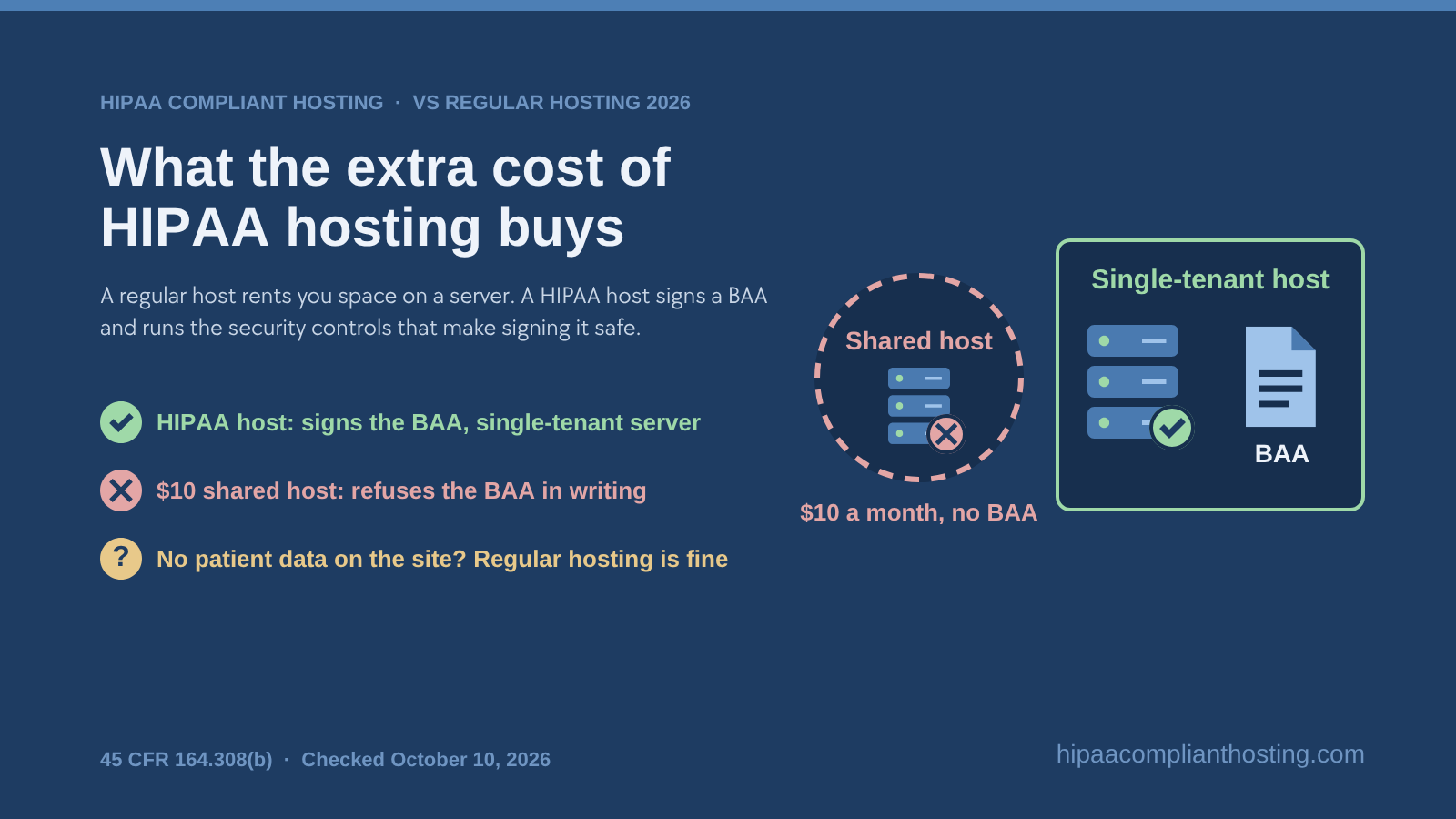
A regular host rents you space on a server. A HIPAA host signs a Business Associate Agreement (BAA) and runs the security controls that make signing it safe. That contract is the one legal difference in HIPAA hosting vs regular hosting, and it explains most of the price gap. A $10 to $30 shared plan is fine for a site with no patient data. Once a form, upload or portal touches patient data, the cheap plan becomes a liability. This guide shows what the extra cost buys, line by line, and when you can skip it. We sell HIPAA hosting, so weigh our view with that in mind. Our plans and prices are public.
TL;DR: Quick answer
The legal line in HIPAA hosting vs regular hosting is the BAA. A covered entity needs one before a host stores patient data (45 CFR § 164.308(b)).
Mainstream hosts refuse. Bluehost and WP Engine say they do not sign BAAs, and GoDaddy's and Hostinger's hosting terms disclaim HIPAA.
The extra cost buys a single-tenant server, encryption at rest and in transit, a firewall, long-term audit logs and tested backups.
Regular hosting is fine when the site holds no patient data, and booking, forms and EHR run at vendors that sign BAAs.
The premium is a few thousand dollars a year. One small OCR settlement in 2025 was $25,000, before legal and recovery costs.
We sign the BAA within 24 hours of signup, on single-tenant AWS, from $229 a month, with 4 hours of migration and configuration included.
The one legal difference in HIPAA hosting vs regular hosting: the BAA
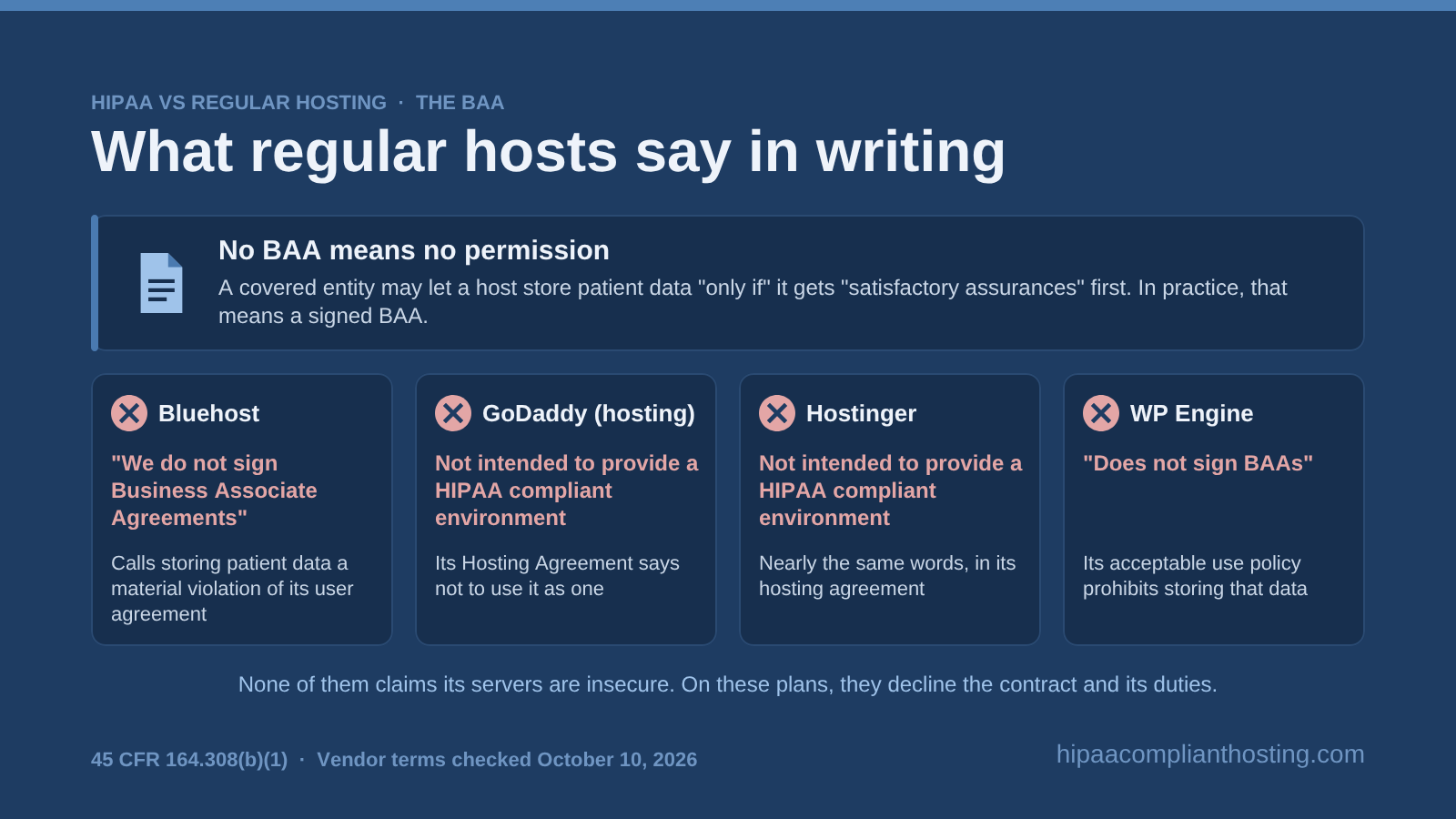
Strip away the marketing and one document separates HIPAA hosting vs regular hosting. Section 164.308(b)(1) lets a covered entity allow a business associate to store patient data "only if" it gets "satisfactory assurances" first. In practice, those assurances are a signed BAA. A host that stores your patient data is a business associate, so no BAA means no permission.
Regular hosts know this and decline the role in writing. Here is what each one published, as checked on October 10, 2026:
Bluehost. "We do not sign Business Associate Agreements," its HIPAA disclaimer says. It also calls storing patient data on its servers a material violation of its user agreement. Details are in our guide to whether Bluehost is HIPAA compliant.
GoDaddy (hosting). Its Hosting Agreement says the hosting services are not intended to provide a HIPAA compliant environment and should not be used as one. Email is a separate question, covered in is GoDaddy HIPAA compliant.
Hostinger. Its hosting agreement uses nearly the same words: the services are not intended to provide a HIPAA compliant environment.
WP Engine. It states that it "does not sign BAAs" and should not hold patient health records. Its acceptable use policy prohibits storing that data.
Notice what these hosts did not say. None of them claims its servers are insecure. On these plans, they decline the contract and its duties: breach reporting, safeguards and return or destruction of data at the end. That refusal is the clearest answer to HIPAA hosting vs regular hosting. Our guide to the HIPAA business associate agreement lists the clauses a real BAA should carry.
How we handle it: we sign the BAA within 24 hours of signup, before any patient data moves. Our BAA covers the servers and services we run.
HIPAA hosting vs regular hosting, line by line
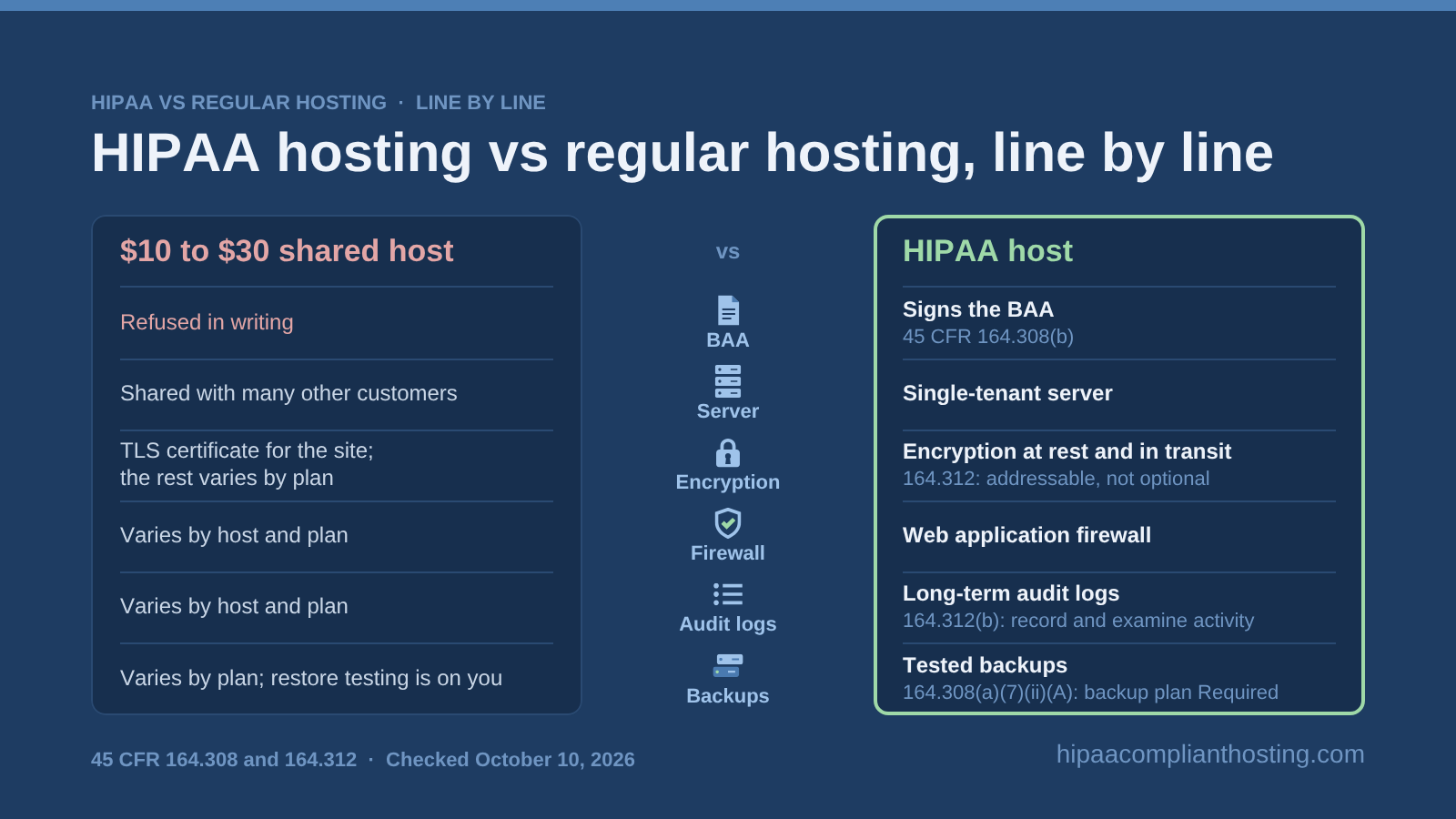
The BAA is the legal difference. The price difference comes from the work behind it. A host cannot safely sign a BAA for a shared server it does not lock down. This table compares HIPAA hosting vs regular hosting on each line, plus what you would build yourself on a cloud account.
Line item | Typical $10 to $30 shared host | HIPAA hosting (our plans) | Build it yourself on a cloud account |
|---|---|---|---|
Business Associate Agreement | Refused in writing | Signed within 24 hours of signup | AWS and Azure offer one, but you configure everything above it |
Server tenancy | Shared with many other customers | Single-tenant AWS server | You choose, size and patch the instance |
Encryption at rest and in transit | TLS certificate for the site; the rest varies by plan | Included on every plan | You enable disk and database encryption and manage keys and certificates |
Web application firewall | Varies by host and plan | Included, with CloudFront CDN | You set up and tune the firewall rules |
Audit logging | Varies by host and plan | Six-year audit logging | You collect, protect and retain the logs, and pay for storage |
Backups | Varies by plan; restore testing is on you | Tested encrypted backups, plus 7-day EBS snapshots | You script backups and run restore tests |
Who does the work | You, within what the plan allows | We run the server; you run your app and content | Your engineer, on an ongoing basis |
Price | Bluehost renews at $9.99 to $21.99 a month; Hostinger at $10.99 to $25.99 (multi-year terms) | From $229 a month, no long-term contract | Cloud bill plus engineer time |
The shared-host prices are renewal rates published on October 10, 2026. Both hosts advertise lower first-term prices on 36 or 48-month terms. Some shared plans do include a firewall or backups. Without a BAA, none of it makes them usable for patient data.
Three rows deserve a closer look. Encryption is "addressable" under § 164.312, not optional. You must use it or document why an equal measure fits better, and few teams can defend skipping it. Audit controls under § 164.312(b) must "record and examine activity" on systems holding patient data. HIPAA also requires you to keep required documentation for six years (§ 164.316(b)(2)(i)), and many teams keep logs on the same clock.
Backups are the third. A data backup plan is "Required" under § 164.308(a)(7)(ii)(A), and an untested backup is a guess. Those three rows are where HIPAA hosting vs regular hosting differs most in daily practice. If you plan to build the right-hand column yourself, read managed vs self-managed HIPAA hosting first.
How we handle it: every plan ships with the middle column already on. You do not configure the firewall, logging or backups.
Why HIPAA hosting costs so much more
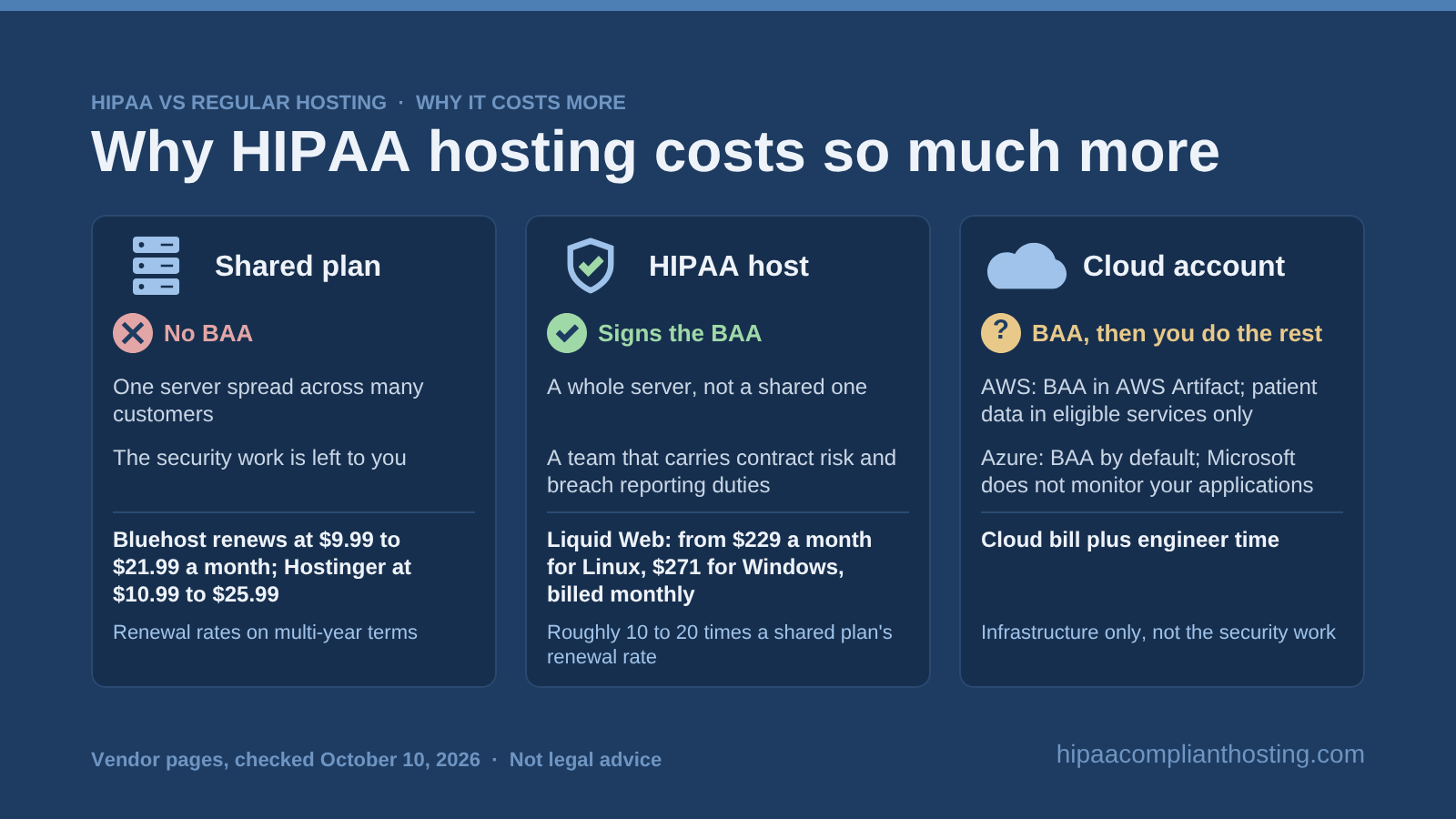
One searcher asked why Liquid Web's HIPAA plans cost "3 to 4 times" more than standard hosting. On sticker price, the gap in HIPAA hosting vs regular hosting is often wider than that. Liquid Web's HIPAA page lists dedicated servers from $229 a month for Linux and $271 for Windows, billed monthly. That is roughly 10 to 20 times a shared plan's renewal rate.
The gap in HIPAA hosting vs regular hosting is not a markup on the same product. A shared plan spreads one server across many customers and leaves the security work to you. A HIPAA plan gives you a whole server and a team that carries contract risk. The host takes on breach reporting duties under the BAA, and it must keep logs and backups it can defend.
The cloud adds a third option to HIPAA hosting vs regular hosting. It looks cheaper on paper, and it can be. One searcher wanted something "cheaper than Azure" with better security. Azure does include a BAA by default for in-scope services. But Microsoft's own HIPAA page says it does not inspect, approve or monitor your applications. AWS works the same way: you accept its BAA in AWS Artifact, then keep patient data in eligible services only.
So a raw cloud bill covers infrastructure, not the security work. Compare the total cost: cloud bill plus the engineer who configures and watches it. Our guide to whether AWS is HIPAA compliant shows where its BAA stops. For full price ranges, see our HIPAA hosting cost guide. For the lowest workable options, see the cheapest HIPAA compliant hosting.
How we handle it: our plans start at $229 a month on single-tenant AWS, with the security work included. Software teams usually start with HIPAA cloud hosting.
When regular hosting is fine (and when it is not)
Here is the honest part of HIPAA hosting vs regular hosting. Many healthcare sites do not need HIPAA hosting at all. If your site never stores, receives or transmits patient data, a regular host is fine. That covers a lot of practices.
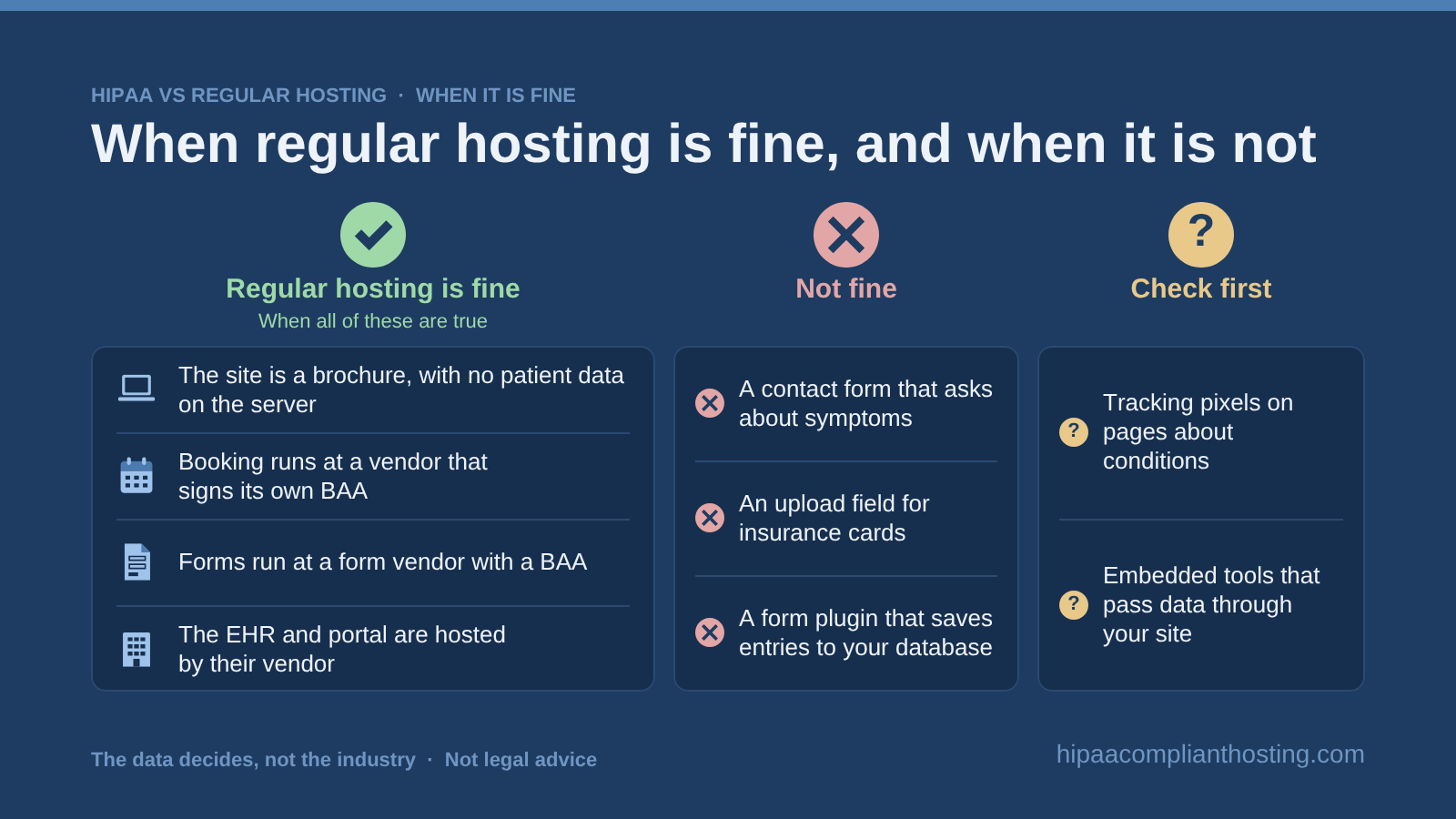
Regular hosting works when all of these are true:
The site is a brochure. Services, staff bios, hours, maps and blog posts, with no patient data on the server.
Booking runs elsewhere. Appointments go through a scheduling vendor that signs its own BAA, and the site only links to it.
Forms run elsewhere. Intake forms live at a form vendor with a BAA, not in a plugin that saves entries to your database.
The EHR and portal are hosted by their vendor. Your website links out and never stores records.
Regular hosting stops being fine the moment one of those changes. This is where most HIPAA hosting vs regular hosting decisions flip. The usual trigger is small: a contact form that asks about symptoms, or an upload field for insurance cards. Tracking pixels on pages about conditions are another quiet risk. Our guides to HIPAA compliant forms and HIPAA tracking technologies show where data slips in.
If you are not sure which side you are on, start with who needs HIPAA compliant hosting. Practices that self-host clinical software should read our guide to HIPAA compliant EHR hosting. In the choice of HIPAA hosting vs regular hosting, the data decides, not the industry.
How we handle it: if your site collects no patient data, we will tell you to stay where you are.
Is HIPAA hosting worth the price? The cost of getting it wrong
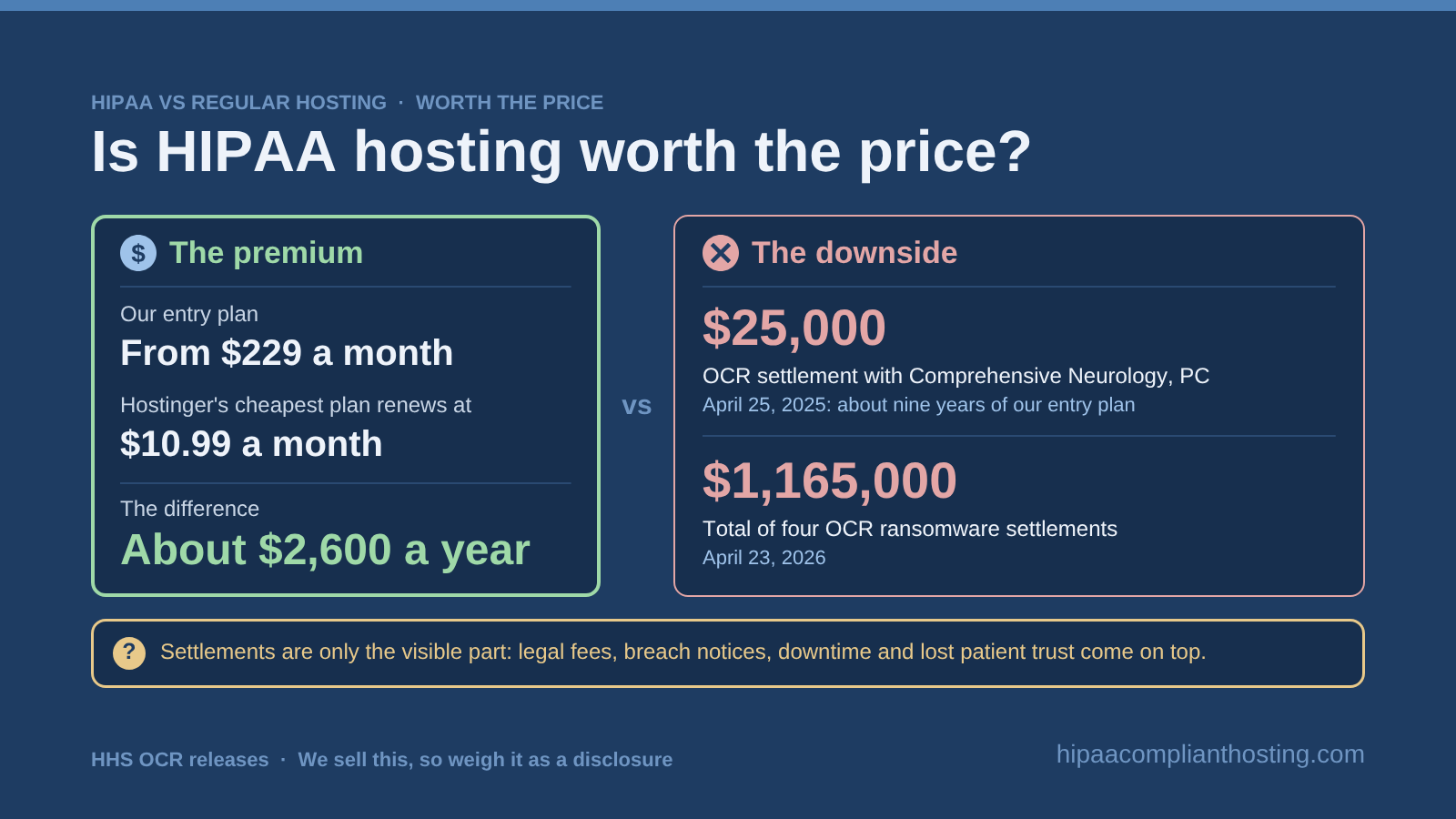
The fair way to judge HIPAA hosting vs regular hosting is to compare the premium with the downside. Start with the premium. Our entry plan is $229 a month. Hostinger's cheapest plan renews at $10.99. The difference is about $2,600 a year.
Now the downside. These are settlement figures OCR announced, as cited in our earlier posts and the HHS releases below.
April 25, 2025: OCR announced a $25,000 settlement with Comprehensive Neurology, PC, under its Risk Analysis Initiative. That one settlement equals about nine years of our entry plan.
April 23, 2026: OCR announced four ransomware settlements totaling $1,165,000.
Settlements are only the visible part. Legal fees, breach notices, downtime and lost patient trust come on top, and we will not guess at those numbers. Hosting alone does not cause or prevent these cases either. A weak risk analysis, missing backups and unpatched systems usually do. Those controls are what separate HIPAA hosting vs regular hosting. A HIPAA host runs them, and a $10 host leaves them to you.
There is also a timing risk. Under § 164.402, an impermissible disclosure is presumed to be a breach unless a documented assessment shows low risk. Patient data on a host with no BAA may count. Our HIPAA risk analysis guide covers how to document your position.
So is it worth it? If your site holds patient data, the question in HIPAA hosting vs regular hosting is not cost. A regular host cannot legally hold that data, at any price. If your site holds none, save the money.
How we handle HIPAA hosting vs regular hosting for you
This is the part we sell, stated plainly. If you have weighed HIPAA hosting vs regular hosting and need the first, here is what changes when you move to us.
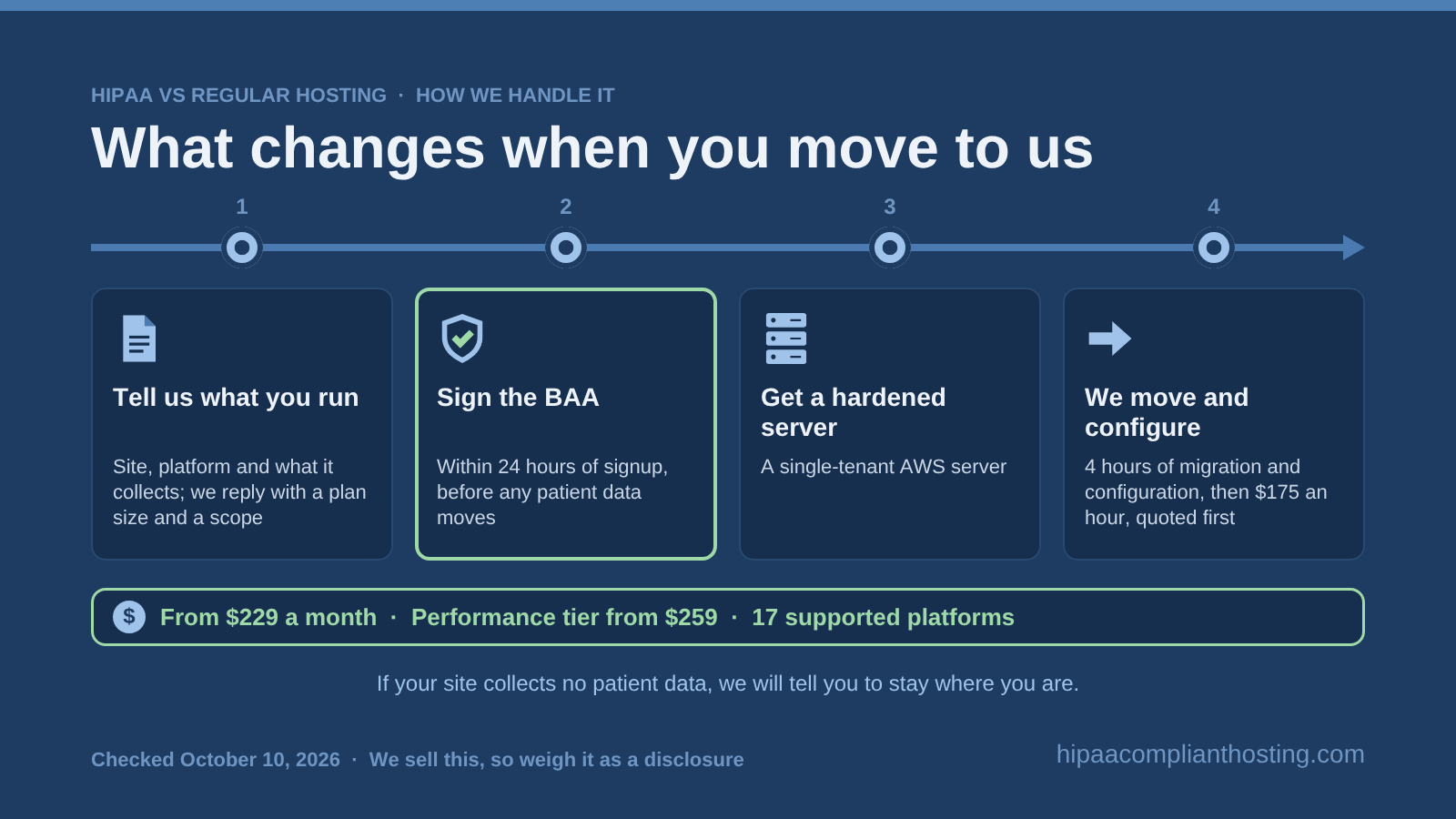
Tell us what you run. Send your site address, platform and what it collects. We reply with a plan size and a scope.
Sign the BAA. We sign within 24 hours of signup, before any patient data moves.
Get a hardened server. A single-tenant AWS server with CloudFront CDN, a web application firewall and encryption at rest and in transit. It also has six-year audit logging, tested encrypted backups and EBS storage with 7-day snapshot retention.
We move and configure your site. 4 hours of migration and configuration are included, used in the first month. After that, extra work is $175 an hour, quoted before it starts.
Stay month to month. Plans start at $229 a month with no long-term contract. The Performance tier for n8n, Drupal, Strapi, Docker and Phalcon starts at $259.
We support 17 platforms, including WordPress, Drupal, Joomla, Laravel, n8n and Docker. Most practices start with HIPAA compliant WordPress hosting. If you are ready to switch, our guide to migrating to HIPAA compliant hosting gives the 8 steps in order.
When are we the wrong choice? If your site holds no patient data, regular hosting is cheaper and fine. If you need root access or a multi-zone design, that is an Enterprise quote, not a standard plan. Each plan is one server in one AWS availability zone. HIPAA Compliant Hosting does not hold SOC 2 or HITRUST certification. Your email, SMS, form and EHR vendors need their own BAAs.
Frequently asked questions
How does HIPAA compliant hosting compare to regular hosting?
The core difference in HIPAA hosting vs regular hosting is the BAA. A HIPAA host signs one and runs the safeguards behind it: a single-tenant server, encryption, a firewall, audit logs and tested backups. A regular host refuses the BAA and shares servers.
Which is better, HIPAA compliant WordPress hosting or regular hosting?
It depends on the data. A WordPress site with no patient data can stay on regular hosting. A site whose forms or plugins store patient data needs a host that signs a BAA. Check every plugin, since WordPress itself is only one layer.
Is HIPAA compliant cloud hosting worth the price?
If you handle patient data, yes, because a regular host cannot legally store it. In HIPAA hosting vs regular hosting, the premium is a few thousand dollars a year. OCR settled with one neurology practice for $25,000 in 2025.
Why does HIPAA hosting cost 3 to 4 times more than standard hosting?
Often the gap is even larger. You pay for a single-tenant server instead of a shared one, plus encryption, logging, backups and a host that accepts BAA duties. In HIPAA hosting vs regular hosting, you are buying work and contract risk, not just disk space.
Can I use Bluehost, GoDaddy or Hostinger for a medical practice website?
Yes, if the site holds no patient data. As published on October 10, 2026, Bluehost says it does not sign BAAs. GoDaddy's and Hostinger's hosting terms say their hosting is not intended as a HIPAA compliant environment. For HIPAA hosting vs regular hosting, the BAA is the test, and none of these shared plans comes with one.
Is there cloud hosting cheaper than Azure that is still secure for healthcare data?
Possibly, depending on what you count. Azure includes a BAA, but you still configure and monitor everything above the infrastructure. A managed HIPAA host bundles that work. Compare the cloud bill plus engineer time against a managed plan.
Do I need HIPAA hosting if my booking and forms use HIPAA compliant vendors?
Not if your own server never stores or receives patient data. Embedded tools can still pass data through your site, so check where submissions land. If anything lands on your server, you need a host that signs a BAA.
Recap: HIPAA hosting vs regular hosting
The choice of HIPAA hosting vs regular hosting comes down to one question: does patient data touch your server? If not, a $10 to $30 host is fine. If it does, you need a host that signs a BAA and runs encryption, firewall, logging and tested backups. Regular hosts refuse that contract in writing, which settles HIPAA hosting vs regular hosting for any site with patient data. The premium is real but small next to one OCR settlement. We sign the BAA within 24 hours, on single-tenant AWS, from $229 a month, with 4 hours of migration and configuration included. Request a quote for your practice, or talk through your app's stack with an engineer. You can also compare our current plans.
This article is general information, not legal advice. It describes our own commercial service. Vendor terms and prices are as published on October 10, 2026, and may change. OCR settlement figures come from HHS releases we cited in earlier posts. Confirm your obligations with qualified counsel.
Sources
45 CFR § 164.308 (BAAs, data backup plan): law.cornell.edu
45 CFR § 164.312 (encryption, audit controls): law.cornell.edu
45 CFR § 164.316 (six-year documentation retention): law.cornell.edu
45 CFR § 164.402 (breach definition): law.cornell.edu
HHS OCR releases of April 25, 2025 and April 23, 2026
Regular hosts: Bluehost HIPAA disclaimer, Bluehost shared prices, GoDaddy Hosting Agreement, Hostinger hosting agreement, Hostinger prices, WP Engine
HIPAA hosts and clouds: Liquid Web HIPAA hosting, AWS HIPAA compliance, Microsoft Azure HIPAA offering
Our offer: scope of support