


HIPAA vendor risk assessment for your hosting provider: the questions and proof to ask for
HIPAA Compliant Hosting · https://hipaacomplianthosting.com/blog/hipaa-vendor-risk-assessment
Last updated: November 16, 2026
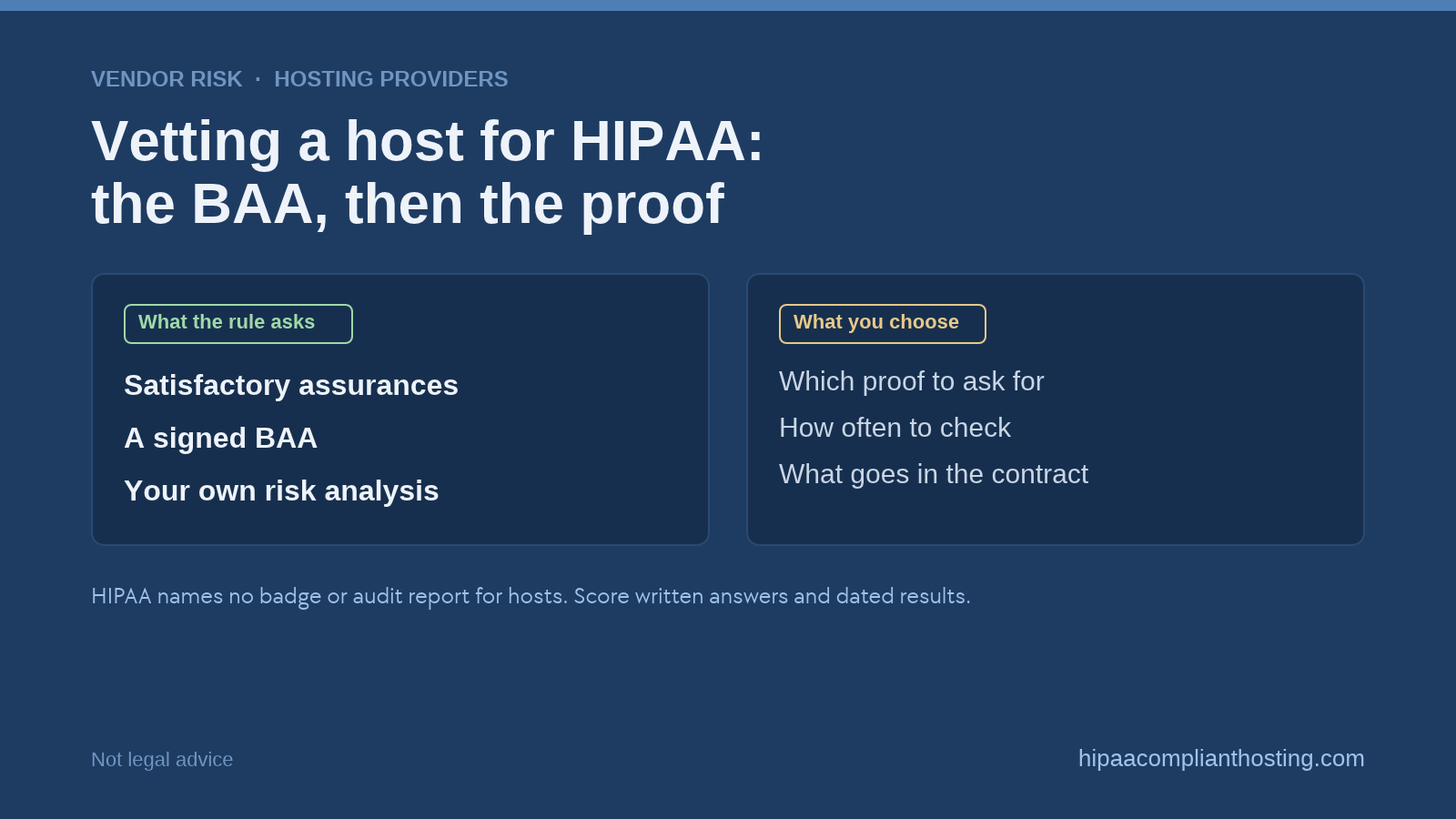
A HIPAA vendor risk assessment of a hosting provider checks two things. The first is a signed business associate agreement (BAA) that gives you satisfactory assurances. The second is a risk analysis that covers the systems where the host keeps your ePHI. HIPAA names no badge or audit report a host must hold. You choose the proof, so this guide shows what to ask for and how to read it.
A HIPAA vendor risk assessment is the review you run before a vendor handles your electronic protected health information (ePHI). You run it again on a set schedule. This guide is for security, compliance and procurement leads at health systems, multi-site groups and healthcare SaaS companies. We are HIPAA Compliant Hosting, and we sell managed hosting. Weigh the one marked section about our plans as a disclosure.
TL;DR: Quick answer
The rule. Under 45 CFR 164.308(b), you may let a host hold ePHI only after you get satisfactory assurances in a BAA that meets 164.314(a).
Your analysis. HHS says you should understand the host's setup so you can run your own risk analysis. Your HIPAA vendor risk assessment feeds it.
Your choice of proof. HIPAA names no audit report or badge for vendors. You decide what proof to ask for, and you write it into the contract.
Two layers. A managed host sits on a cloud platform. Ask who runs each layer and what proves it.
A proposed yearly check. HHS has proposed a yearly written check from each business associate. As of November 16, 2026, it is still a proposal.
What is a HIPAA vendor risk assessment?
A HIPAA vendor risk assessment is a written review of whether a vendor can protect your ePHI, and what risk is left for you. For a host, it decides if the host can go live, and on what terms.
The duty starts in the Security Rule. Under 164.308(b)(1), a covered entity may let a business associate create, receive, maintain or transmit ePHI only after it obtains satisfactory assurances. Under 164.308(b)(3), those assurances go into a written contract that meets 164.314(a). Our guide to the business associate agreement covers each clause.
The second source is your own risk analysis. Under 164.308(a)(1)(ii)(A), it must be an accurate and thorough assessment of risks to the ePHI you hold. Moving that ePHI to a host does not take it out of scope. HHS says a customer should understand a cloud provider's environment so it can run its own risk analysis. Our HIPAA risk analysis guide lists what that analysis must cover. For background on hosting terms and costs, see our HIPAA compliant hosting guide.
The chain keeps going. Under 164.308(b)(2), your host must get the same assurances from any subcontractor that handles ePHI. So a HIPAA vendor risk assessment of a host also asks about the vendors behind it.
Does HIPAA require a specific audit report from your host?
No. HIPAA does not require a host to hold any named audit report or badge. HHS's Office for Civil Rights (OCR) says it does not endorse, certify or recommend specific technology or products. AWS says there is no HIPAA certification for a cloud service provider.
HHS also says the HIPAA Rules do not expressly require a cloud provider to show customers its security practices, or to allow audits. You can still require both in the BAA, a service level agreement or another contract. That is why a HIPAA vendor risk assessment rests on proof you choose, not on rule text.
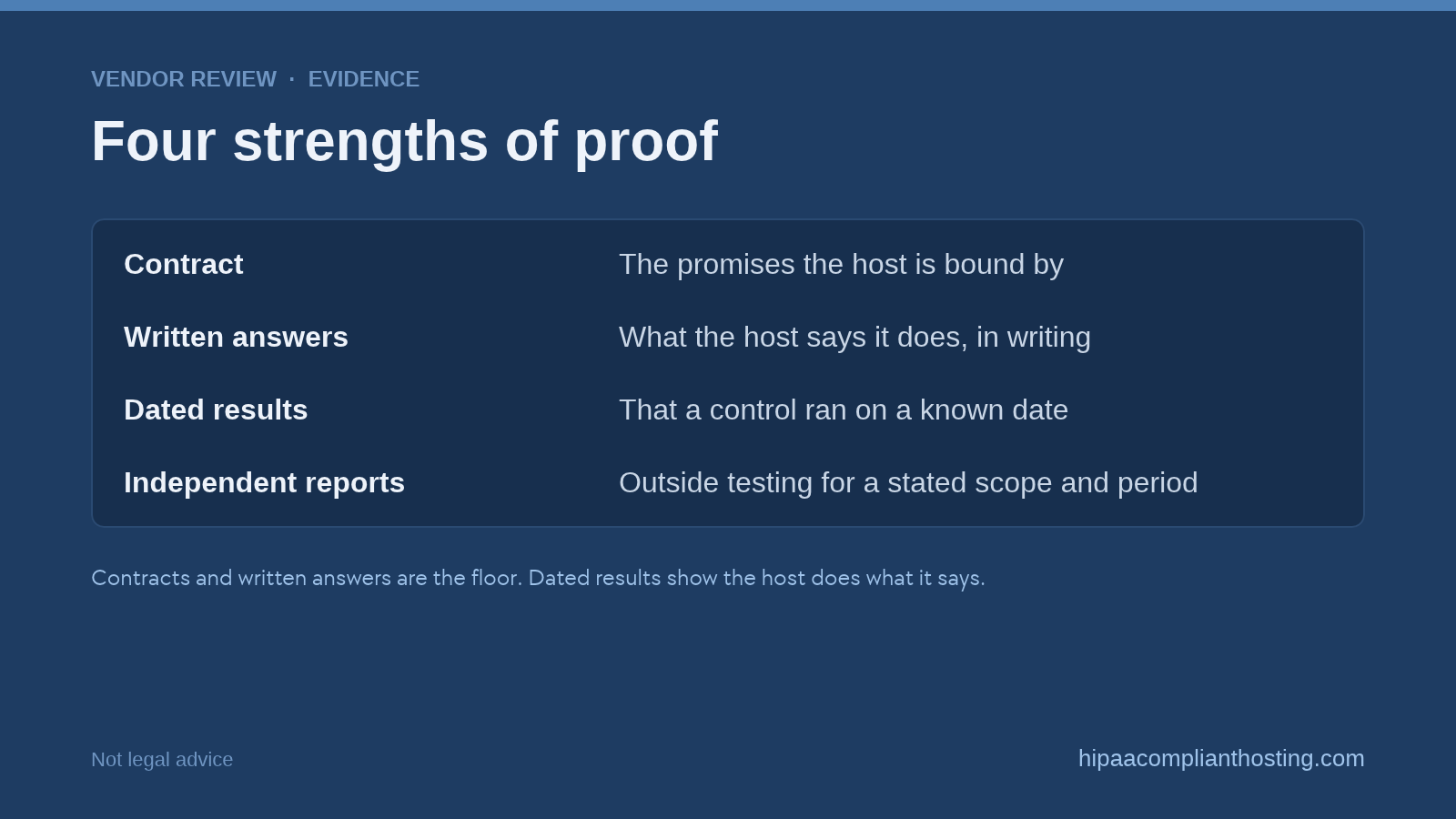
Proof comes in four strengths. In a HIPAA vendor risk assessment, rank what each host gives you before you score it.
Strength | Examples | What it shows | What it does not show |
|---|---|---|---|
Contract | Signed BAA, named service list, notice terms | The promises the host is bound by | That controls work in practice |
Written answers | Questionnaire, responsibility matrix, policies | What the host says it does, in writing | Independent testing |
Dated results | Restore test, access review, scan or pen test summary, log export sample | That a control ran on a known date | Anything outside the test scope |
Independent reports | An outside assessor's report, if your policy asks for one | Testing by a third party for a stated scope and period | Systems or teams outside that scope |
Contracts and written answers are the floor. Dated results show the host does what it says. If your policy calls for an outside report, read its scope and dates first.
What should the security questionnaire ask a hosting provider?
Ask about ten areas, and ask for a document or dated result behind each answer. Most of a HIPAA vendor risk assessment happens here. Many health systems send their own form. Others use a standard form. Two examples are the Shared Assessments Standardized Information Gathering (SIG) questionnaire and the Cloud Security Alliance Consensus Assessments Initiative Questionnaire (CAIQ). Either works if it covers the rows below.
Area | Question for the host | Evidence to ask for | Red flag |
|---|---|---|---|
BAA scope | Which services does your BAA cover? | The signed BAA and a named service list | "It covers everything" |
Subcontractors | Who else handles our ePHI? | A named subcontractor list | No list |
Responsibility | Who runs each layer, from facility to application? | A layer-by-layer responsibility matrix | Layers nobody owns |
Tenancy | What do we share with other customers? | A tenancy statement by layer | Vague isolation wording |
Access | Does every admin use a named account and multi-factor authentication (MFA)? | The access policy and a recent access review | Shared admin logins |
Encryption | Where is ePHI encrypted, and who holds the keys? | An encryption statement at rest and in transit | "Encrypted where possible" |
Logging | What do you log, for how long, and can we export it? | Log scope, retention and a sample export | No export path |
Recovery | How do you keep backups and test restores? | Backup design and a recent restore result | No test on record |
Incidents | How and when will you tell us about an incident? | Notice terms in the BAA | Only the 60-day outer limit |
Patching and testing | Who patches each layer, and when was the last scan? | A patch list by layer and a scan summary | "Security is the customer's job" |
The incident row matters most in a crisis. Under 164.410, a business associate must report a breach without unreasonable delay, and no later than 60 calendar days after discovery. Your BAA can set a shorter window. Our glossary entry on the breach notification rule covers the timing.
For the RFP version of these questions, see our hosting RFP checklist. The RFP picks a host. The HIPAA vendor risk assessment checks the evidence before go-live and every year after.
Which proof should you ask a host to show?
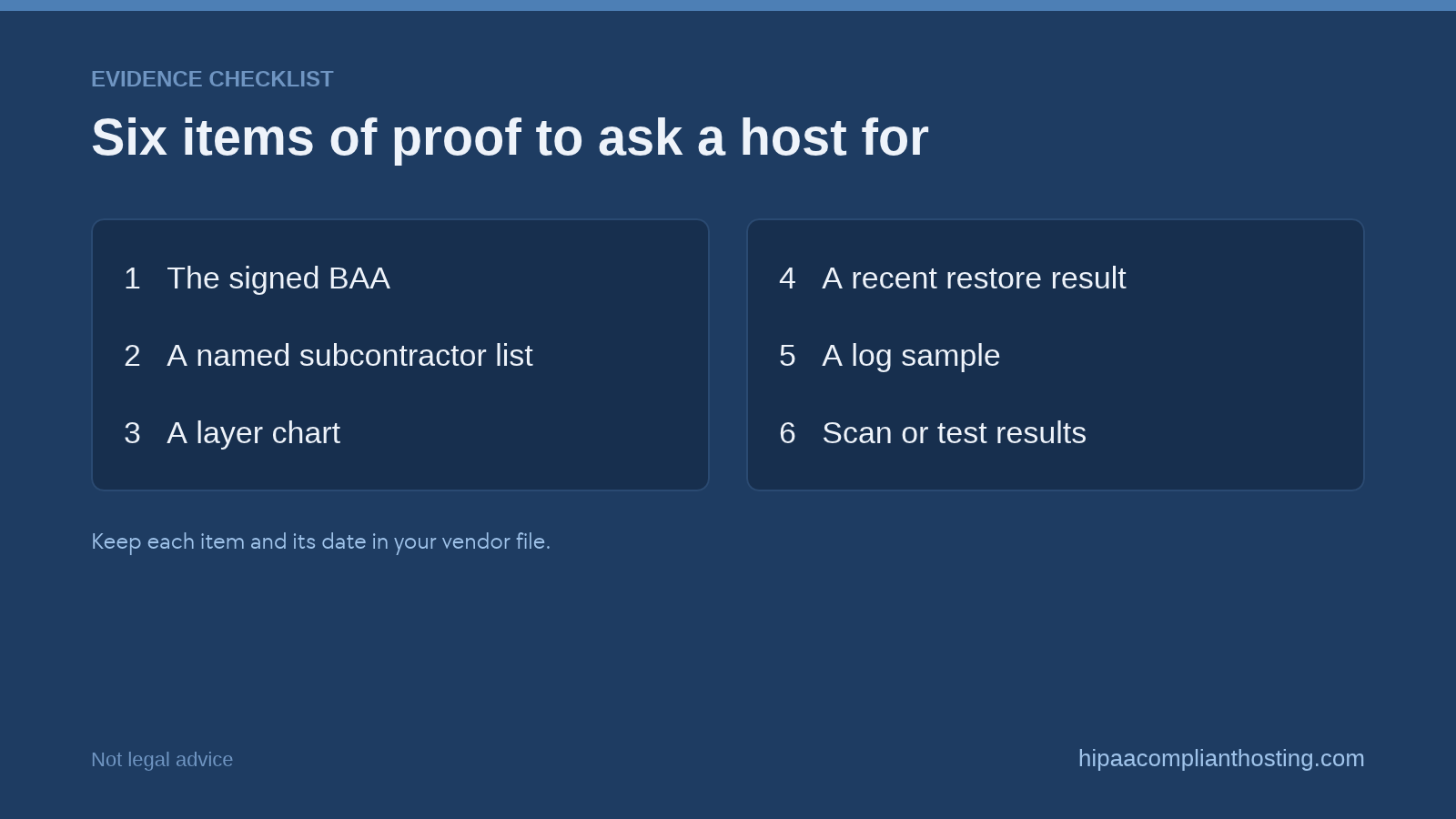
Ask for proof you can date and test. A HIPAA vendor risk assessment is only as strong as its weakest proof, so ask for these six items.
The signed BAA. Read its service list against what you are buying.
A named subcontractor list. Include the cloud platform under the host.
A layer chart. Often called a responsibility matrix. One row per layer, with an owner and the proof for each.
A recent restore result. The contingency plan standard asks for backups and a plan to recover. A test shows they work.
A log sample. Under 164.312(b), the host needs systems that record and examine activity. A sample shows you can get the records out.
Scan or test results. A recent vulnerability scanning summary, or a penetration testing summary with fix dates.
Keep each item and its date in your vendor file. Our guide to HIPAA audit logs explains what a log export should hold.
How do you check a host that runs on AWS?
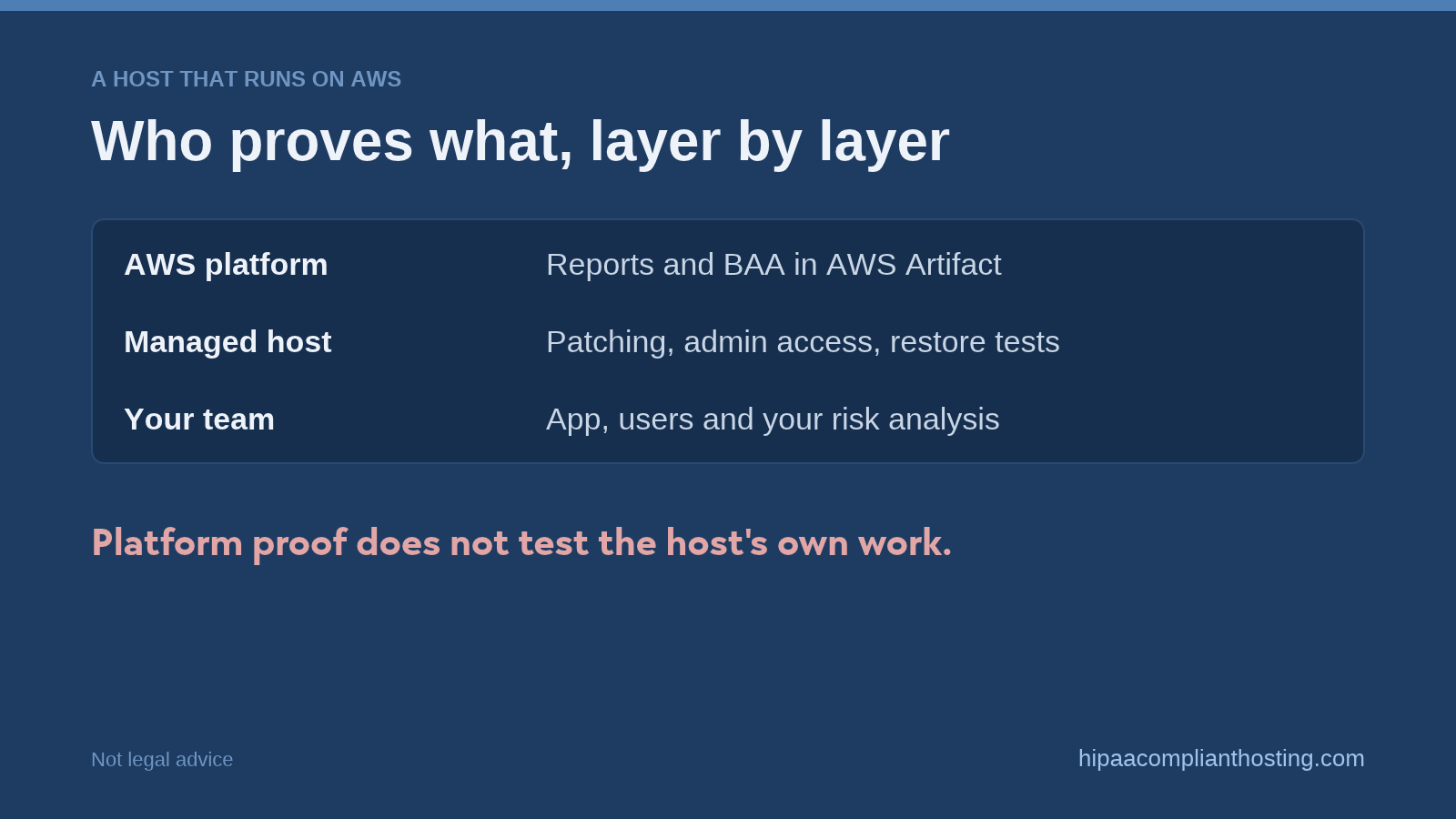
Check the two layers apart. AWS has its own proof for the platform. The managed host needs its own proof for the work it does on top.
AWS publishes its compliance reports and its Business Associate Addendum through AWS Artifact. AWS also says customers should process, store and transmit PHI only with HIPAA eligible services. Our guide to AWS HIPAA eligible services lists the main ones.
None of that covers a managed host's own work, such as patching, admin access or restore tests. That split is the shared responsibility model. In your HIPAA vendor risk assessment, ask for a chart that names AWS, the host and your team for each layer. Then ask for the proof behind every row the host owns.
Architecture choices sit one step earlier. Our guide to HIPAA compliant infrastructure covers tenancy, zones and root access.
How do recognized security practices fit a vendor review?
They give you one yardstick for every vendor. Public Law 116-321, signed January 5, 2021, tells HHS to consider whether an entity had recognized security practices in place for the prior 12 months. HHS weighs that when it sets fines, audit results and remedies.
The law points to practices developed under the NIST Act and to approaches under section 405(d) of the Cybersecurity Act of 2015. It does not let HHS raise a penalty because an entity lacks them. So your HIPAA vendor risk assessment can ask each host which framework it follows, and since when.
NIST's Cybersecurity Framework 2.0 gives vendor risk its own group, called supply chain risk management (GV.SC). NIST SP 1305, published October 21, 2024, is a quick-start guide for that category. It suits teams that are building their first vendor program.
What would the proposed Security Rule add to vendor reviews?
It would make part of each HIPAA vendor risk assessment a yearly rule. HHS proposed the update on January 6, 2025. As of November 16, 2026, it is still a proposal, and the federal agenda estimates a final rule for July 2027.
If finalized as proposed, business associates would have to verify their technical safeguards to covered entities at least once every 12 months. The check would be a written review by a subject matter expert. A signed statement would confirm the review was done and is accurate.
Business associates would also have to tell covered entities within 24 hours after they activate a contingency plan. Our post on the new HIPAA Security Rule tracks its status.
None of this is law yet. Many buyers already add a yearly check to the BAA and to their HIPAA vendor risk assessment. If you do, label it as your term, not current rule text.
How should you tier vendors, and how often should you reassess?
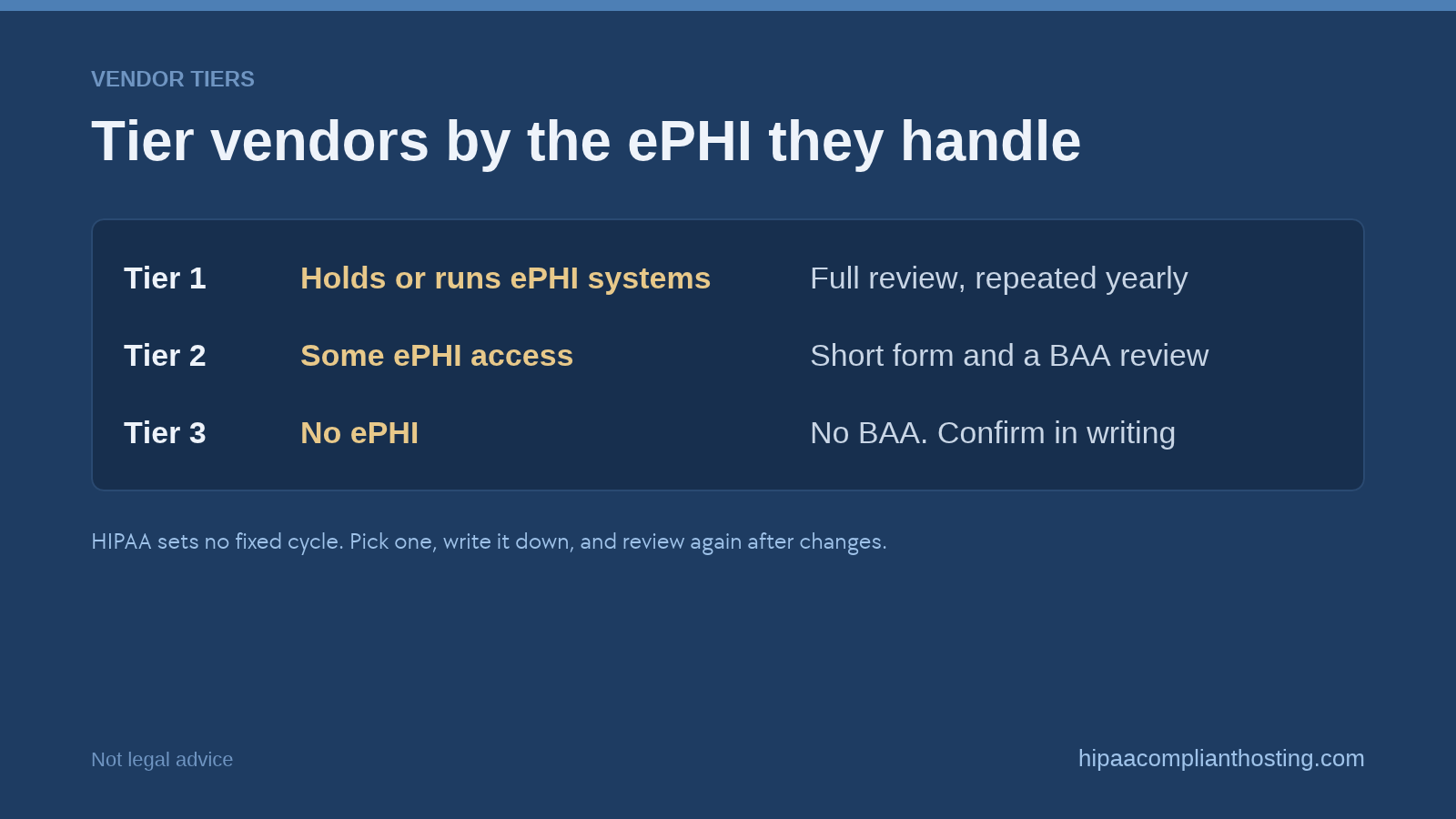
Tier each vendor by how much ePHI it handles and how much breaks when it fails. A host that runs your patient portal sits in the top tier. A vendor that never sees ePHI needs no BAA at all.
Tier 1: holds or runs ePHI systems. Hosts, EHR vendors and clearinghouses. A full HIPAA vendor risk assessment, repeated each year.
Tier 2: some ePHI access. Support, email or form tools. A short form and a BAA review.
Tier 3: no ePHI. No BAA. Confirm in writing that no ePHI reaches them.
HIPAA sets no fixed cycle, so pick one and write it down. Yearly is a common choice for Tier 1. The evaluation standard in 164.308(a)(8) also calls for a review after changes in your setup or operations. A new subcontractor, a new data location or a merger should restart the HIPAA vendor risk assessment.
Plan for the day a vendor fails. In its Change Healthcare guidance, OCR said a covered entity may delegate breach notices to its business associate. The covered entity is still ultimately responsible for making sure they happen. HHS reported about 192.7 million people affected as of July 31, 2025.
The Health Sector Coordinating Council released its SMART toolkit on October 7, 2025. It helps teams map which vendors could cause a wide outage. Recovery planning still starts with your own HIPAA backup and disaster recovery plan.
Which answers should pause a vendor review?
Five answers should pause the review until the host fixes them in writing.
No BAA before data moves. 164.308(b) requires the assurances first.
A BAA that covers "everything." Ask for the named services.
No subcontractor list. The host must pass its BAA terms down the chain.
Platform proof only. The cloud platform's reports do not test the host's own work.
A badge as the answer. HHS offers no HIPAA badge for hosts, so a badge never replaces your review.
Score only what the host puts in writing. A HIPAA vendor risk assessment built on spoken promises will not hold up if OCR asks how you chose the vendor.
How do our standard plans answer a vendor review?
Here is how our standard plans answer the main rows of a HIPAA vendor risk assessment. We sell this, so weigh it as a disclosure.
BAA. We sign the BAA within 24 hours of signup, before patient data moves. Our BAA covers the servers and services we run. Email, SMS, EHR, form and AI model vendors need their own BAA.
Tenancy. Single-tenant AWS. Each plan is one server in one AWS availability zone.
Safeguards. Every plan includes CloudFront CDN, a web application firewall (WAF), encryption at rest and in transit, six-year audit logging and tested encrypted backups.
Recovery. Point-in-time recovery from EBS snapshots, kept for 7 days. A multi-zone design is quoted separately.
Patching. Our team applies OS and PHP updates. Your application code, CMS, plugins, themes, modules and extensions, and their updates, stay with you.
Control. Fully managed infrastructure. Root access comes only with an Enterprise engagement.
Six sizes, Starter to Network. Monthly plans have no long-term contract. Managed plans from $229 a month.
When do you not need us?
In three common cases, you may not need us, or not a standard plan.
Your team already runs its workloads on a cloud under an accepted BAA, and patches the operating system itself. Our guide to managed vs self-managed HIPAA hosting sets out the trade-off.
Your vendor review calls for more than one availability zone on day one. Standard plans are one server in one zone, so you need a quoted multi-zone design or another host.
The system is a vendor's SaaS product, such as an EHR. That vendor hosts it and signs its own BAA.
If one managed server fits a workload, send your questionnaire and scope your network's infrastructure with us.
Frequently asked questions
What is a HIPAA vendor risk assessment?
It is a written review of a vendor that will handle your ePHI. It confirms the BAA gives satisfactory assurances under 164.308(b). It also feeds your own risk analysis under 164.308(a)(1)(ii)(A).
Does HIPAA require a host to hold an audit report or badge?
No. HIPAA names no audit report or badge for vendors, and HHS certifies no cloud provider. You can require the evidence you want in the BAA or another contract.
Is the cloud platform's evidence enough for a managed host?
No. The platform's reports cover the platform. They do not test the host's own staff, servers or processes. Ask the host for a layer chart and proof for its own layer.
How often should you reassess a hosting vendor?
Repeat the HIPAA vendor risk assessment yearly for a vendor that holds ePHI, and after major changes. HIPAA sets no fixed cycle. HHS has proposed a yearly written check from business associates, but as of November 16, 2026, it is still a proposal.
Can a host refuse a security questionnaire or audit?
Yes, unless your contract says otherwise. HHS says the HIPAA Rules do not expressly require a cloud provider to allow audits. Put documentation or audit rights in the BAA before you sign.
Recap: HIPAA vendor risk assessment
A HIPAA vendor risk assessment of your host rests on a signed BAA and your own risk analysis. HIPAA names no badge, so you choose the proof and write it into the contract. Check the platform and the host as two layers. Score only written answers and dated results, and check again each year.
This article is general information, not legal advice. Rules, guidance and the proposed Security Rule are as read on November 16, 2026, and they can change. Base vendor decisions on your own risk analysis, and ask counsel about contract terms. We sell HIPAA compliant hosting. Reviewed November 2026.
Sources
HHS: Guidance on HIPAA and cloud computing and FAQ on cloud provider documentation and audits.
HHS: FAQ on cloud provider endorsements and Change Healthcare cybersecurity incident FAQs.
Proposed Security Rule: Federal Register, January 6, 2025 (90 FR 898), the HHS fact sheet and agenda entry, RIN 0945-AA22.
Congress: Public Law 116-321 (January 5, 2021).
AWS: HIPAA compliance page and compliance FAQs.
NIST: Cybersecurity Framework 2.0 and SP 1305, CSF 2.0 quick-start guide for supply chain risk management (October 21, 2024).
Health Sector Coordinating Council: SMART toolkit release (October 7, 2025).