


Managed HIPAA Hosting: The Problems We Solve and Exactly What You Get
HIPAA Compliant Hosting · https://hipaacomplianthosting.com/blog/managed-hipaa-hosting
Last updated: July 8, 2026
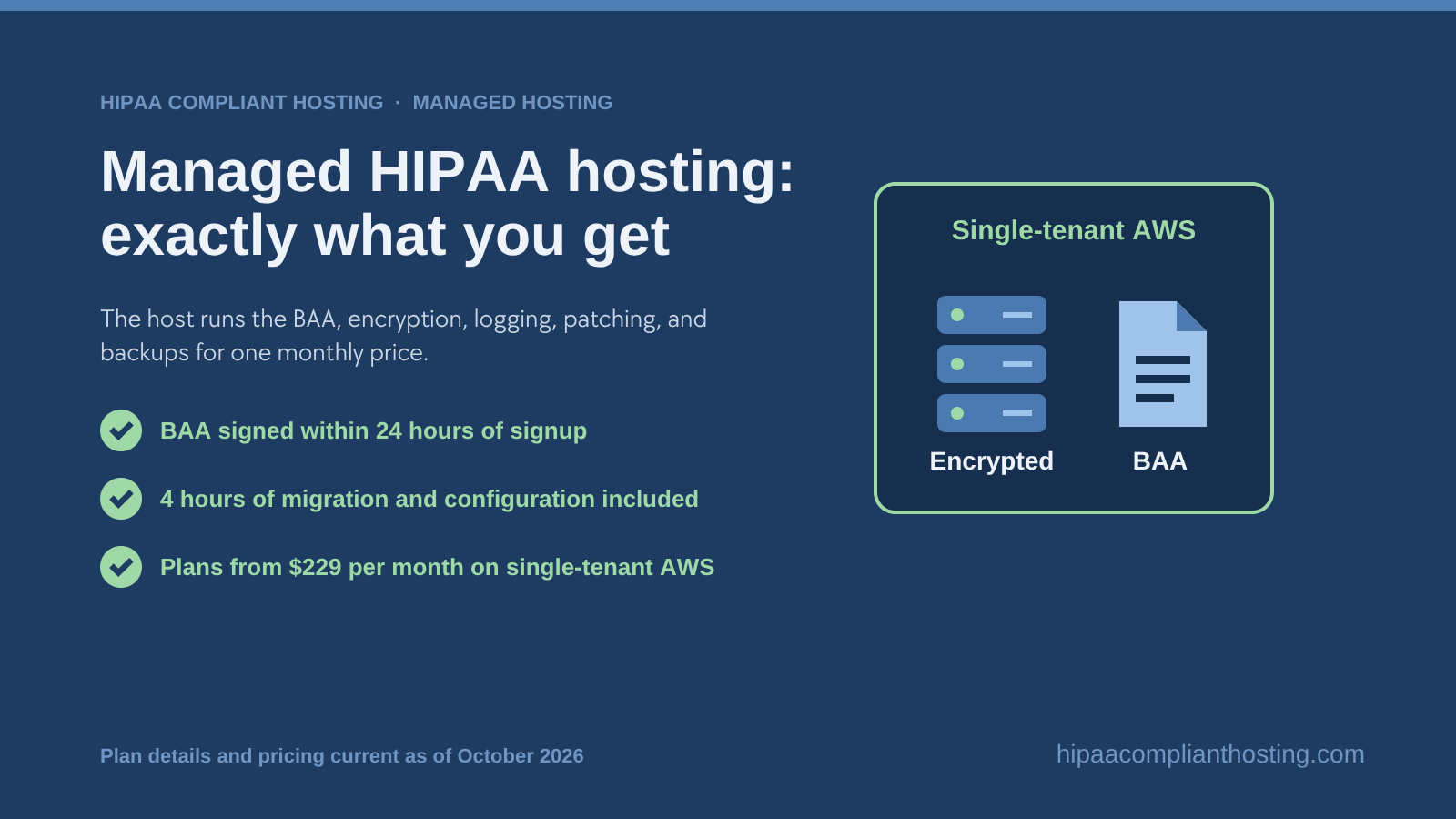
Managed HIPAA hosting is a service where the provider runs the compliant infrastructure for you: the signed Business Associate Agreement (BAA), encryption, access controls, audit logging, patching, monitoring, and tested backups, all for one monthly price. You run your practice or product. The host runs the safeguards at 45 CFR § 164.312. One thing to be clear about up front: this page is our pitch. We are HIPAA Compliant Hosting, we sell managed HIPAA hosting starting at $229 per month, and everything below is us explaining what we do and for whom. We have kept it factual so you can hold us to it. Here are the five problems that bring healthcare teams to us, and exactly what we do about each one.
TL;DR: Quick answer
Managed HIPAA hosting means the host configures and operates the Security Rule safeguards, under a BAA, so your team does not have to.
Our plans start at $229 per month on single-tenant AWS: BAA signed within 24 hours of signup, 4 hours of migration and configuration, encryption at rest and in transit, a web application firewall, six-year audit logging, and tested encrypted backups.
Migration to us has no compliance gap: the BAA is signed before any patient data moves, and data moves encrypted.
Four services cover the common cases: WordPress hosting for practices, cloud hosting for healthcare software, healthcare hosting for multi-site groups, and a client-side compliance review for tracking-script risk.
If a cheaper architecture fits your situation, we say so. Some sites do not need HIPAA hosting at all.
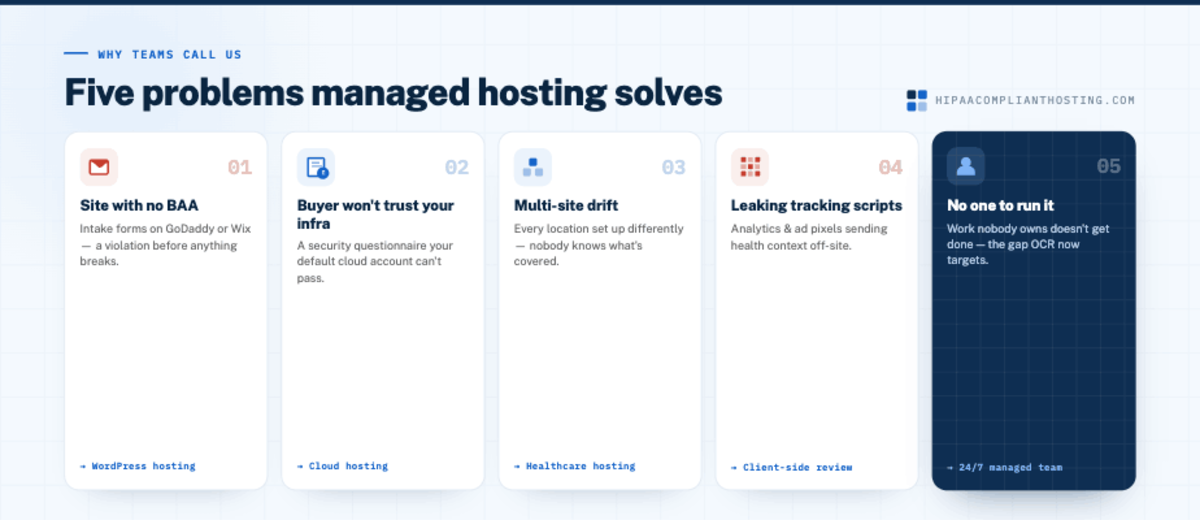
Problem 1: your website collects patient data on a host with no BAA
This is the most common call we get. A practice built its site on GoDaddy, Bluehost, or Wix years ago. Then someone added an intake form, an appointment request, or a symptom checklist. Now patient data flows through a host that signs no BAA, which is a violation under 45 CFR § 164.308(b) before anything even goes wrong.
What we do: our HIPAA compliant WordPress hosting moves your existing site onto a hardened, BAA-covered environment. 4 hours of migration and configuration are included and handled by us, the BAA is signed within 24 hours of signup, and your forms land in encrypted storage instead of a plain inbox. Plans start at $229 per month. If you want to see what the move involves first, send us your site address and we will tell you exactly what would change.
Problem 2: your healthcare product needs infrastructure a buyer will trust
Healthtech and SaaS teams come to us mid-sales-cycle. A hospital or clinic buyer sent a security questionnaire, and "we run on a default cloud account" is not passing it. As a Business Associate you carry direct liability, and your buyers want proof of isolation, logging, and a clean BAA chain.
What we do: our managed HIPAA cloud hosting provisions single-tenant AWS environments that arrive pre-hardened: encryption with managed keys, a web application firewall, intrusion detection, six-year audit logging, and encrypted cross-region backups. You get a responsibility matrix to hand your buyer, and infrastructure answers for the questionnaire instead of apologies. The full checklist your buyer is working from is in our guide to HIPAA compliant hosting for healthcare SaaS. When the workload is a database or file store full of patient records, our ePHI hosting gives it a single-tenant home.
Problem 3: you run multiple locations and compliance drifts at every new site
Clinic groups tell us the same story: each location was set up at a different time, by a different vendor, to a different standard. Nobody can say which sites have encryption, whose logs go where, or whether the BAA covers the newest office.
What we do: our healthcare hosting puts the whole network on one platform under one BAA, with role-based access that respects site boundaries and audit logs that name the location. Every new site inherits the same safeguards on day one. The multi-site playbook, including the two legal structures that shape who can see what, is in HIPAA compliant hosting for multi-location clinics.
Problem 4: your tracking scripts may be leaking patient data right now
Kaiser's 13.4 million record exposure came from advertising pixels, not hackers. Practices routinely discover Google Analytics or the Meta Pixel running on booking pages, sending identity plus health context to vendors that will never sign a BAA.
What we do: our client-side compliance review is a one-time audit of every script, cookie, form, and third-party tool on your key pages, returned as a findings report with risk levels and clear fixes. It pairs with the hosting but does not require it. You can run the 15-minute self-check in our HIPAA tracking technologies guide first; the review is for documenting it properly.
Problem 5: you have no one to run any of this
The most honest reason teams choose managed HIPAA hosting: the practice manager is not a sysadmin, the developer left, or the IT company that "handles the website" has never read the Security Rule. Compliance work that nobody owns does not get done, and OCR's current enforcement initiative targets exactly that gap.
What we do: all plans include our 24/7 HIPAA-trained team, monitoring, patching, and support from people who work in healthcare hosting all day. You get a named point of contact, not a ticket queue lottery.
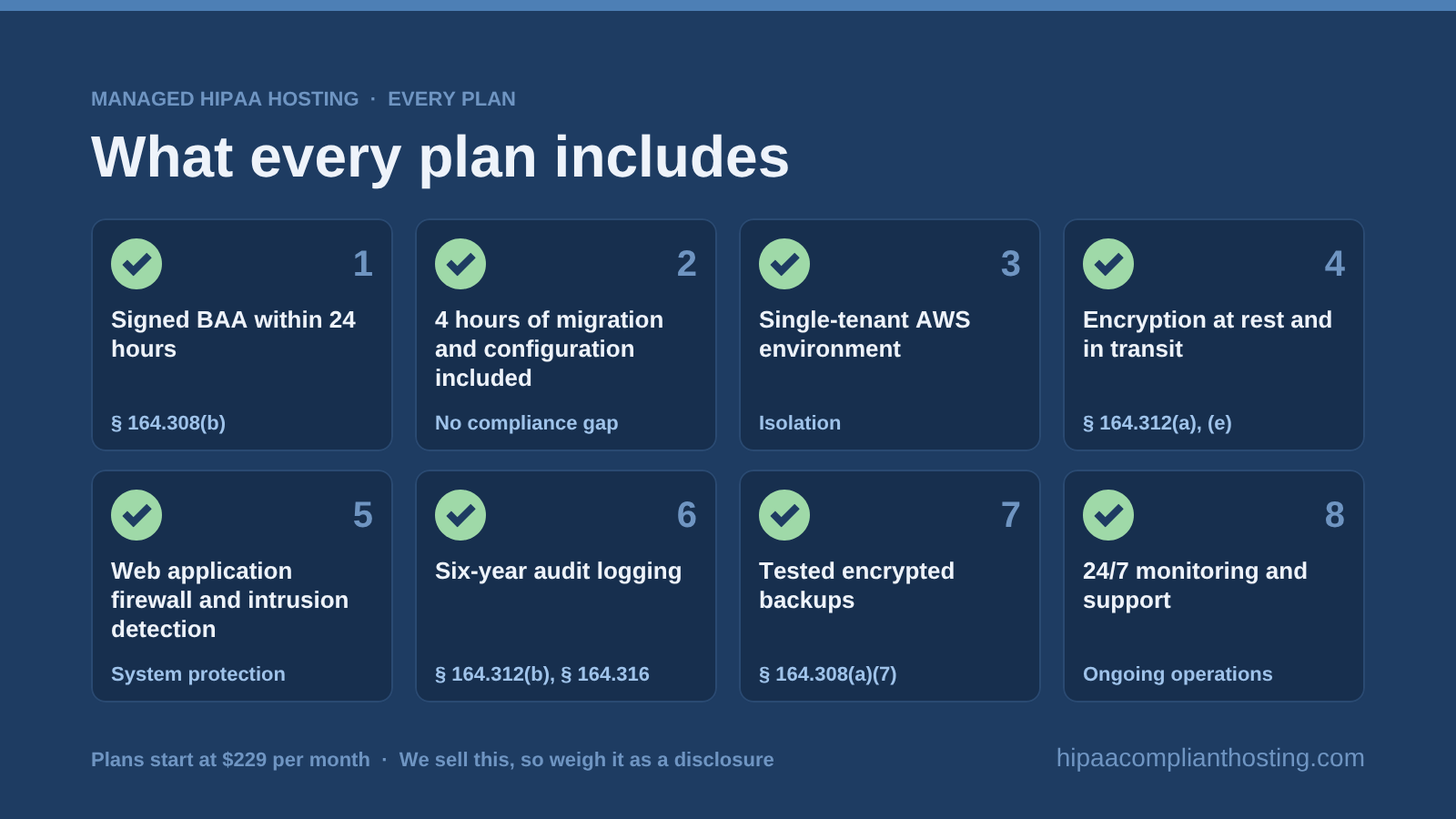
What every plan includes
Included | What it means | Rule it serves |
|---|---|---|
Signed BAA within 24 hours | Legal coverage before any data moves | § 164.308(b) |
4 hours of migration and configuration | We move your site; elsewhere this runs $500 to $2,500 | No compliance gap |
Single-tenant AWS environment | No other customers on your infrastructure | Isolation |
Encryption at rest and in transit | AES-256 storage, TLS 1.2 or higher | § 164.312(a), (e) |
Web application firewall and intrusion detection | Attacks filtered before they reach ePHI | System protection |
Six-year audit logging | Reviewable records, retained to the documentation rule | § 164.312(b), § 164.316 |
Tested encrypted backups | Restores we have actually run | § 164.308(a)(7) |
24/7 monitoring and support | A HIPAA-trained team watching the environment | Ongoing operations |
Plans start at $229 per month and scale with traffic and environments. Every tier and what it includes is listed on our pricing page. The market context for those numbers is in our 2026 HIPAA hosting cost guide, and how we stack up against the other specialists is in our own comparison of HIPAA Vault alternatives, disclosure included. The boundary between customers matters too. That is covered in client-level isolation. If you also process card payments, PCI compliant hosting explains how that standard differs from HIPAA.
How switching works, without a compliance gap
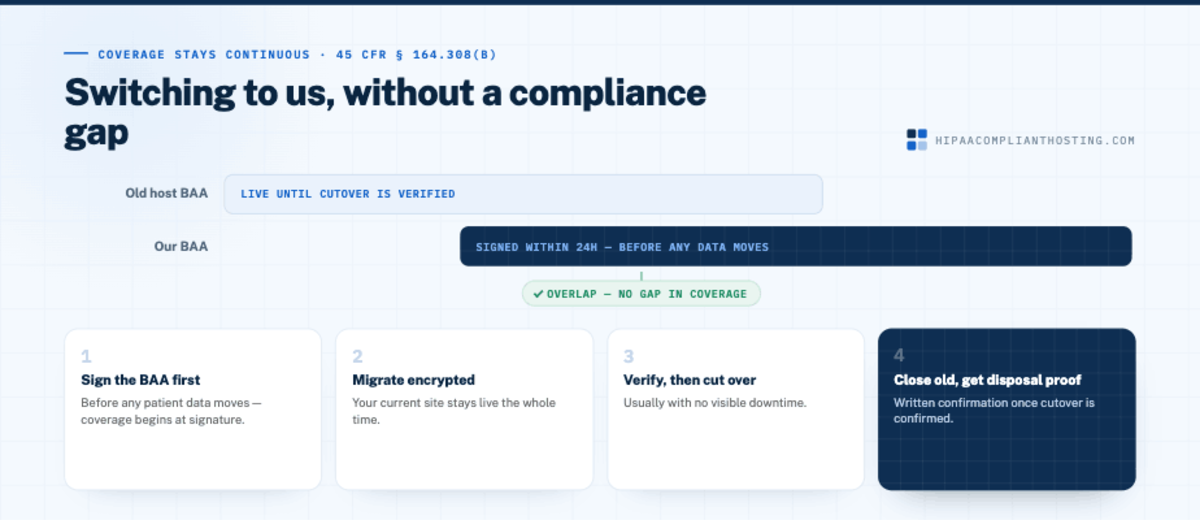
Fear of the move keeps many teams on non-compliant hosting for years. The process is simpler than the fear. We sign the BAA first, before any patient data moves. We migrate your site and data over encrypted channels while your current site stays live. We verify everything on the new environment, then cut over, usually with no visible downtime. You close the old account once cutover is confirmed and get written confirmation of disposal. Coverage stays continuous the entire time, which is what keeps the switch compliant under 45 CFR § 164.308(b). Our step-by-step migration plan walks through each stage in detail.
When we tell you not to buy
Managed HIPAA hosting is the wrong purchase for a site that never touches patient data. A brochure site with a phone number does not need us, and we say so when asked; the test is in who needs HIPAA-compliant hosting. Teams with cloud engineers on staff can also build this themselves on AWS, and our guides show how. The honest positioning is this: we exist for the teams that need the safeguards done right and do not have the people to do them. That is HIPAA compliant hosting as a managed service. If you are still comparing managed providers, we weigh Atlantic.Net and its alternatives in a separate article.
Frequently asked questions
What does managed HIPAA hosting include?
A signed BAA, single-tenant infrastructure, encryption at rest and in transit, a web application firewall, audit logging with six-year retention, tested encrypted backups, patching, and 24/7 monitoring, operated by the host. Our plans include all of it from $229 per month, with 4 hours of migration and configuration included.
How fast can we be covered by a BAA?
We sign the BAA within 24 hours of signup, and always before any patient data moves to us. Coverage begins at signature, not at migration.
Will switching hosts take my site down or break compliance?
No. Your current site stays live during the encrypted migration, cutover happens after verification, and the BAA overlap means there is no coverage gap at any point.
What does managed HIPAA hosting cost?
Our plans start at $229 per month for a managed single-tenant environment. Across the market, managed plans run roughly $120 to $600 for small practices and more for software platforms and networks. Migration elsewhere typically adds $500 to $2,500; ours includes 4 hours of migration and configuration. If budget is the main constraint, start with the cheapest HIPAA compliant hosting options. Deciding between the tiers is covered in managed vs self-managed HIPAA hosting. For anyone comparing against a low-cost shared plan, here is what the price gap over regular hosting buys.
What if managed HIPAA hosting is not the right fit for us?
Then we say so. Sites with no patient data need ordinary hosting, and engineering-heavy teams may prefer building on AWS directly. Send us your setup and we will give you a straight answer either way.
Get a straight answer this week
Tell us what your site or product stores, who your clients are, and what is bothering you about your current setup. We respond from our Portland office with a specific recommendation and a quote within 24 hours, including "you do not need us" when that is the truth. Request your quote, or start with the service that matches your problem above. To see the tier that fits, request a quote.
Recap: managed HIPAA hosting
To recap, managed HIPAA hosting hands the compliance layer to a host that runs it all day: the BAA, encryption, isolation, logging, backups, and monitoring. Ours starts at $229 per month on single-tenant AWS, with the BAA signed in 24 hours and 4 hours of migration and configuration included. The five problems it solves are the no-BAA website, the unconvincing product infrastructure, the drifting multi-site network, the leaking tracking scripts, and the compliance work nobody owns. This page is our pitch; the linked guides are the criteria to judge it by.
This article describes our own commercial services and is also general information, not legal advice. Plan details and pricing are current as of October 2026 and may change; regulatory citations refer to the HIPAA Security Rule (45 CFR Part 164). Confirm your obligations with qualified counsel.
Sources
45 CFR § 164.308 (administrative safeguards, BAA provisions): ecfr.gov
45 CFR § 164.312 (technical safeguards): ecfr.gov
45 CFR § 164.316 (documentation requirements): ecfr.gov