


HIPAA compliant chatbot: the three BAAs you need, and where transcripts leak
HIPAA Compliant Hosting · https://hipaacomplianthosting.com/blog/hipaa-compliant-chatbot
Last updated: November 19, 2026
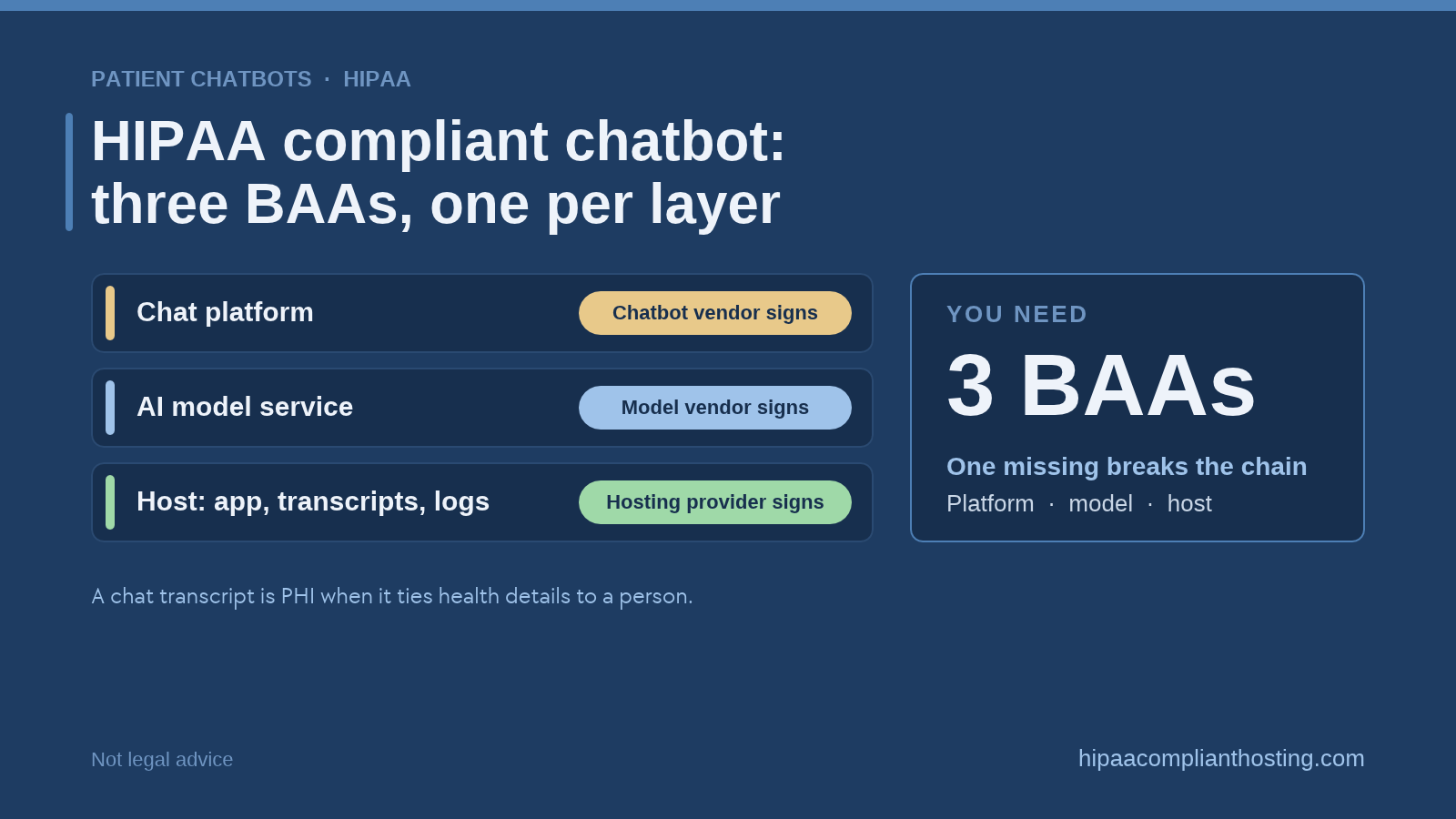
A HIPAA compliant chatbot is one where every vendor that touches patient messages has signed a business associate agreement (BAA). The transcripts are also protected like any other record. That usually means three contracts: the chat platform, the AI model service and the host that stores the conversations. No chatbot is compliant out of the box. The setup around it decides whether you have a HIPAA compliant chatbot.
This guide is for IT, security and compliance leads at health systems, multi-site groups and healthtech companies. The same steps work for a small clinic adding a chat window to its website. We are HIPAA Compliant Hosting, and we sell managed hosting, not chatbot software. Weigh the one marked section about our plans as a disclosure.
TL;DR: Quick answer
The test is simple. If the chatbot collects health details tied to a person, it handles protected health information (PHI), and HIPAA applies.
Count the vendors. A HIPAA compliant chatbot needs a BAA with the chat platform, the AI model service and the host. One missing contract breaks the chain.
Consumer AI accounts are out. A personal chatbot account with no BAA is not a route for PHI.
Transcripts are the risk. Conversations end up in logs, dashboards, email alerts and analytics tools. Each copy needs the same protection.
You can avoid PHI. A bot that only answers general questions, and never asks who the visitor is, may not need any of this.
What is a HIPAA compliant chatbot?
It is a chatbot that a covered entity or business associate can use with patient data without breaking the HIPAA rules. Two things make that true. Every vendor in the path has signed a BAA, and the Security Rule safeguards are in place for the stored conversations.
HIPAA does not certify software. The rule applies to how an organization uses a tool. So a HIPAA compliant chatbot is a result you build, not a product you buy. Our guide to the HIPAA business associate agreement covers what each contract must say.
When does a chatbot handle PHI?
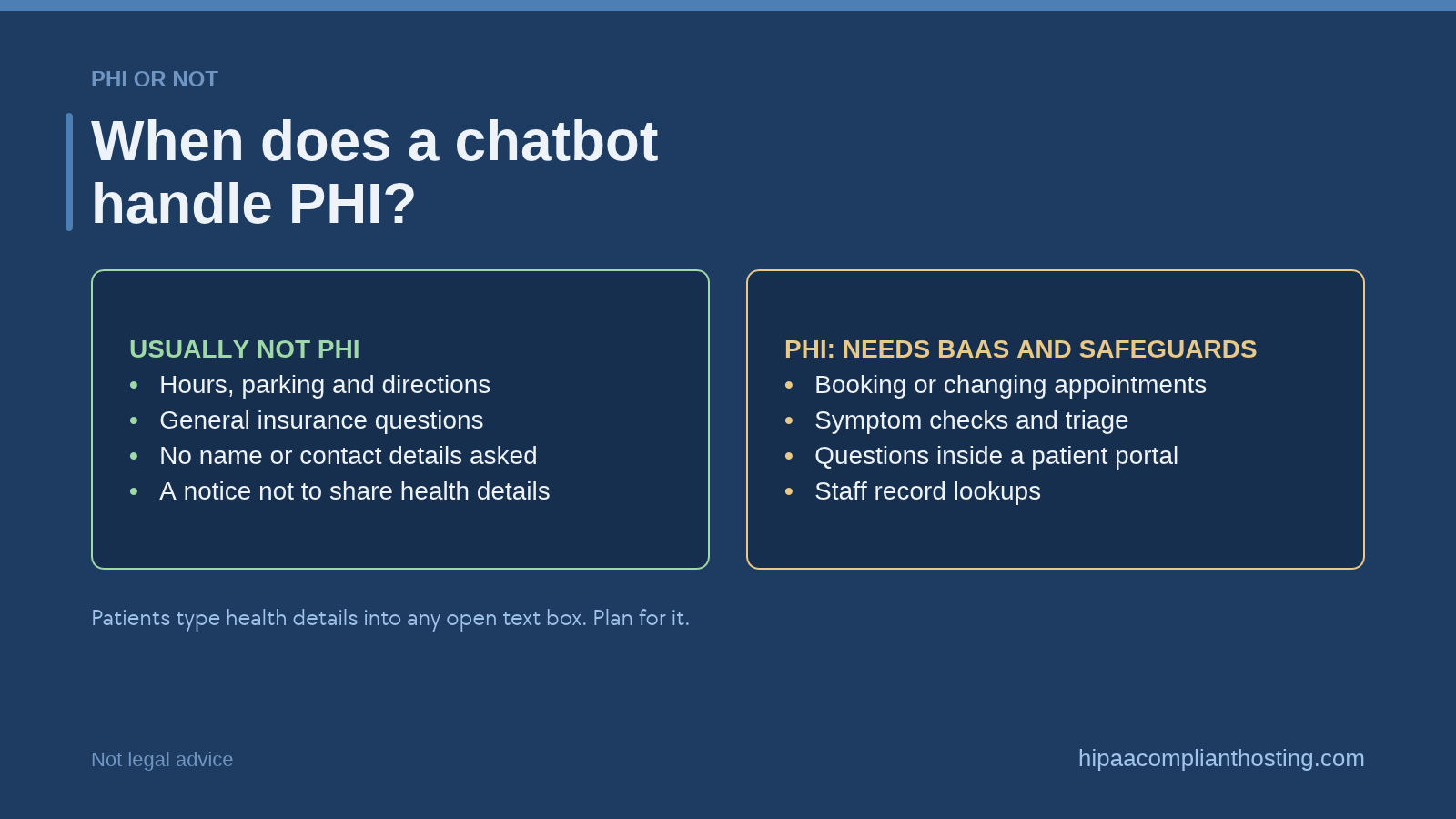
When it collects health information that can be tied to a person. HHS gives examples in its guidance on online tracking. It names a visitor who enters symptoms in an online tool, and a reason for seeking care that a visitor types or selects.
A chat window does the same thing in plain language. A patient types a name, a phone number and a symptom, and the transcript is PHI. From that point you need a HIPAA compliant chatbot.
What the chatbot does | PHI? | What it needs |
|---|---|---|
Answers hours, parking and insurance questions with no identity | Usually not | A clear notice not to share health details |
Books or changes appointments | Yes | BAAs and safeguards |
Checks symptoms or triages | Yes | BAAs and safeguards |
Answers questions inside a patient portal | Yes | BAAs and safeguards |
Helps staff look up or summarize records | Yes | BAAs, safeguards and access limits |
The first row has a catch. Patients type health details into any open text box. If the bot stores what they type, plan for PHI even when you did not ask for it.
Which vendors must sign a BAA for a HIPAA compliant chatbot?
Every vendor that creates, receives, maintains or transmits the conversation. For a HIPAA compliant chatbot, that is usually three layers.
Layer | What it does | Who signs |
|---|---|---|
1. The chat platform | The window on your site, the routing and the staff dashboard | The chatbot or live chat vendor |
2. The AI model service | Receives the message and writes the reply | The model or cloud vendor, for that exact service |
3. The host | Runs the app and stores transcripts, logs and backups | The hosting provider |
Some products combine layers. A cloud provider may run the model and the servers under one BAA. A chat platform may run everything on its own cloud. Ask each vendor which layers its BAA covers, and get the answer in writing.
Side tools count too. An analytics script on the chat page, an error tracker or an email alert that quotes the message each sends PHI to another vendor. Our guide to HIPAA tracking technologies covers the scripts.
Which AI services publish a BAA route?
The answer depends on the exact service, not the brand. These are the vendors' own statements, as read on the dates shown. Terms change often, so confirm each one before you build a HIPAA compliant chatbot on it.
Vendor | What its page says | Read on |
|---|---|---|
Google Cloud | Lists Conversational Agents and Gemini Enterprise Agent Platform as covered products | November 19, 2026 |
Anthropic | Says it provides a BAA covering its HIPAA-ready services, and names its first-party API and Enterprise plans | November 19, 2026 |
Microsoft | Says Copilot Studio is covered under its HIPAA BAA and is not intended for use as a medical device | November 17, 2026 |
AWS | Says PHI belongs only in its HIPAA eligible services. Check its list for the service you plan to use | November 18, 2026 |
Two limits apply to every row. A BAA covers the listed service, not everything the vendor sells. Google, for example, says that if you cannot disable a service, you must not use it for PHI. And some vendors set conditions. Anthropic says its covered models require 30-day data retention.
We did not recheck OpenAI's terms for this article, so read its current pages and get a BAA in place before any PHI use. Our guides to Microsoft Copilot and Google Cloud go deeper on those two.
Where do chatbot transcripts leak?
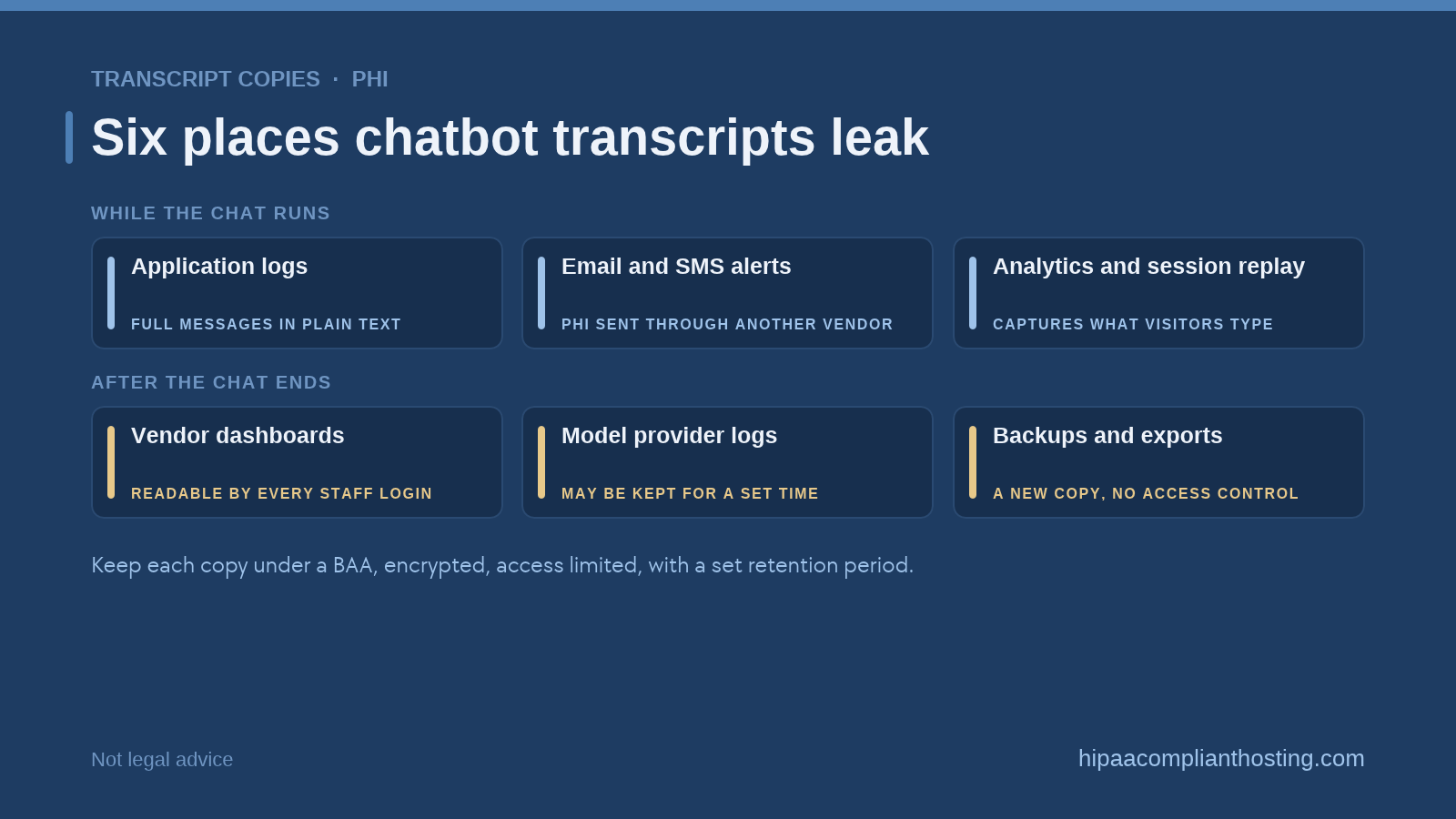
In the copies nobody planned for. A HIPAA compliant chatbot protects every one of them.
Application logs. Debug logging often writes the full message to a plain text file.
Vendor dashboards. Transcripts sit in the chat platform, readable by every staff login.
Email and SMS alerts. A "new chat" alert that quotes the patient sends PHI through another vendor.
Analytics and session replay. Scripts on the page can capture what the visitor types.
Model provider logs. Prompts and replies may be kept by the model service for a set time.
Backups and exports. A spreadsheet export of chats is a new copy with no access control.
The fix is the same for each. Keep the copy inside a system with a BAA, encrypt it, limit who can read it, and set how long it is kept. Our guide to HIPAA audit logs covers what to record without storing the clinical text.
How do you set up a HIPAA compliant chatbot?
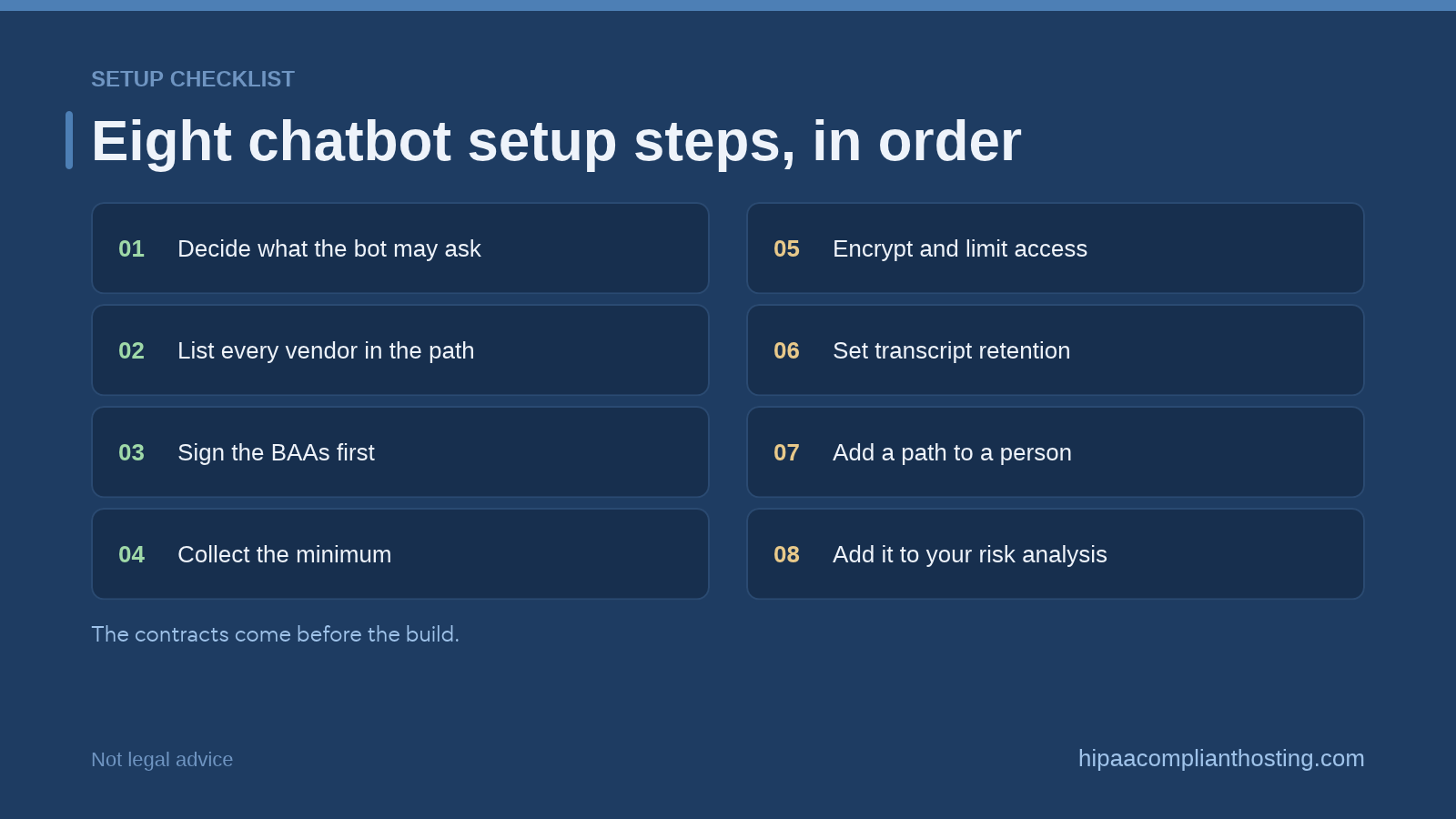
A HIPAA compliant chatbot takes eight steps, in this order. The contracts come before the build.
Decide what the bot may ask. Write down which topics are in scope, and keep the rest out.
List every vendor in the path. Include the platform, the model, the host and each side tool.
Sign the BAAs. Get each one before any patient message moves.
Collect the minimum. Ask only for what the task needs, in line with the minimum necessary standard.
Encrypt and limit access. Use TLS in transit, encrypted storage, named logins and multi-factor authentication for staff.
Set retention. Choose how long transcripts and model logs are kept, and delete on schedule.
Add a human path. Tell patients they are talking to a bot, and give them a way to reach a person.
Add it to your risk analysis. Record the chatbot, its vendors and its data flows in your HIPAA risk analysis.
Step 7 is good practice, and some state laws go further. California's AB 3030, for example, requires a disclaimer on AI-generated patient messages about clinical information, unless a licensed provider reviews them. Check the rules for the states you serve. For the vendor questions in steps 2 and 3, our HIPAA vendor risk assessment guide lists the proof to ask for.
What changes for a health system and for a small clinic?
The rules are the same. The work to keep a HIPAA compliant chatbot running is not.
Health systems and multi-site groups. The hard part is integration. A bot that reads the scheduling system or the EHR needs access limits, logging and a security review like any other clinical system. Run a pilot on one service line first.
Healthtech companies. Your customers will ask which vendors see their patients' messages. Keep the vendor list and the BAAs ready for their reviews.
Small clinics. The risk is a free chat widget added in an afternoon. Either pick a vendor that signs a BAA, or keep the bot to general questions and send health questions to the phone or a secure form. Our guide to HIPAA compliant forms covers that second path.
Staff use of AI tools is a separate question from a patient chatbot. Our guide to AI patient data privacy covers it.
Where does our hosting fit, and where does it not?
We sell this, so weigh it as a disclosure. We do not sell a chatbot or an AI model. We host layer 3 of a HIPAA compliant chatbot.
Where we fit. The server that runs your chatbot app and stores its transcripts, logs and backups. Teams that run the app in containers use our HIPAA compliant Docker hosting.
Setup. Single-tenant AWS. Each plan is one server in one AWS availability zone.
BAA. We sign the BAA within 24 hours of signup, before patient data moves. Our BAA covers the servers and services we run. Email, SMS, EHR, form and AI model vendors need their own BAA.
Safeguards. Every plan includes CloudFront CDN, a web application firewall (WAF), encryption at rest and in transit, six-year audit logging and tested encrypted backups.
Where we do not fit. A chat platform that runs only on its vendor's cloud. In that case the vendor is your host, and its BAA is the one that matters.
Monthly plans have no long-term contract. Managed plans from $229 a month.
Frequently asked questions
What makes a chatbot HIPAA compliant?
A signed BAA with every vendor that handles the conversation, plus the Security Rule safeguards for stored transcripts. That means encryption, access control, audit logging and a set retention period.
Does a website chatbot need a BAA?
Yes, if it collects health information tied to a person. Booking, symptom and portal chats all do. A bot limited to general questions with no identity may not, but plan for patients who type health details anyway.
Can I use a consumer AI chatbot with patient data?
No. A personal account with no BAA is not a route for PHI, whatever its privacy settings. Use a service whose vendor signs a BAA for that exact product. That is the base of a HIPAA compliant chatbot.
Are chatbot transcripts PHI?
They are when they hold health information that identifies a patient. A HIPAA compliant chatbot treats them like any other record. Encrypt them, limit access, log who reads them and set how long you keep them.
Do we have to tell patients they are talking to a bot?
HIPAA does not address it. It is good practice, and some state laws require a disclosure. California's AB 3030 is one example. Check the rules for the states you serve.
Recap: what a HIPAA compliant chatbot needs
A HIPAA compliant chatbot needs a BAA at every layer: the chat platform, the AI model service and the host. It also needs protected transcripts, a short data list and a place in your risk analysis. Decide what the bot may ask, sign the contracts, then build.
If you want the hosting layer handled, tell us what your chatbot runs on and where its transcripts go. Request a quote and we will reply with a plan and a price, with no long-term contract.
This article is general information, not legal advice. Vendor statements are as read on the dates shown, and they change often. Check each vendor's current pages and your own agreements, and ask counsel about contract terms. We sell HIPAA compliant hosting. Reviewed November 2026.
Sources
Google Cloud: HIPAA compliance and covered products (list updated November 11, 2026).
Anthropic: BAAs for commercial customers.
Microsoft: Copilot Studio compliance.
AWS: HIPAA compliance.
California AB 3030, as summarized by ArentFox Schiff: disclaimers for AI-generated patient communications.