


HIPAA compliant data center: what the rule requires, and who owns it on site, in colocation and in the cloud
HIPAA Compliant Hosting · https://hipaacomplianthosting.com/blog/hipaa-compliant-data-center
Last updated: November 18, 2026
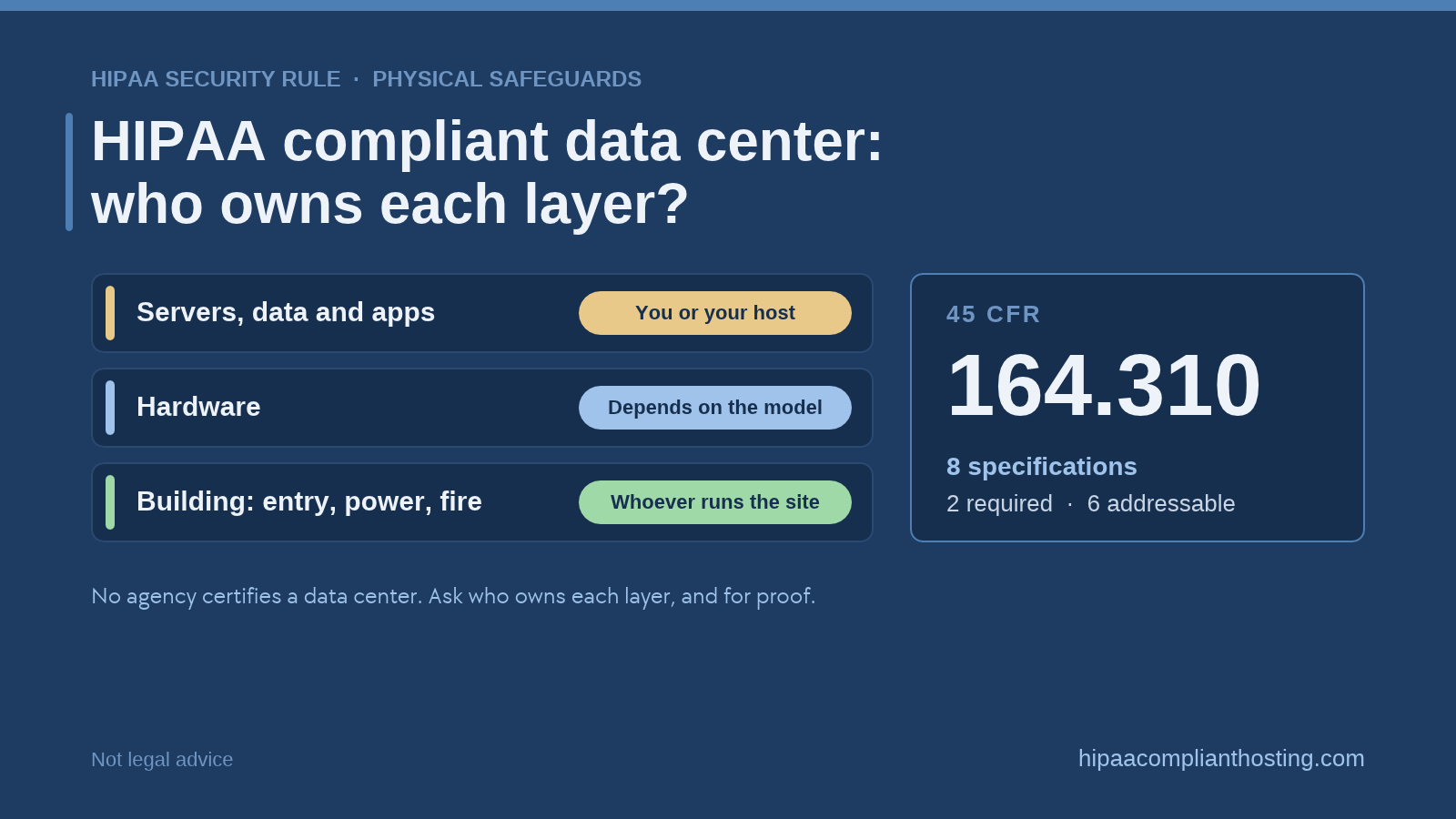
A HIPAA compliant data center is a facility that meets the physical safeguards in 45 CFR 164.310 for the systems that hold patient data. No agency certifies one. The building is also only one layer, because the servers inside it need their own safeguards and a business associate agreement (BAA). So the useful question is who owns each layer, and what proof they can show.
This guide is for IT, security and compliance leads at health systems, multi-site groups and healthtech companies. The same rules apply to a small clinic with one server in a closet. We are HIPAA Compliant Hosting, and we sell managed hosting on AWS. Weigh the one marked section about our plans as a disclosure.
TL;DR: Quick answer
The rule is 45 CFR 164.310. It covers facility access, workstations, and devices and media. It applies to any site that holds electronic protected health information (ePHI).
No certificate exists. HHS says it does not endorse or recognize private certifications of Security Rule compliance.
The model decides who does the work. In your own facility, you own every physical safeguard. In colocation, you share them. In the cloud, the provider runs the building.
A compliant building is not a compliant system. A HIPAA compliant data center still needs hardened servers, access control, logs and tested backups inside it.
Ask for proof. A BAA, access records, media destruction steps and recovery test results tell you more than a badge on a website.
What is a HIPAA compliant data center?
It is a facility where the physical safeguards of the HIPAA Security Rule are in place and documented. Those safeguards control who can enter, what happens to hardware, and how media is destroyed.
HIPAA does not use the phrase. The rule regulates ePHI, not buildings. A HIPAA compliant data center is a short name for a site where the operator can show each safeguard and will sign a BAA.
The term HIPAA compliant data center covers four very different setups. It can mean a server room you own, a rented cage in a colocation site, a public cloud region, or a managed host. The rule is the same for all four. The owner of each task is not.
What must a HIPAA compliant data center have in place?
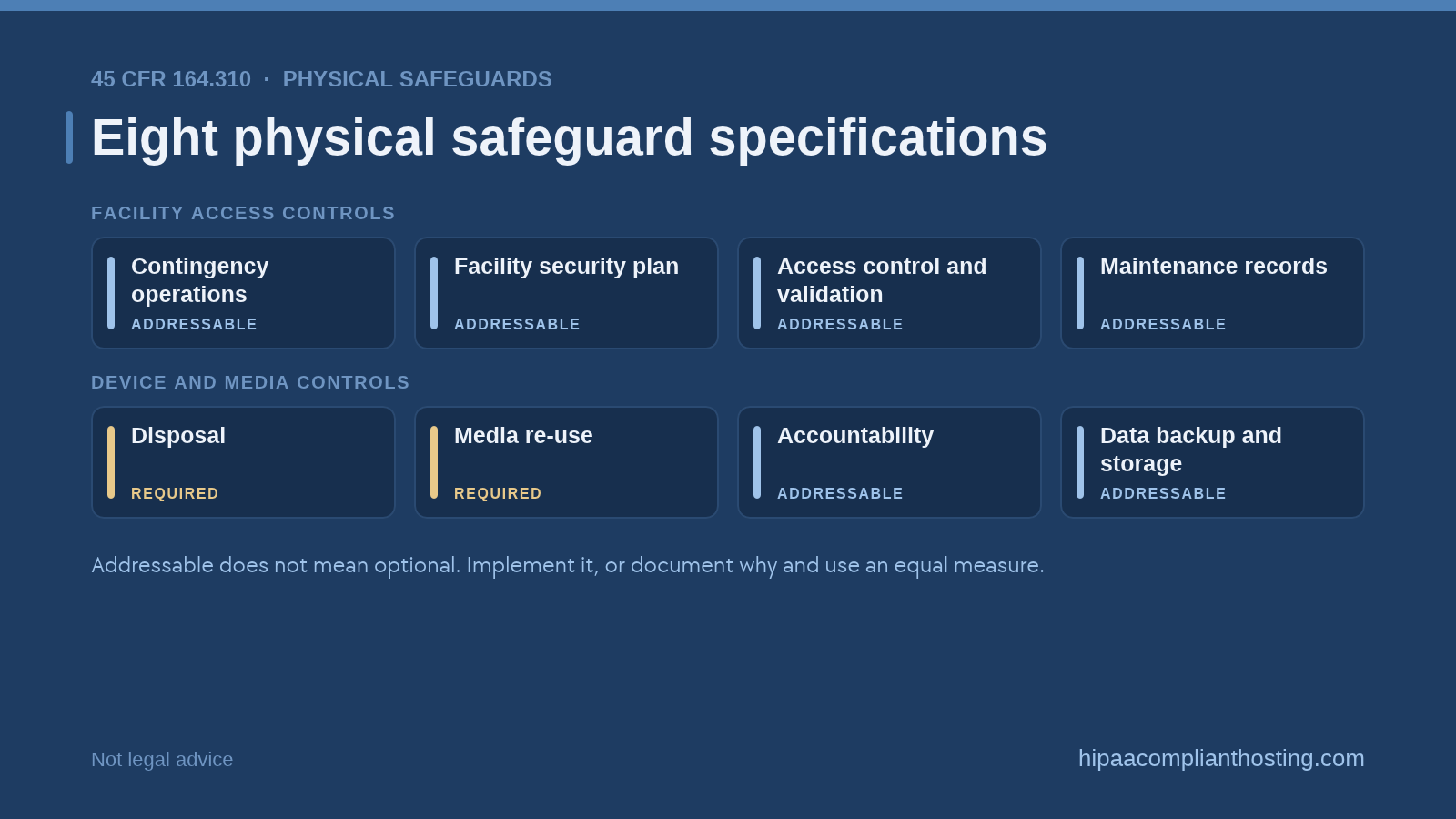
The physical safeguards sit in 45 CFR 164.310. The section has four standards and eight implementation specifications. Two are required and six are addressable.
Standard | Specification | Type | In a data center |
|---|---|---|---|
Facility access controls | Contingency operations | Addressable | Staff can get in to restore data during an emergency |
Facility access controls | Facility security plan | Addressable | The site and its equipment are protected from break-in, tampering and theft |
Facility access controls | Access control and validation | Addressable | Entry depends on role, and visitors are checked and escorted |
Facility access controls | Maintenance records | Addressable | Repairs to doors, locks and security hardware are written down |
Device and media controls | Disposal | Required | Drives that held ePHI are destroyed or wiped at end of life |
Device and media controls | Media re-use | Required | ePHI is removed before a drive is used again |
Device and media controls | Accountability | Addressable | Each hardware move is recorded with the person responsible |
Device and media controls | Data backup and storage | Addressable | An exact copy of the data exists before equipment is moved |
The other two standards, workstation use and workstation security, have no listed specifications. They cover the screens and laptops that reach ePHI, including the ones admins use.
Addressable does not mean optional. You put the safeguard in place when it is reasonable and appropriate. If not, you document why and use an equal measure. Our glossary entry on the addressable implementation specification explains the test.
For disposal, HHS names three methods for electronic media: clearing, purging and destroying. It points to NIST SP 800-88 for the detail. NIST published Revision 2 of that guide in September 2025.
Is there a HIPAA data center certification?
No. HHS says it "does not endorse or otherwise recognize private organizations' certifications" for the Security Rule. It adds that such certifications do not remove your legal duties.
The large clouds say the same. AWS states that there is "no HIPAA certification for a cloud service provider" such as itself. A provider that claims to run a certified HIPAA compliant data center is using a marketing phrase.
Independent audit reports still help. They show that an outside firm tested the controls. Read the report scope and dates, and do not treat any report as a HIPAA pass.
Who owns the physical safeguards in a HIPAA compliant data center?
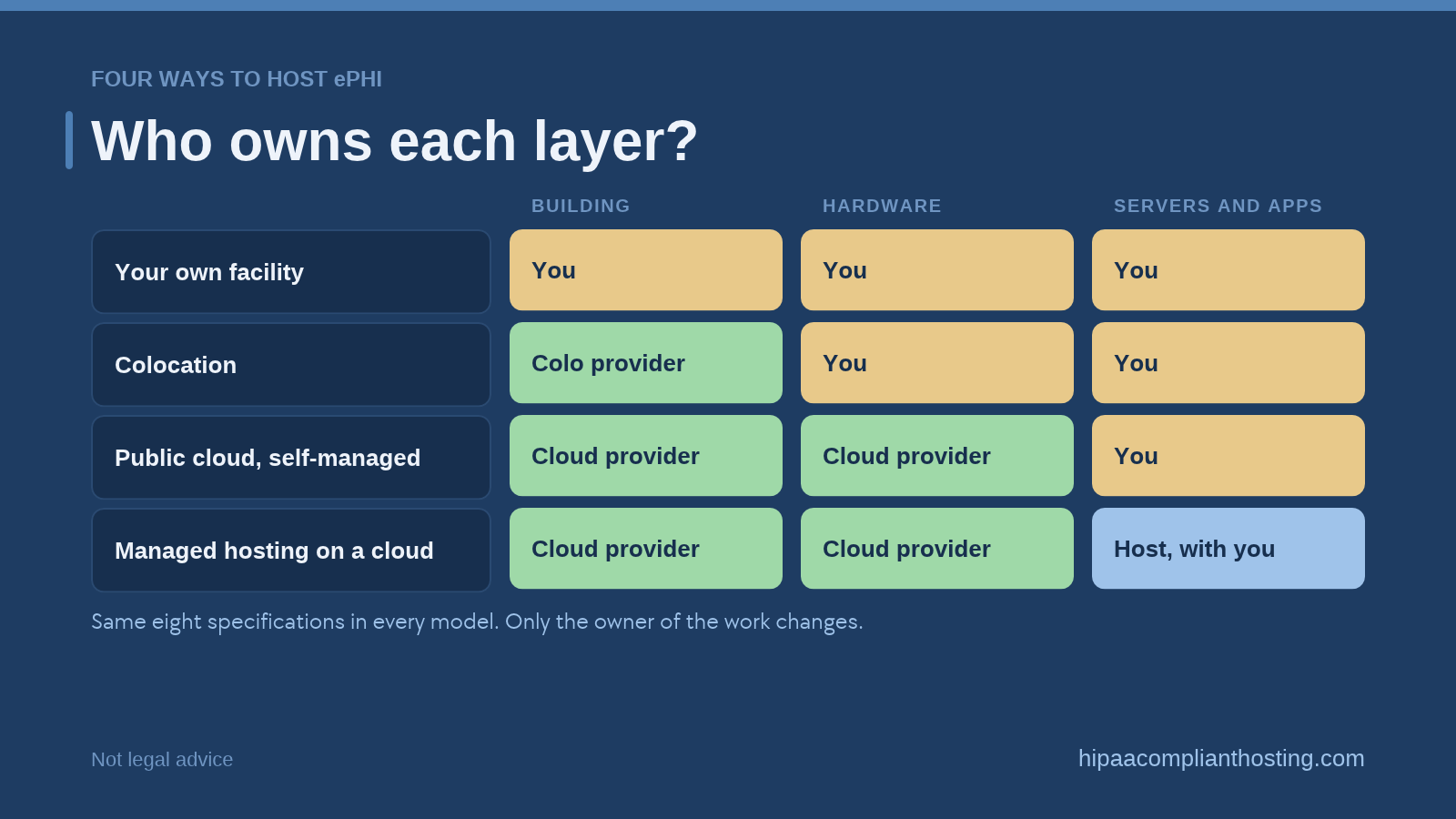
This is the question that drives cost and risk. The same eight specifications apply in every model, but the work moves.
Model | Who runs the building | Who runs the hardware | Who runs the servers and apps | BAA with |
|---|---|---|---|---|
Your own data center or server room | You | You | You | Outside vendors with access to ePHI |
Colocation | The colocation provider | You | You | Ask the provider. See the next section |
Public cloud, self-managed | The cloud provider | The cloud provider | You | The cloud provider |
Managed hosting on a public cloud | The cloud provider | The cloud provider | The managed host, with you | The managed host |
Owning the site gives you full control. It also gives you every task in the first table, plus power, cooling, fire protection and hardware refresh. For a health system, that is a standing team and a capital budget.
The server layer is a separate job in every row. Our guides to a HIPAA compliant server and a HIPAA dedicated server cover it.
Does a colocation provider need a BAA?
It depends on what the provider can reach. HIPAA makes a vendor a business associate when it creates, receives, maintains or transmits ePHI for you.
HHS has settled the question for cloud storage. Its cloud guidance says a provider that stores ePHI is a business associate even when the data is encrypted and it lacks the key. We found no HHS guidance that names colocation, so treat the next point as our view, not a ruling.
Colocation staff often have physical access to your cage. Many sites also sell remote hands, where their staff touch your equipment. Ask for a BAA in both cases, and ask counsel if the provider refuses. Our guide to the HIPAA business associate agreement covers what the contract must say.
What does a cloud provider cover, and what stays with you?
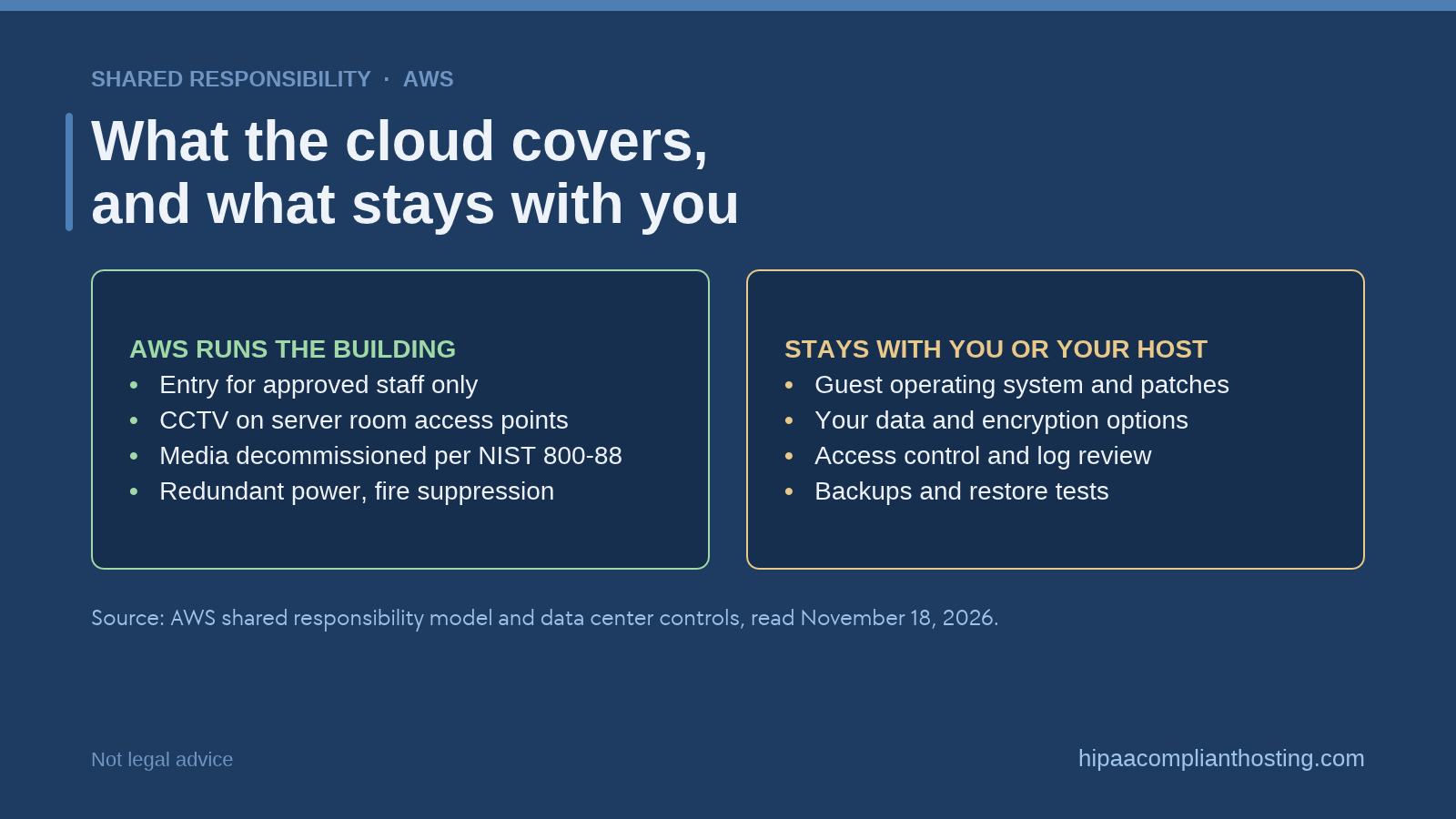
In the cloud, the provider runs the HIPAA compliant data center layer. You inherit its physical controls. AWS describes this split in its shared responsibility model.
AWS says it protects the hardware, software, networking and facilities that run its services. It lists physical and environmental controls among those a customer fully inherits. Its published data center controls include these:
Entry. Physical access goes only to approved employees. Visitors show identification and are escorted.
Monitoring. Access points to server rooms are recorded by CCTV. Intrusion detection systems watch the data layer.
Media. AWS says it decommissions storage media with techniques from NIST 800-88 before the media leaves its control.
Power and fire. Power systems are built to be fully redundant. Sites have automatic fire detection and suppression.
What stays with you is everything above the building. AWS says customers manage their data, including encryption options, and the guest operating system on each server. Our guide answers is AWS HIPAA compliant in more detail.
That is the gap most teams miss. A HIPAA compliant data center under your servers does not patch them, review their logs or test their backups.
What proof should you ask a data center or host for?
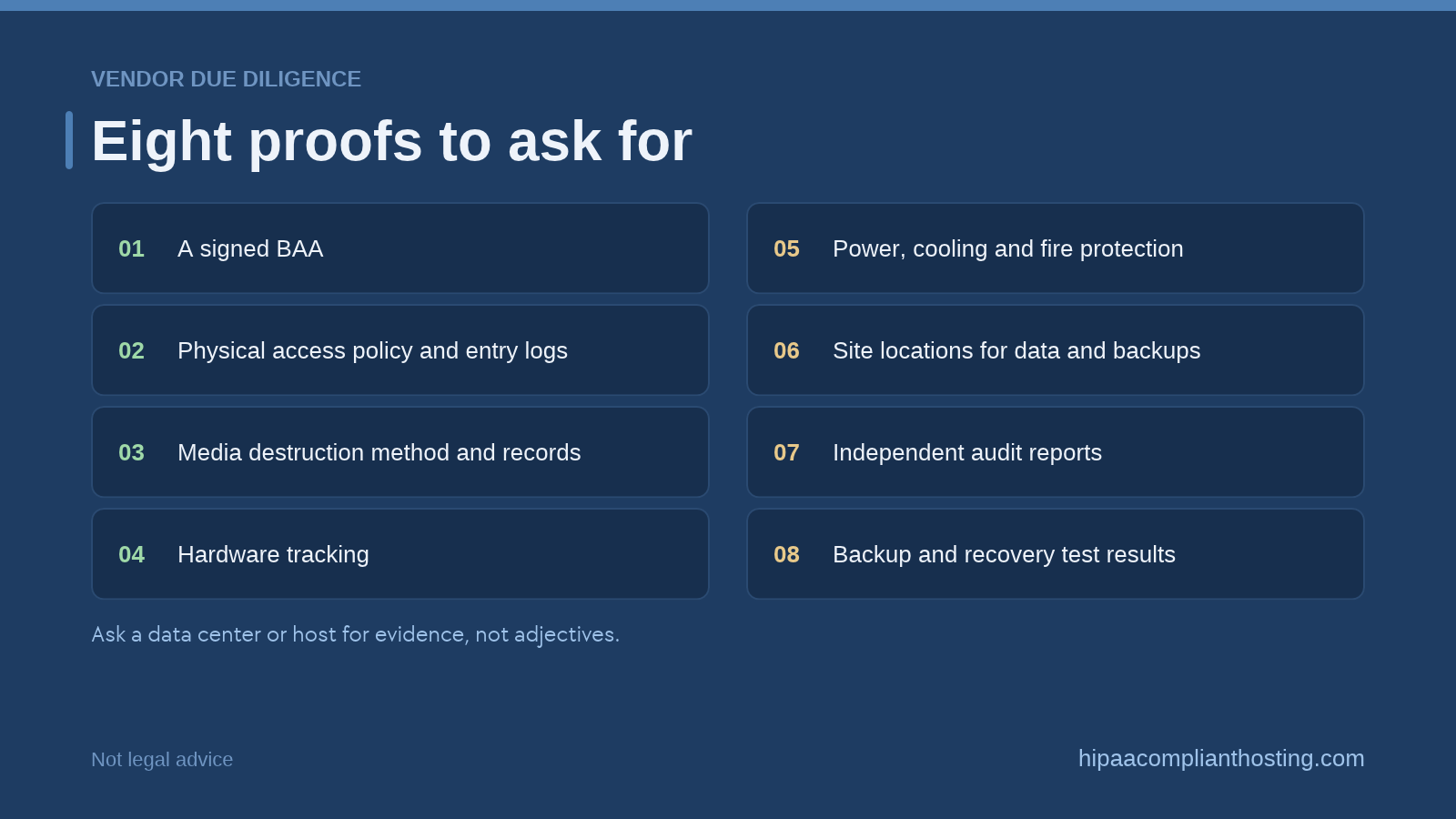
Ask any HIPAA compliant data center or host for evidence, not adjectives. These eight items map to the rule and to HHS guidance.
A signed BAA. Get it before any ePHI moves.
The physical access policy. Ask who can enter, how visitors are handled and how long entry logs are kept.
Media destruction steps. Ask which method is used and whether you get a record of destruction.
Hardware tracking. Ask how drives and servers are tracked when they move or are replaced.
Power, cooling and fire protection. Ask what is redundant and how often it is tested.
Site locations. Ask where your data and backups sit, by city or cloud region.
Independent audit reports. Ask for the latest report, its scope and its dates.
Backup and recovery tests. Ask for the date and result of the last restore test.
HHS also says a service level agreement can cover system availability, backup and data recovery. It says those terms should be consistent with the BAA and the HIPAA Rules. Our HIPAA vendor risk assessment guide lists more questions, and our guide to HIPAA backup and disaster recovery covers recovery tests.
What changes for a health system and for a small clinic?
The rule is the same. The starting point is not.
Health systems and multi-site groups. Many still run their own rooms or rent colocation space. The pressure is aging hardware, staffing and audit evidence across many sites. A move to a provider's HIPAA compliant data center shifts the facility work and its evidence to that provider. Our guide to HIPAA compliant infrastructure covers the wider design choices.
Healthtech companies. Most start in the cloud. The facility layer is covered, so customer security reviews focus on the server and application layers.
Small clinics. The risk is one server in an unlocked closet with no entry log and no disposal plan. A hosted setup in a HIPAA compliant data center moves that work to a provider under a BAA.
If you plan a move, do it in a set order so no system runs without coverage. Our steps to migrate to HIPAA compliant hosting show that order.
Where does our hosting fit, and where does it not?
We sell this, so weigh it as a disclosure. We do not own or run a data center. Our plans run on AWS, and AWS runs the facility layer.
Where we fit. The layer above the building: the servers that hold your website, patient portal or app. That is the work a HIPAA compliant data center does not do for you.
Setup. Single-tenant AWS. Each plan is one server in one AWS availability zone.
BAA. We sign the BAA within 24 hours of signup, before patient data moves. Our BAA covers the servers and services we run. Email, SMS, EHR, form and AI model vendors need their own BAA.
Safeguards. Every plan includes CloudFront CDN, a web application firewall (WAF), encryption at rest and in transit, six-year audit logging and tested encrypted backups.
Where we do not fit. Hardware you must keep on your own premises, or contracts that require a facility you control.
Monthly plans have no long-term contract. Managed plans from $229 a month.
Frequently asked questions
What makes a data center HIPAA compliant?
The physical safeguards in 45 CFR 164.310, in place and documented. They cover facility access, workstations, and devices and media. Where a vendor runs the site and maintains ePHI, a BAA is also needed.
Is there a HIPAA certified data center?
No. HHS does not endorse or recognize private certifications of Security Rule compliance. Audit reports can support a provider's claims, but none is a HIPAA certificate.
Is AWS a HIPAA compliant data center?
AWS runs the facility layer and signs a BAA with customers. It says PHI should be processed, stored and transmitted only in its HIPAA eligible services. The servers and data you run on AWS remain your job.
Who is responsible for physical security in the cloud?
The cloud provider. AWS lists physical and environmental controls among those a customer fully inherits. You still secure the servers, data and access inside that HIPAA compliant data center.
Do we need our own data center for HIPAA?
No. HIPAA asks for safeguards, not ownership. A HIPAA compliant data center can be your own site, a colocation site or a cloud region. The choice is about who does the work and who holds the proof.
Recap: what a HIPAA compliant data center covers
A HIPAA compliant data center meets the physical safeguards in 45 CFR 164.310, and no agency certifies it. Your own site puts every task on you. Colocation splits them. The cloud moves the building to the provider, and the servers stay with you or your host.
If you want the server layer handled, tell us what you run today. Request a quote and we will reply with a plan and a price, with no long-term contract.
This article is general information, not legal advice. AWS and HHS statements are as read on November 18, 2026, and they can change. Check the current pages and your own agreements, and ask counsel about contract terms. We sell HIPAA compliant hosting. Reviewed November 2026.
Sources
45 CFR 164.310, physical safeguards.
NIST: SP 800-88 Rev. 2, Guidelines for Media Sanitization (September 2025).
AWS: Shared responsibility model, data center controls and HIPAA compliance.