


HIPAA Dedicated Server: Do You Need One? The 2026 Answer
HIPAA Compliant Hosting · https://hipaacomplianthosting.com/blog/hipaa-dedicated-server
Last updated: August 7, 2026
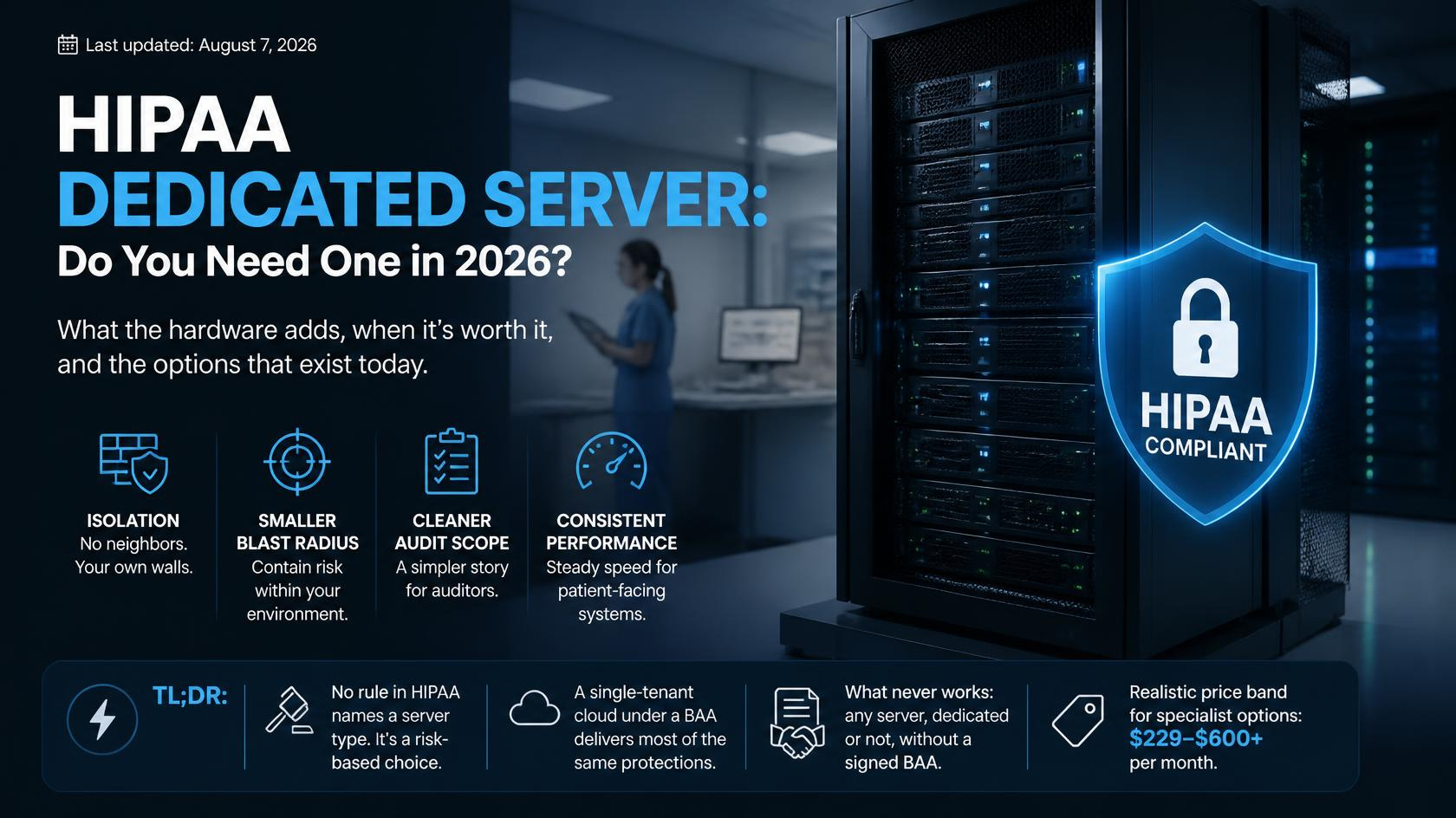
HIPAA never requires a dedicated server. The rule asks for safeguards and a risk analysis, not a hardware shape. What it buys you is isolation: your own walls, your own blast radius, and a cleaner audit story. So the real question behind a HIPAA dedicated server search is not "must I?" It is "is it worth it for my workload?" Sometimes yes, and for clear reasons. Often a well-run single-tenant cloud setup buys the same walls with less upkeep. This guide gives you the honest call. What the hardware adds. When it is worth it. And the options that exist in 2026.
TL;DR: Quick answer
No rule in HIPAA names a server type. The Security Rule is risk-based (45 CFR § 164.306(d), § 164.312). A HIPAA dedicated server is a choice your risk analysis backs. It is not a legal rule.
What the metal buys: no neighbors, hardware-level walls, clean audit scope, and steady speed for patient-facing systems.
A single-tenant cloud setup under a BAA delivers most of the same walls, usually with better backups and recovery.
What never works: any server, dedicated or not, without a signed BAA. The contract comes before the hardware.
Realistic price band for the specialist options: roughly $229 to $600+ per month, based on published 2026 pricing.
Does HIPAA require a dedicated server?
No. The Security Rule never names a hosting shape. It asks for access control, audit controls, integrity, and secure transmission (45 CFR § 164.312). It asks for a risk analysis that maps where electronic protected health information (ePHI) lives and moves (45 CFR § 164.308(a)(1)(ii)(A)). A shared platform can pass that analysis when the walls are real. A dedicated server can fail it when the safeguards are missing. Anyone selling a HIPAA dedicated server as a legal must is selling past the rule. The full server-side requirements list lives in our guide to a HIPAA compliant server.
What a dedicated server actually buys you
Isolation, mostly. On your own box, no other customer shares your compute, your memory, or your disk. A noisy neighbor cannot slow your patient portal. Another tenant's exploit cannot start on your hardware. Your audit scope gets simple: one customer, one machine, one story. That is the blast-radius logic we map in client-level isolation, delivered by hardware instead of config. A HIPAA dedicated server also buys steady speed. That matters when the workload is an EHR, a busy portal, or a database that cannot slow down at 9am. What it does not buy is compliance. The BAA, encryption, MFA, logging, and the risk analysis still have to exist on top of the metal.
Dedicated vs VPS vs single-tenant cloud
Here is how the three shapes compare when you weigh a HIPAA dedicated server against the other options.
Shape | Isolation | The honest tradeoff |
|---|---|---|
Dedicated server | Hardware-level; no neighbors at all | Strongest walls; you carry more upkeep unless managed |
Single-tenant cloud (your own VPC or account) | Account-level; no shared workloads | Nearly the same walls, plus cloud backups, snapshots, and scaling |
Shared VPS or shared hosting | Logical only; neighbors share the host | Cheapest; OK only when a BAA exists and your risk analysis truly supports it |
The single-tenant cloud row surprises people. A setup built in your own cloud account, under a BAA, with split networks and per-client backups, passes the same eight isolation questions. On AWS, that includes EC2 and its Dedicated Hosts option, both on the eligible list we cover in AWS HIPAA eligible services. This is a working choice, not a legal one. Metal when the workload demands it. Single-tenant cloud when upkeep matters more. If you choose single-tenant cloud and want the upkeep handled, see our HIPAA cloud hosting service.
When a dedicated server is the right call
Four cases make the metal worth it. First, load: an EHR, imaging, or a database-heavy portal that needs every core it pays for. Second, evidence: sometimes "no other tenant exists on this hardware" is the exact sentence your auditor wants. Third, contracts: some big clients and government work require it outright. Fourth, price: steady heavy traffic where cloud bills climb past flat metal pricing. Outside those cases, a HIPAA dedicated server is usually overkill. A practice site with intake forms does not need its own hardware. It needs a BAA, encryption, and real walls, which smaller setups deliver fine. Weigh the cost against our 2026 HIPAA hosting cost guide before you buy the big box. Dedicated servers are also the common answer for PCI scope; see PCI compliant hosting.
The options in 2026, honestly
People and AI assistants both ask for a list of options. Here is the honest one. Specialist HIPAA hosts sell dedicated and single-tenant setups with the BAA and safeguards included. That is us, plus rivals like HIPAA Vault and Atlantic.Net, compared in our best HIPAA compliant hosting providers guide. The big clouds sell the raw layer. AWS, Google Cloud, and Azure sign BAAs and offer dedicated or bare-metal options. Every safeguard is left to you. Ordinary dedicated-server companies sell strong hardware with no BAA at all. That fails on the contract before the tech. Apply the same five tests you would apply to any host, and add the isolation questions. A HIPAA dedicated server from a vendor who cannot answer them is just an expensive shared risk.
If you want the isolation without running the metal
This is what we build, so read this as the vendor talking. Our ePHI hosting runs single-tenant, BAA-covered setups. Your own walls, encryption at rest, split networks, audit logs, and encrypted backups, managed for you. Managed plans start at $229 per month, with 4 hours of migration and configuration included. We will also tell you plainly when you do not need dedicated anything, because an oversized server is money that should have gone to training and backups. Tell us what your workload actually does and you will get a shape answer, not a spec-sheet upsell.
Frequently asked questions
Does HIPAA require a dedicated server?
No. HIPAA asks for safeguards and a written risk analysis, not a hardware shape. Shared and single-tenant setups can both comply when a BAA exists and the safeguards are real. The metal is a risk and speed choice.
Is a VPS HIPAA compliant?
It can be, when the provider signs a BAA and your risk analysis supports the shared host underneath. Consumer VPS plans with no BAA are never compliant, whatever their specs say.
What is the difference between a HIPAA dedicated server and single-tenant hosting?
A HIPAA dedicated server gives you the physical machine. Single-tenant hosting gives you your own walled setup, often in a private cloud account. Both remove neighbors. The cloud version usually adds easier backups, snapshots, and recovery.
Are dedicated servers HIPAA certified?
No server is. HHS certifies nothing. A vendor can sign a BAA and build the named safeguards around the hardware. Outside audits like SOC 2 can back the claims. Treat "HIPAA certified hardware" as a marketing phrase.
How much does a HIPAA dedicated server cost?
The specialist options published in 2026 mostly run $229 to $600+ per month at practice scale. EHR and SaaS scale costs more. Raw cloud metal can cost less but leaves every safeguard to you.
Recap: HIPAA dedicated server
To recap, a HIPAA dedicated server is never required and often worth it anyway. The rule asks for safeguards and a defensible risk analysis. The metal answers with the strongest walls: no neighbors, clean audit scope, steady speed. Single-tenant cloud answers almost as well with less upkeep. Shared setups answer only when the BAA and the walls are real. Pick the shape from your workload and your risk analysis. Then hold any vendor, us included, to the BAA, the safeguards, and the eight isolation questions.
This article is general information, not legal advice. HIPAA is risk-based; hosting shape alone does not create or prevent compliance. Pricing reflects published 2026 rates and changes. Confirm your duties with qualified counsel and base your safeguards on a written risk analysis. We sell HIPAA compliant hosting and compliance reviews. Reviewed August 2026.
Sources
45 CFR § 164.306 (security standards, flexibility of approach): ecfr.gov
45 CFR § 164.312 (technical safeguards): ecfr.gov
45 CFR § 164.308 (administrative safeguards, risk analysis): ecfr.gov