


Is Docker HIPAA Compliant? Engine, Docker Hub, and the Host That Signs the BAA (2026)
HIPAA Compliant Hosting · https://hipaacomplianthosting.com/blog/is-docker-hipaa-compliant
Last updated: September 23, 2026
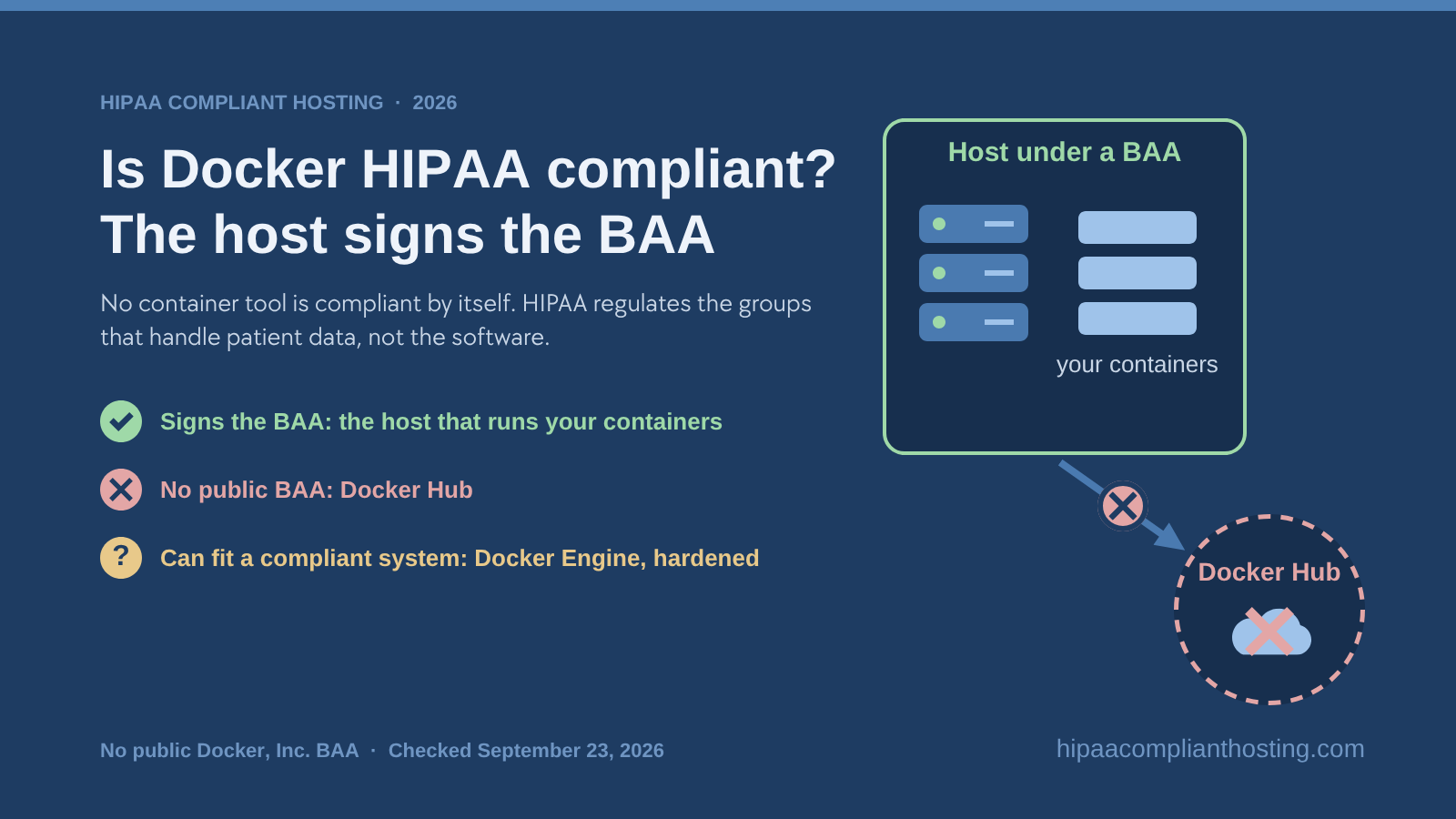
Docker is not HIPAA compliant by itself, and no container tool can be. HIPAA regulates the groups that handle patient data, not the software they run. A Docker HIPAA compliant setup is a system. It needs a host that signs a Business Associate Agreement (BAA), a hardened Docker Engine, and an app with its own safeguards. The word "Docker" also names four products, and the answer differs for each. Docker Engine is software you run. Docker Hub is a hosted service with no public BAA. We sell HIPAA compliant Docker hosting, so weigh our advice accordingly.
TL;DR: Quick answer
Docker, Inc. publishes no HIPAA or BAA statement on its trust, compliance, legal, or pricing pages, as of September 23, 2026. Keep PHI out of Docker Hub.
Docker Engine 29.8.1, released September 15, 2026, runs its daemon as root by default. User namespaces, log rotation, and signature checks are off.
Docker Content Trust is retiring. Its Notary v1 service shuts down on December 8, 2026, so sign images with cosign.
runc fixed three container-escape flaws, each rated 7.3, on November 5, 2025. Most 2026 Critical containerd flaws sit in the plugin Kubernetes uses.
Amazon ECS, AWS Fargate, and Google Cloud Run are on their clouds' covered lists as of September 22, 2026. Docker HIPAA compliant workloads can run on any of them.
Is Docker HIPAA compliant? The three-layer answer
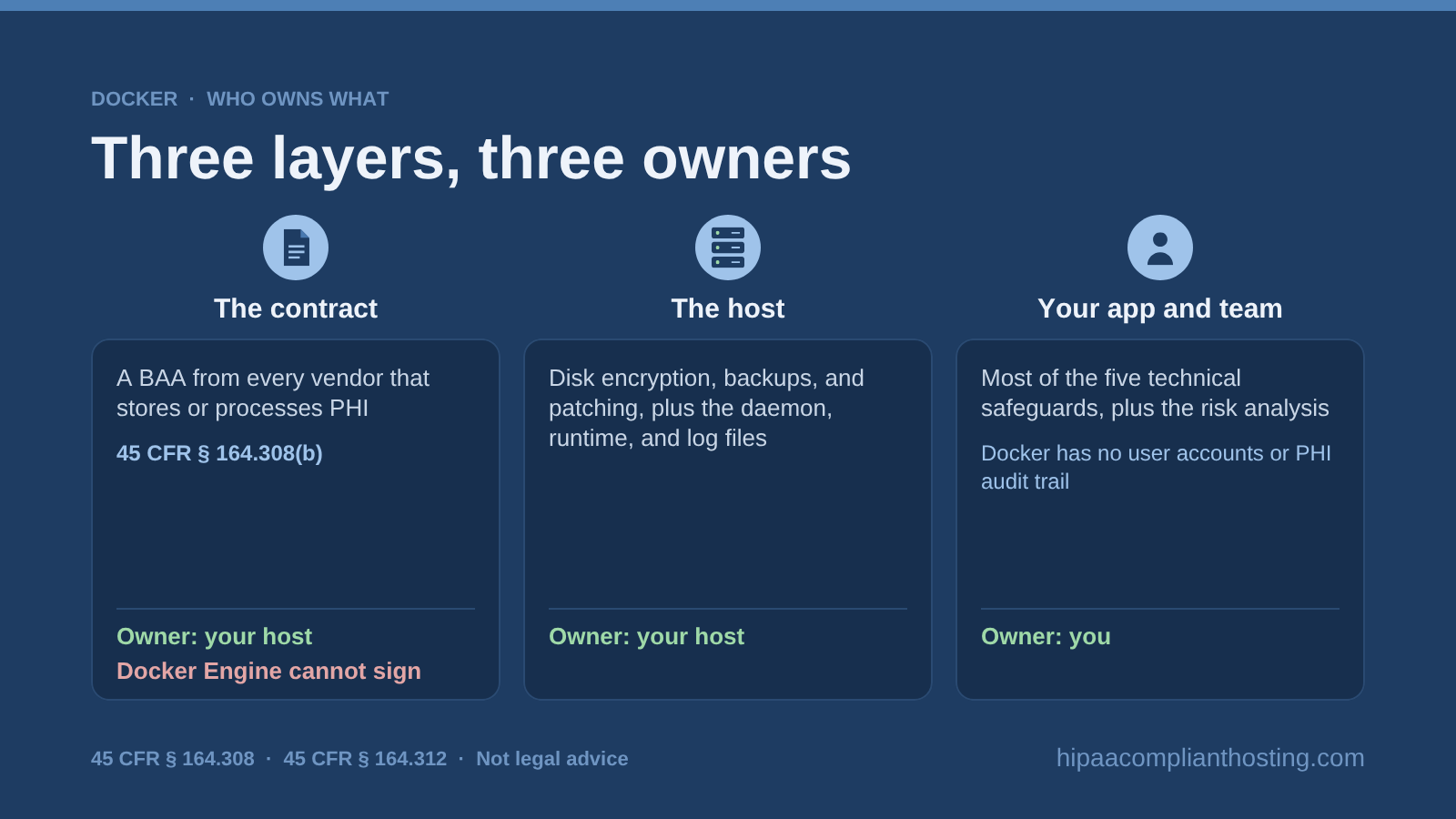
A Docker HIPAA compliant system has three layers, and each needs an owner. The first is the contract. A vendor that stores or processes protected health information (PHI) for a covered entity is a business associate under 45 CFR § 160.103. Under 45 CFR § 164.308(b), it must sign a BAA first. The second layer is the host. It runs disk encryption, backups, and patching, plus the daemon, runtime, and log files. The third layer is your app and team. Most of the five technical safeguards in 45 CFR § 164.312 land in the app. Docker has no user accounts, no PHI audit trail, and no encryption of patient data. You also run a risk analysis under 45 CFR § 164.308(a)(1).
Docker Engine is software you run, so it cannot sign anything. Docker Hub could sign, but it publishes no BAA. So the Docker HIPAA compliant answer lands on the host that runs your containers. The same goes for containers that run AI agents or chatbots, as our guide to hosting AI workflows under a BAA explains.
Which Docker are you asking about?
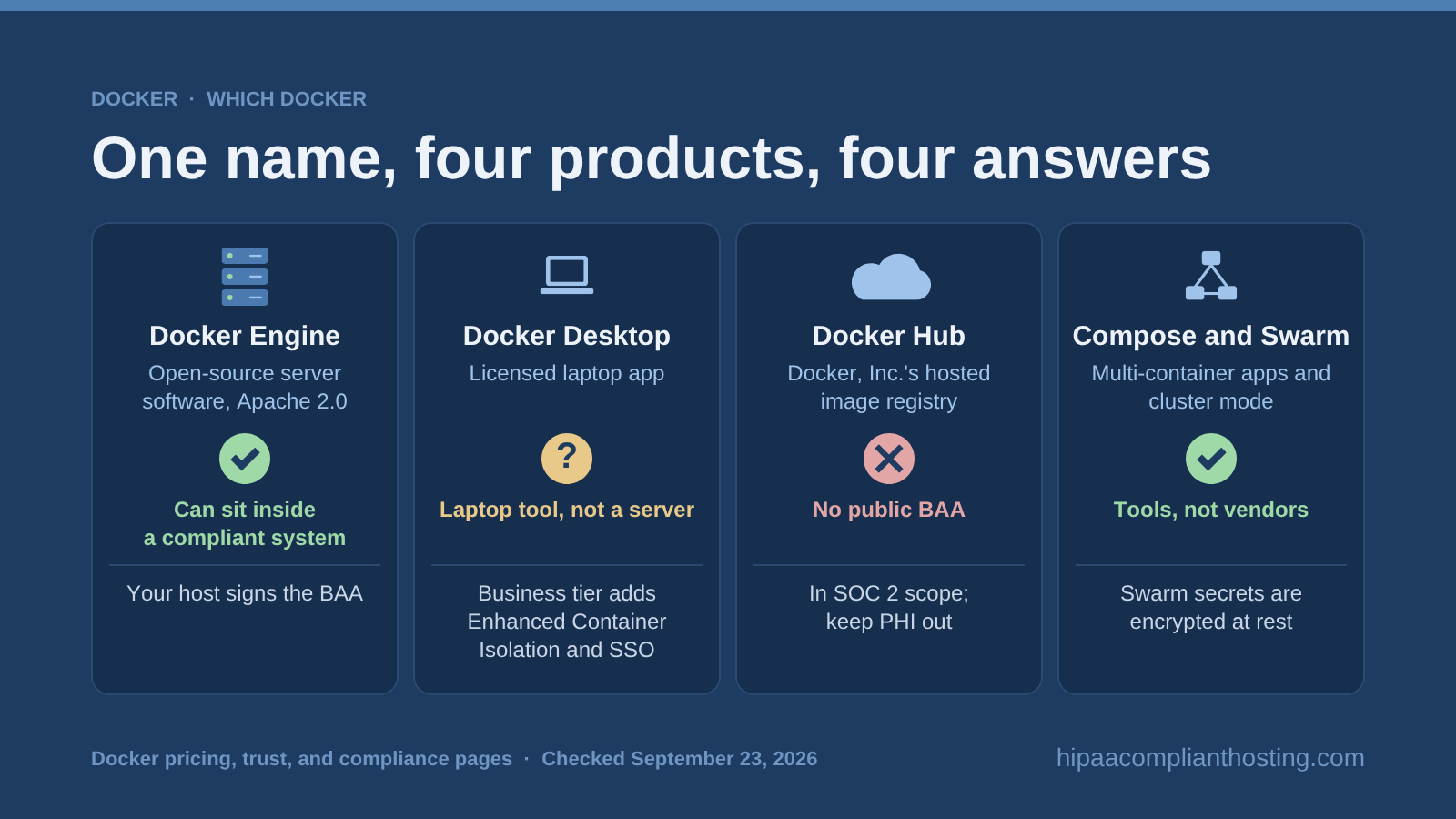
Four products share the name, and the Docker HIPAA compliant answer differs for each.
Product | What it is | HIPAA answer |
|---|---|---|
Docker Engine | Open-source server software from the Moby project, Apache 2.0 license | Can sit inside a compliant system; your host signs the BAA |
Docker Desktop | Licensed laptop app; paid for firms with 250 or more staff or $10 million or more in revenue | Laptop tool; the Business tier adds Hardened Desktop, Enhanced Container Isolation, Registry Access Management, and SSO |
Docker Hub | Docker, Inc.'s hosted image registry | In SOC 2 scope; no public BAA; keep PHI out |
Docker Compose and Swarm | Compose runs multi-container apps; Swarm is Docker's cluster mode | Tools, not vendors; Swarm secrets are encrypted at rest |
This guide covers Docker HIPAA compliant use of Engine in production, plus Docker Hub. Desktop's Business features protect laptops, not servers.
What Docker Engine gives you for the HIPAA technical safeguards
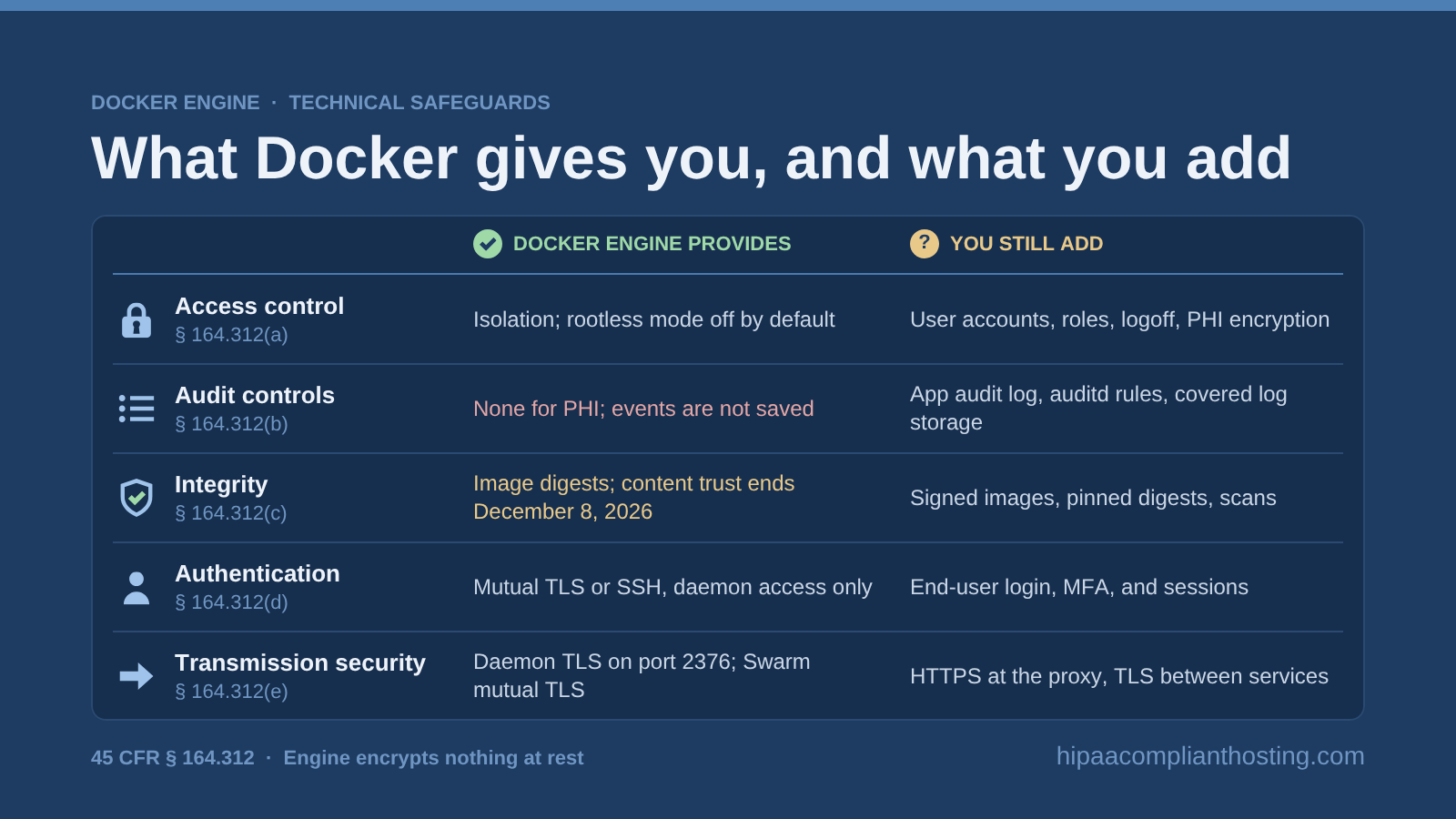
Here is how Docker Engine maps to 45 CFR § 164.312. The last column is what a Docker HIPAA compliant host still needs.
Safeguard (45 CFR § 164.312) | What Docker Engine provides | What you still add |
|---|---|---|
Access control, (a) | Isolation; rootless mode and user remapping, off by default | User accounts, roles, logoff, and PHI encryption in the app |
Audit controls, (b) | None for PHI; the event stream is not saved | An app audit log, host auditd rules, and covered log storage |
Integrity, (c) | Image digests; content trust, retiring December 8, 2026 | Signing your own images, pinned digests, and scans |
Person or entity authentication, (d) | Mutual TLS or SSH for daemon access only | All end-user login, MFA, and sessions |
Transmission security, (e) | Daemon TLS on port 2376; Swarm mutual TLS | HTTPS at the proxy and TLS between services |
dockerd is the Docker daemon, the background service that runs containers. docker events is a command that streams what the daemon does, but it saves nothing. auditd, the Linux audit service, fills that gap by recording who touched the daemon. Our entry on audit logging covers what a PHI audit trail must record.
Docker Engine also encrypts nothing at rest. Images, volumes, and logs sit in plain files under /var/lib/docker, Docker's data folder. So every Docker HIPAA compliant plan needs host disk encryption, as encryption at rest and in transit explains.
Does Docker, Inc. sign a BAA?
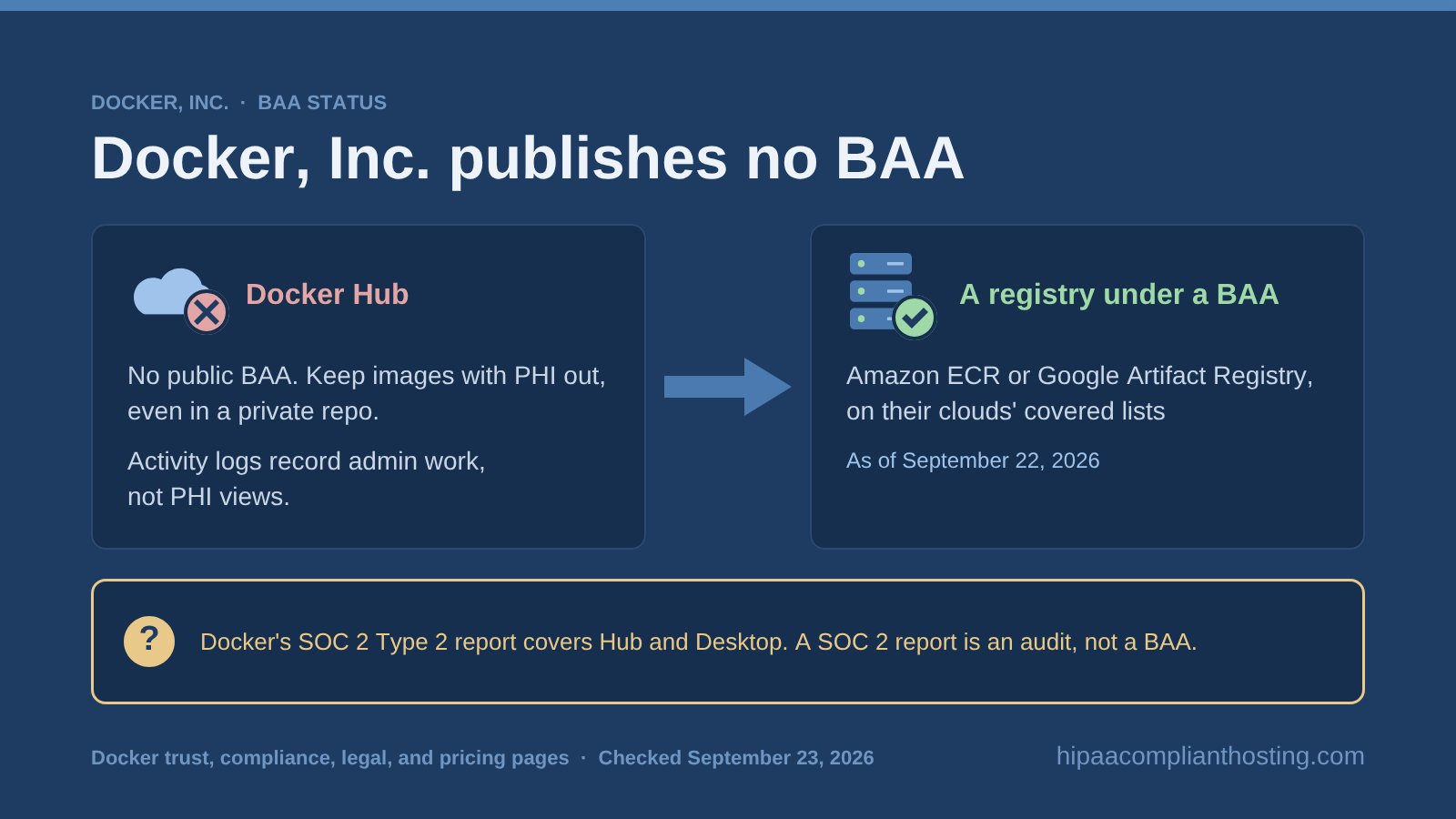
Not publicly. As of September 23, 2026, Docker's trust, compliance, legal, and pricing pages never mention HIPAA or a BAA. The compliance page says its SOC 2 Type 2 report covers Docker Desktop, Hub, Scout, Build Cloud, Testcontainers Cloud, Docker Hardened Images, and Offload. A SOC 2 report is an audit, not a BAA.
Docker Hub cannot hold an image with PHI, even in a private repo. A Docker HIPAA compliant image belongs in a registry under a BAA. Amazon ECR and Google Artifact Registry are on their clouds' covered lists as of September 22, 2026.
Docker Hub activity logs, on Team and Business plans, record registry admin work, not anyone viewing PHI. They do not meet 45 CFR § 164.312(b).
Which Docker defaults to change before a container touches PHI?
Change each of these defaults before a Docker HIPAA compliant host goes live.
Setting | Default | Change it to |
|---|---|---|
Daemon user | Runs as root | Rootless mode, or user remapping |
User namespaces | Off; container root is host root | userns-remap set to default |
Container logs | json-file with no rotation | The local driver, or a covered log service |
Image signatures | Content trust off, and retiring | cosign signatures and pinned digests |
Secrets | Often in environment variables or .env files | Swarm or Compose secrets |
Daemon access | Local socket only | Keep it local, or mutual TLS on port 2376 |
daemon.json is the Docker daemon's settings file. Adding "userns-remap": "default" maps container root to a host user with no power. json-file is the default log driver, which writes all container output to a host file. Docker's docs recommend the local driver, which rotates logs by default. DOCKER_CONTENT_TRUST makes the client refuse unsigned images, but its Notary service ends December 8, 2026.
The Compose docs warn that secrets in environment variables mean you "risk unintentional information exposure". A .env file, the text file Compose reads variables from, carries the same risk. Self-hosted n8n is configured through environment variables too, often including the key that encrypts its stored credentials. Our guide to an n8n HIPAA compliant setup covers where that key belongs and the run data n8n saves by default.
Which Docker versions are safe to run?
A Docker HIPAA compliant host runs only the newest patched line. As of September 23, 2026, the newest Docker Engine is 29.8.1, released September 15, 2026. Docker Desktop 4.92.0 shipped September 21, 2026, with containerd 2.3.5. Engine releases 29.3.1 through 29.7.0 fixed 15 CVEs in 2026, including five in BuildKit, Docker's image builder.
runc is the low-level tool that starts each container. On November 5, 2025, it fixed three container-escape flaws: CVE-2025-31133, CVE-2025-52565, and CVE-2025-52881. Each let a malicious image reach the host. A low-severity fix followed on June 13, 2026. Run runc 1.3.6, 1.4.3, or later.
containerd sits between Docker Engine and runc. Its 2026 Critical advisories are mostly in the CRI plugin, which Kubernetes uses and plain Docker Engine does not. Still, run containerd 2.3.4 or later. That covers CVE-2026-53488, CVE-2026-53489, and a Critical flaw published September 1, 2026. We found no newer runc or containerd advisory on September 23, 2026.
Docker Engine 28.x had its last release on November 5, 2025, and Docker publishes no end-of-life policy. Treat 28.x as unsupported in your HIPAA risk analysis. A Docker HIPAA compliant host patches Engine, runc, and containerd together.
The 8 settings that make a Docker host HIPAA-ready
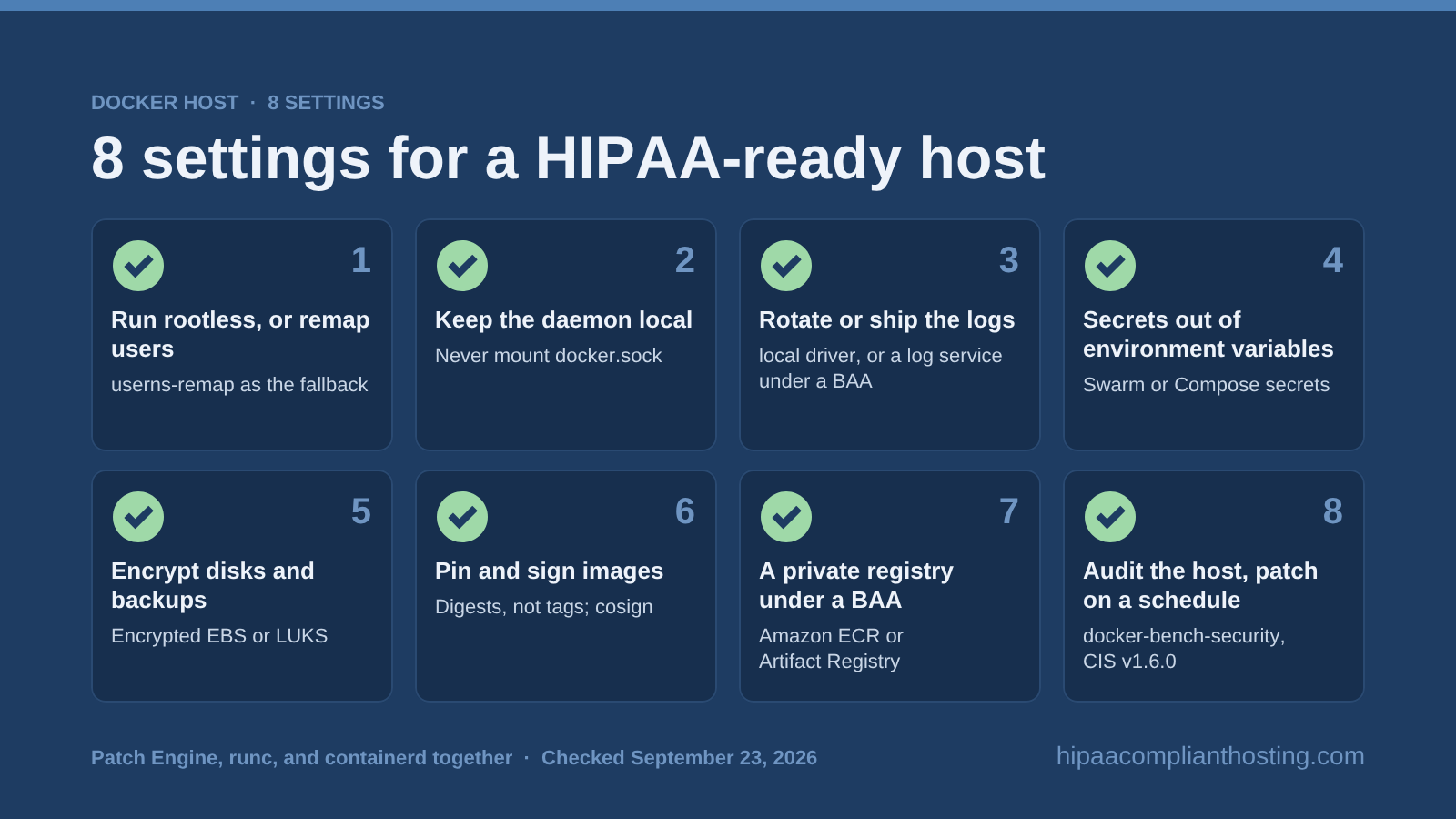
These are the first settings we check on a Docker HIPAA compliant host.
Run rootless, or remap users. Run
dockerd-rootless-setuptool.sh install, Docker's setup script for a daemon without root. If that will not fit, set userns-remap.Keep the daemon local. Leave it on
/var/run/docker.sock, its local socket file. For remote access, use--tlsverify, which demands client certificates. Never mount docker.sock into a container.Rotate or ship the logs. Use the local driver, or set
max-sizeandmax-fileon json-file to cap file size and count. To ship logs, useawslogs(CloudWatch Logs) orgcplogs(Google Cloud Logging) under a BAA, with PHI redacted. Rotation caps files by size, not age, so decide how long to keep HIPAA logs first, then set retention in the log service to match.Move secrets out of environment variables. Use Swarm secrets or the Compose
secrets:key, which mounts each secret as a file under/run/secretsinside the container. For builds, use the Dockerfile optionRUN --mount=type=secret, so secrets never land in a layer.Encrypt disks and backups. Put /var/lib/docker on an encrypted EBS volume or LUKS, the standard Linux disk encryption. Back up volumes to encrypted storage under a BAA.
Pin and sign images. Pull images by digest, not tag. Sign your own with
cosign, the Sigstore signing tool, and scan them.Use a private registry under a BAA. Amazon ECR, Google Artifact Registry, or your own registry on a covered server.
Audit the host and patch on a schedule. Run
docker-bench-security, Docker's free script that checks a host against the CIS Docker Benchmark v1.6.0. Add auditd rules for dockerd and docker.sock. Patch Engine, runc, and containerd on a set cadence.
Item 5 ties to HIPAA backup and disaster recovery. Items 2 and 8 are host work, covered in HIPAA compliant server. With all eight done, the Docker layer of a Docker HIPAA compliant stack is in place.
Where Docker deployments leak PHI
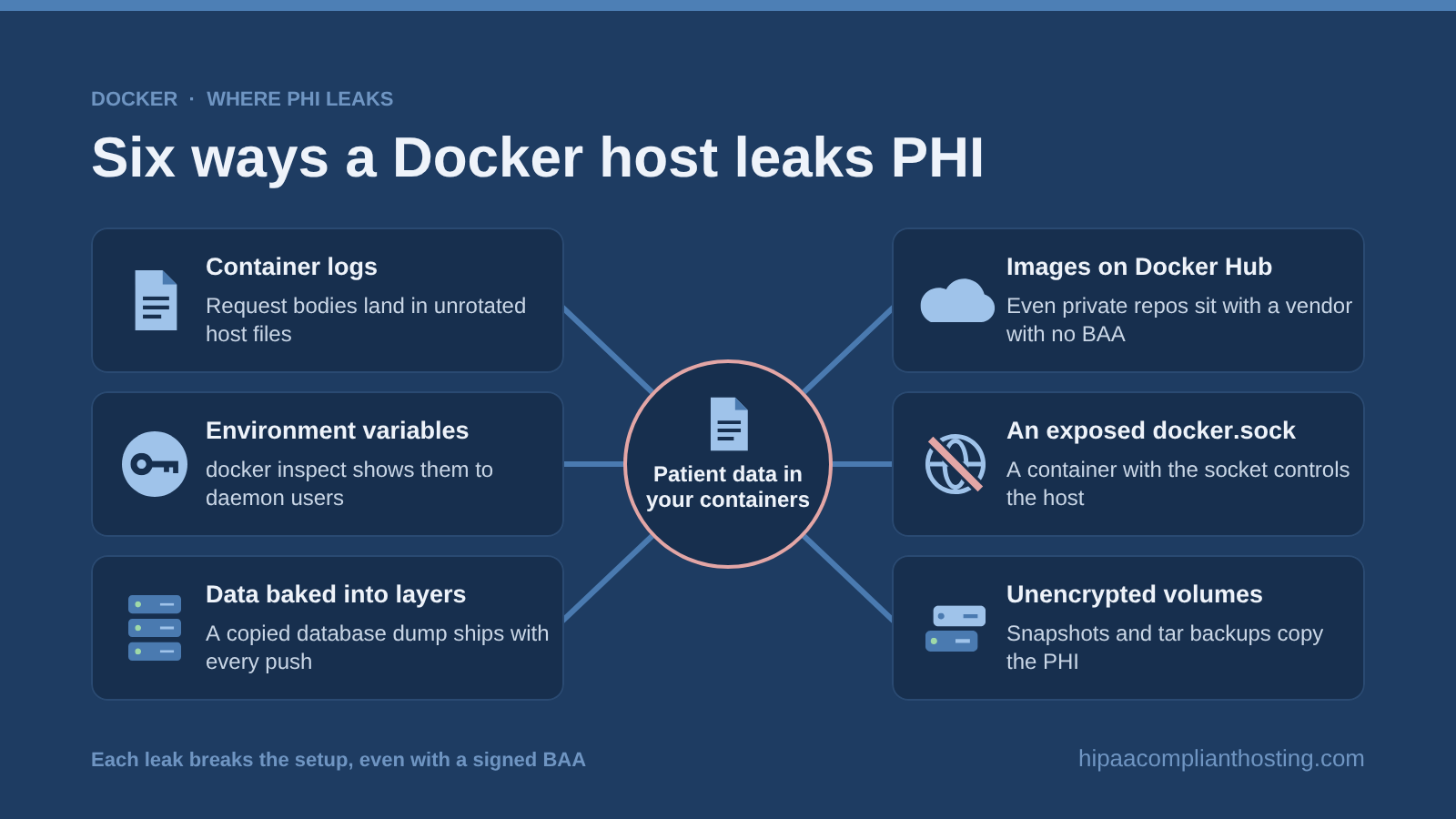
Each leak breaks a Docker HIPAA compliant setup, even with a signed BAA.
Container logs. Apps that log request bodies write PHI into unrotated, unencrypted host files.
docker logs, the command that prints a container's output, reads them back.Environment variables.
docker inspect, which prints a container's settings, shows its environment to anyone with daemon access.Data baked into layers. Copying a folder with a database dump into an image ships that data with every push.
Images on Docker Hub. A public repo can be pulled by anyone. A private one sits with a vendor that has no BAA.
An exposed docker.sock. A container with the socket mounted controls the host and every volume on it.
Unencrypted volumes and snapshots. Volumes are plain folders. Snapshots and tar backups copy that PHI unless disks and backup targets are covered.
Container-based CMS builds face the same leaks, as our Ghost CMS HIPAA compliant and Payload CMS HIPAA compliant guides show. A compiled PHP extension runs the argument the other way: pinning the build into one image layer is why our guide to whether Phalcon HIPAA compliant apps are possible points at containers rather than a managed server, since a host that patches PHP but not the extension stays exposed. Containerized databases need HIPAA compliant database hosting care too.
Who signs the BAA for a Docker app, and what does it cost?
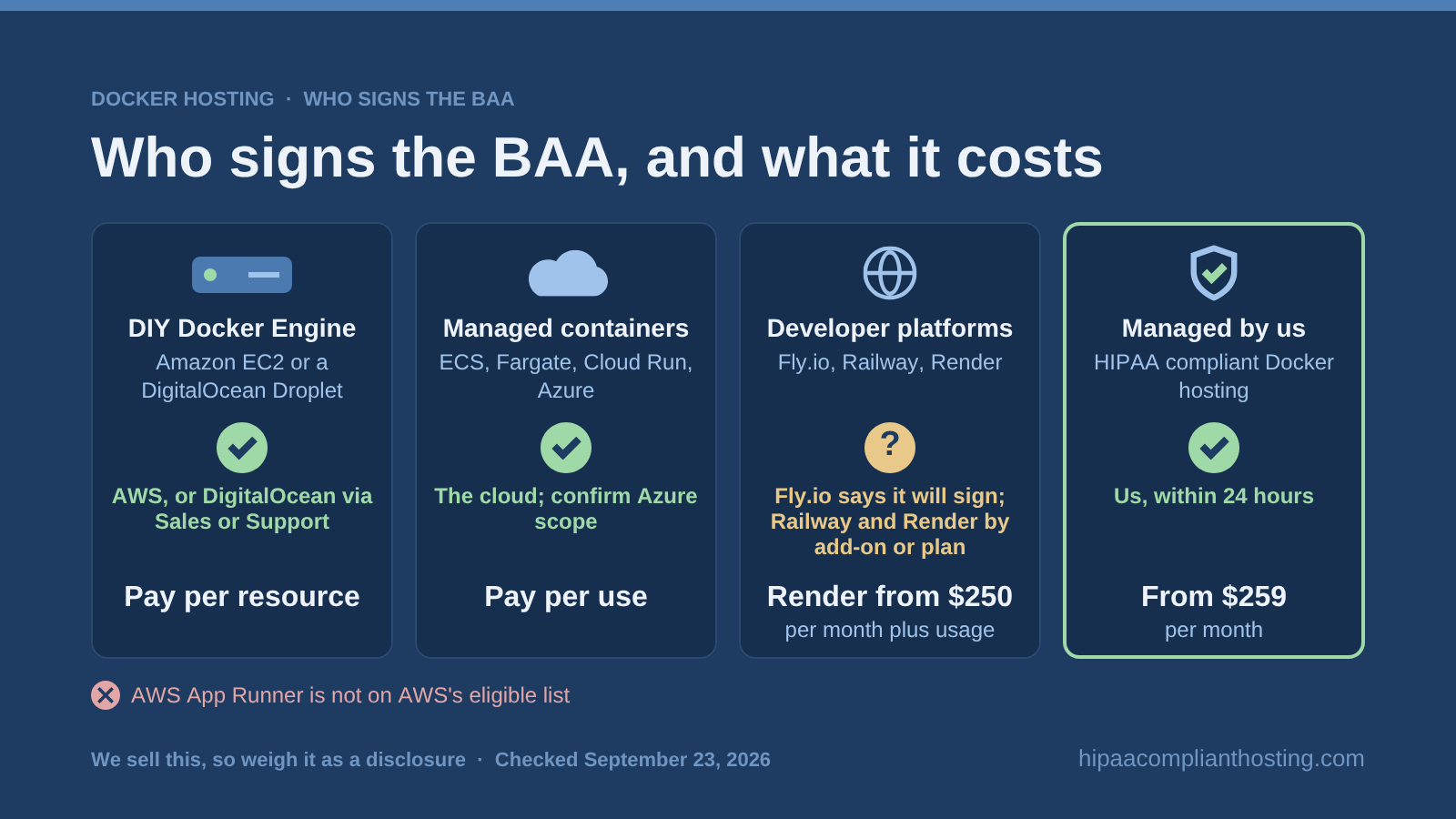
Your host does. Docker, Inc. does not, and Docker Engine cannot. Render and DigitalOcean details come from our September 11, 2026 review of HIPAA compliant app hosting.
Route | Who signs the BAA | Published price | What you still own |
|---|---|---|---|
DIY Docker Engine on Amazon EC2 or a DigitalOcean Droplet | AWS; or DigitalOcean through Sales or Support | Pay per resource | Everything: disks, daemon, logs, patches, backups |
Managed containers: Amazon ECS and Fargate, Google Cloud Run, Azure | The cloud; confirm the Azure service is in scope | Pay per use | App controls, logs, and images |
Developer platforms: Fly.io, Railway, Render | Fly.io says it will sign; Railway sells an add-on; Render signs on Organization or Enterprise | Render from $250 per month plus a usage fee; Railway has a spend threshold | App settings, logs, and other vendors' BAAs |
Managed HIPAA compliant Docker hosting from us | Us, within 24 hours | From $259 per month, 4 hours of migration and configuration included | App settings, images, and risk analysis |
We sell the last row, so weigh it as a disclosure. DigitalOcean's covered products include Droplets, Kubernetes, Spaces, and Load Balancers. AWS App Runner is not on AWS's eligible list, so keep PHI containers off it. See is AWS HIPAA compliant for the AWS picture. The DIY row looks cheapest until you price the patching a Docker HIPAA compliant host needs.
If you would rather not harden the host yourself
Most teams want to ship their app, not patch runc. Our HIPAA compliant Docker hosting runs your containers on dedicated AWS servers with encryption, a web application firewall, audit logging, and tested backups. We run the host layer, patch the operating system and runtime, and sign for it. The BAA is signed within 24 hours. Plans start from $259 per month, with 4 hours of migration and configuration included. We sell this, so weigh it as a disclosure.
Here is the honest inverse. If a platform engineer runs your containers on ECS or Fargate under AWS's BAA, that path works, and you do not need us. If a container never touches PHI, none of this applies, and it does not need to be Docker HIPAA compliant. For everyone else, our HIPAA compliant hosting plans are public. You can request a quote or tell us what your containers do.
Frequently asked questions
Is Docker HIPAA compliant out of the box?
No. Docker Engine runs as root, keeps logs unrotated and unencrypted, and leaves signature checks off by default. A Docker HIPAA compliant setup needs a host that signs a BAA, hardened daemon settings, and encrypted disks.
Does Docker, Inc. sign a BAA?
Not publicly. As of September 23, 2026, Docker's trust, compliance, legal, and pricing pages do not mention HIPAA or a BAA. A SOC 2 report is not a BAA.
Can I store images with PHI on Docker Hub?
No. Docker Hub has no public BAA, so even a private repository holding PHI is a disclosure to a vendor without one. Keep PHI out of images, and use a registry under a BAA, such as Amazon ECR.
Is AWS ECS or Fargate HIPAA eligible?
Yes. Amazon ECS, AWS Fargate, Amazon EKS, and Amazon ECR are on AWS's HIPAA Eligible Services list as of September 22, 2026. Accept the AWS BAA first. AWS App Runner is not on the list.
Can I run an EHR in a container?
Yes. OpenEMR publishes an official Docker image, so an electronic health record runs on a Docker host like any other app. The container changes nothing about who signs: your host signs for the server, and no host installs, patches, upgrades or certifies the EHR software for you. Size the host by users and document storage rather than record count. Our guide to HIPAA compliant EHR hosting sets that route against a vendor cloud EHR.
Docker or Kubernetes for HIPAA?
Either can work. Kubernetes talks to containerd directly, not to the Docker daemon. Managed Kubernetes, such as EKS or GKE, runs under the cloud's BAA. For one app, a Docker HIPAA compliant host is simpler to audit than a cluster.
Recap: Docker HIPAA compliant
To recap, Docker HIPAA compliant is a property of the system, not the software. Docker, Inc. offers no public BAA, so keep PHI off Docker Hub. Run Engine 29.8.1 with patched runc and containerd, apply the eight settings, and get a BAA from your host.
This article is general information, not legal advice. Docker's docs, runtime advisories, and vendor pages were read on September 22, 2026, and versions and advisories were rechecked on September 23, 2026. Render and DigitalOcean details come from our September 11, 2026 review. Confirm current terms with each vendor, consult qualified counsel, and base your safeguards on a documented risk analysis. We sell HIPAA compliant hosting and compliance reviews. Reviewed September 2026.
Sources
Docker, Inc.: Pricing, Trust, Compliance.
Docker security docs: Rootless mode, User namespaces, Daemon access, Content trust.
Docker secrets and logs: Swarm secrets, Compose secrets, Logging, Hub activity logs.
Runtime and audit: runc advisories, containerd advisories, Docker Bench for Security.
Clouds: AWS eligible services, Google Cloud HIPAA, Azure HIPAA.
Platforms: Fly.io, Railway, Render, DigitalOcean.
HIPAA rules: 45 CFR § 160.103, 45 CFR § 164.308, 45 CFR § 164.312.