


HIPAA Compliant Texting: Rules, Consent, and Apps (2026)
HIPAA Compliant Hosting · https://hipaacomplianthosting.com/blog/hipaa-compliant-texting
Last updated: July 28, 2026
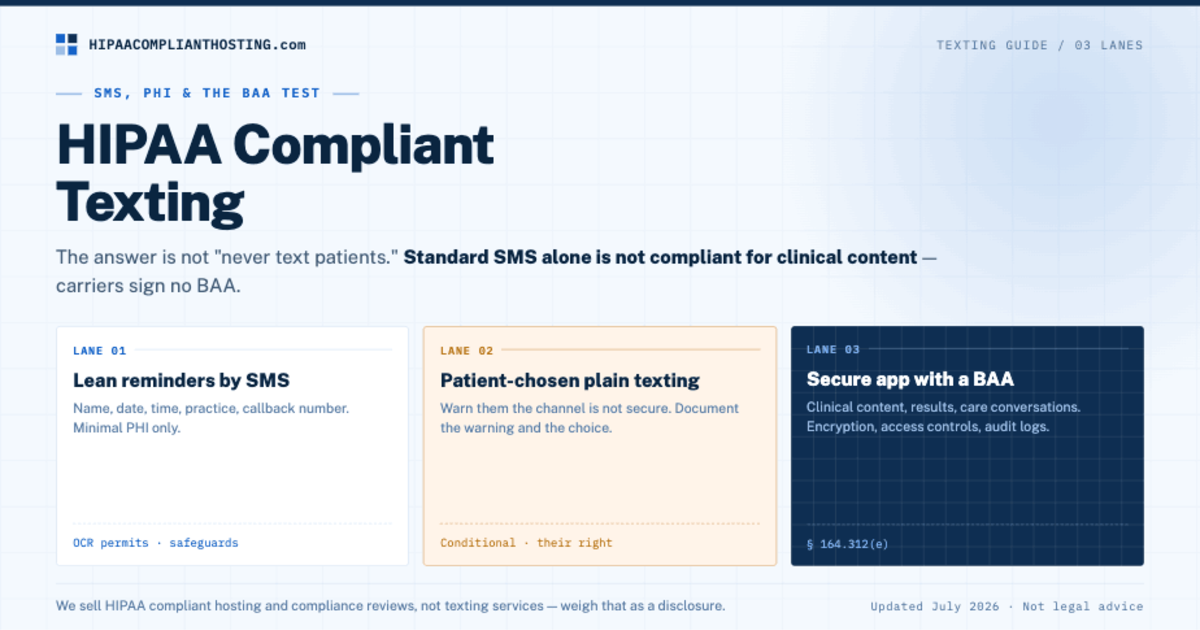
HIPAA compliant texting is possible in three lanes: appointment reminders with minimal detail, standard SMS a patient has chosen after a risk warning, and secure messaging apps that sign a Business Associate Agreement (BAA). Standard SMS on its own is not compliant for clinical content. Carriers sign no BAA. Messages sit unencrypted on phones. But the answer is not "never text patients." Practices text patients every day, lawfully. The rules of HIPAA compliant texting decide which lane a message belongs in. Reminders can go by plain text with safeguards. Clinical details need a covered app. And a patient can choose plain texting for themselves, once you warn them and write it down. This guide maps the lanes, the consent rules, and the apps.
TL;DR: Quick answer
HIPAA compliant texting has three lanes. Lean reminders by SMS. Patient-chosen plain texting, documented. Secure apps with a BAA for everything clinical.
OCR permits appointment reminders by SMS with reasonable safeguards. The message body must carry minimal PHI: name, date, practice, callback number.
Never put a diagnosis, test result, or medication in a plain text. That content needs a BAA-covered channel.
The TCPA sits on top of HIPAA. Collect opt-in consent at booking, name your practice in each message, and honor STOP at once.
Consumer SMS, iMessage, and WhatsApp sign no BAA. They are never compliant for clinical content. TigerConnect, Spruce, and Twilio-built flows can be, under a signed BAA.
Verified against published vendor terms and guidance in July 2026. Terms change; confirm before you sign.
When is a text PHI?
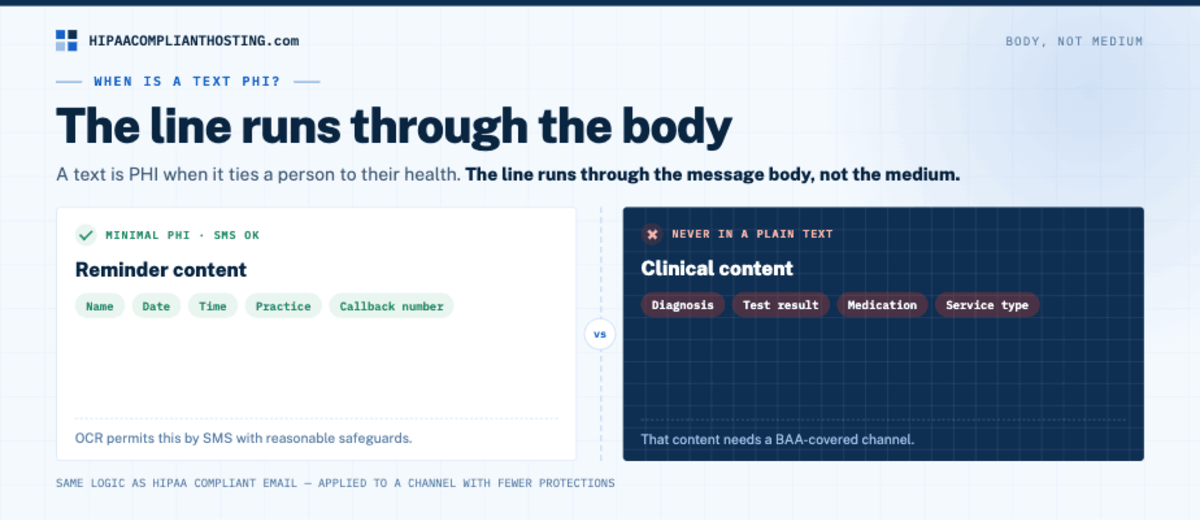
A text is PHI when it ties a person to their health. A reminder with a name, a date, and your practice name carries minimal PHI. OCR permits that by SMS with reasonable safeguards. A diagnosis, a test result, or a medication in the message body is a different matter. That content needs a covered channel. The line runs through the message body, not the medium. That line is where HIPAA compliant texting starts. It is the same logic that governs HIPAA compliant email, applied to a channel with even fewer built-in protections.
The three lanes of HIPAA compliant texting
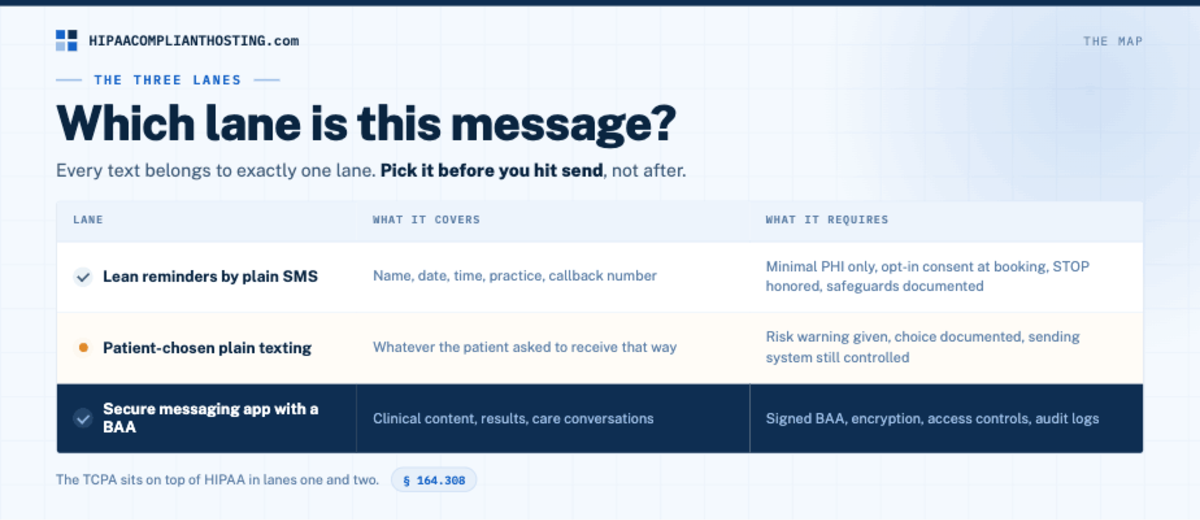
Three lanes make HIPAA compliant texting work in practice. Here is the map.
Lane | What it covers | What it requires |
|---|---|---|
Lean reminders by plain SMS | Name, date, time, practice, callback number | Minimal PHI only, opt-in consent at booking, STOP honored, safeguards documented |
Patient-chosen plain texting | Whatever the patient asked to receive that way | Risk warning given, choice documented, sending system still controlled |
Secure messaging app with a BAA | Clinical content, results, care conversations | Signed BAA, encryption, access controls, audit logs |
Lane one: reminder texts done right
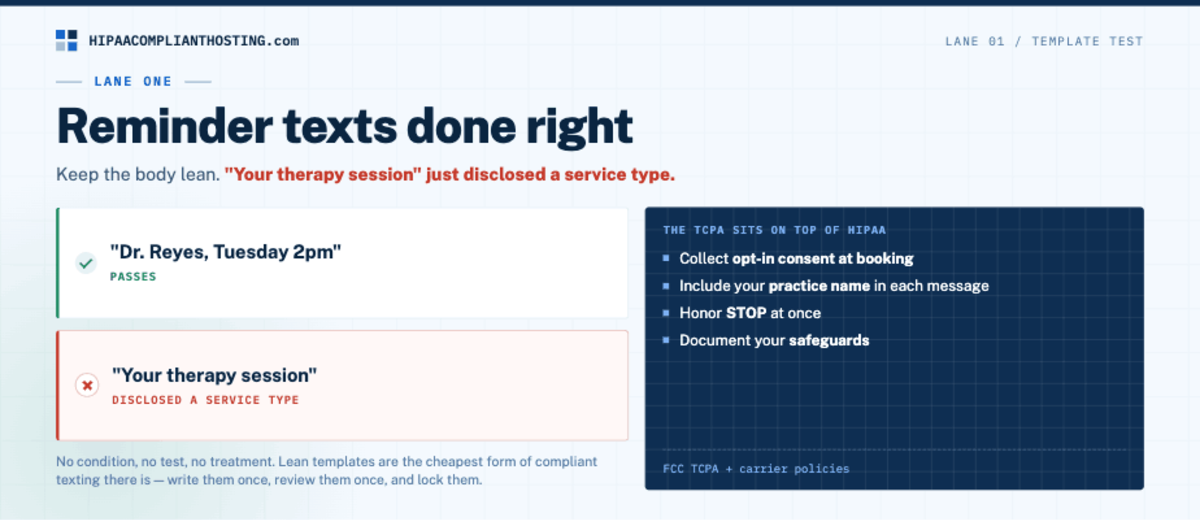
Keep the body lean. Name, date, time, practice, a number to call. No condition, no test, no treatment. Collect opt-in consent at booking. Include your practice name. Honor STOP immediately. Those last rules come from the TCPA and carrier policies, which sit on top of HIPAA. A reminder that says "Dr. Reyes, Tuesday 2pm" passes. A reminder that says "your therapy session" just disclosed a service type. Lean templates are the cheapest form of HIPAA compliant texting there is. Write them once, review them once, and lock them.
Lane two: the patient's choice
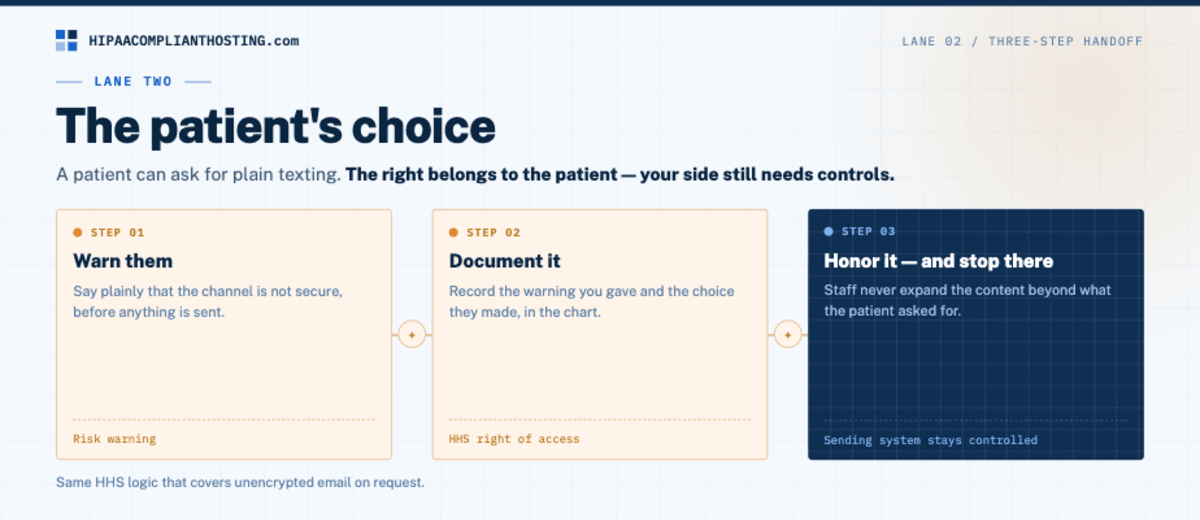
Like email, a patient can ask for plain texting. Warn them the channel is not secure. Document the warning and their choice. Then honor it, per the same HHS logic that covers unencrypted email on request. The right belongs to the patient. Your side still needs controls on the sending system. And staff should never expand the content beyond what the patient asked for.
Lane three: secure apps for clinical content
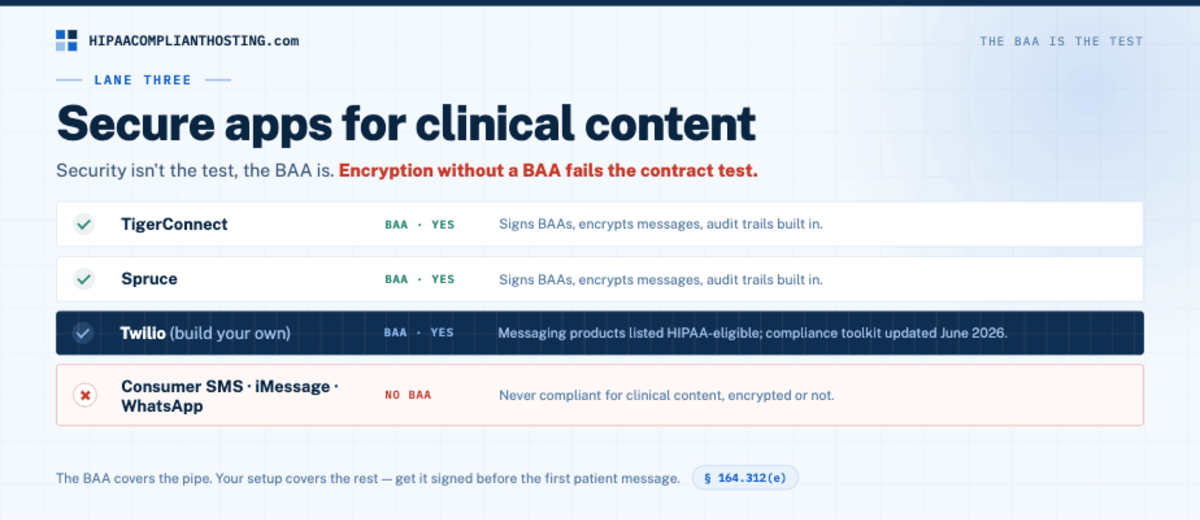
This is where secure messaging platforms earn their fee. This lane of HIPAA compliant texting covers real care conversations. TigerConnect and Spruce sign BAAs and encrypt messages, with audit trails built in. Teams building their own reminder or messaging flows can use Twilio. It signs a BAA and lists its messaging products as HIPAA-eligible, with a compliance toolkit update as recent as June 2026. The shared responsibility rule applies there too. The BAA covers the pipe. Your setup covers the rest, the same way it does for the AWS HIPAA eligible services a healthcare app runs on. Suite channels like Teams chat sit under the Microsoft 365 HIPAA umbrella. Email has the same BAA question; the vendor comparison is in best HIPAA compliant email.
The trap is drift
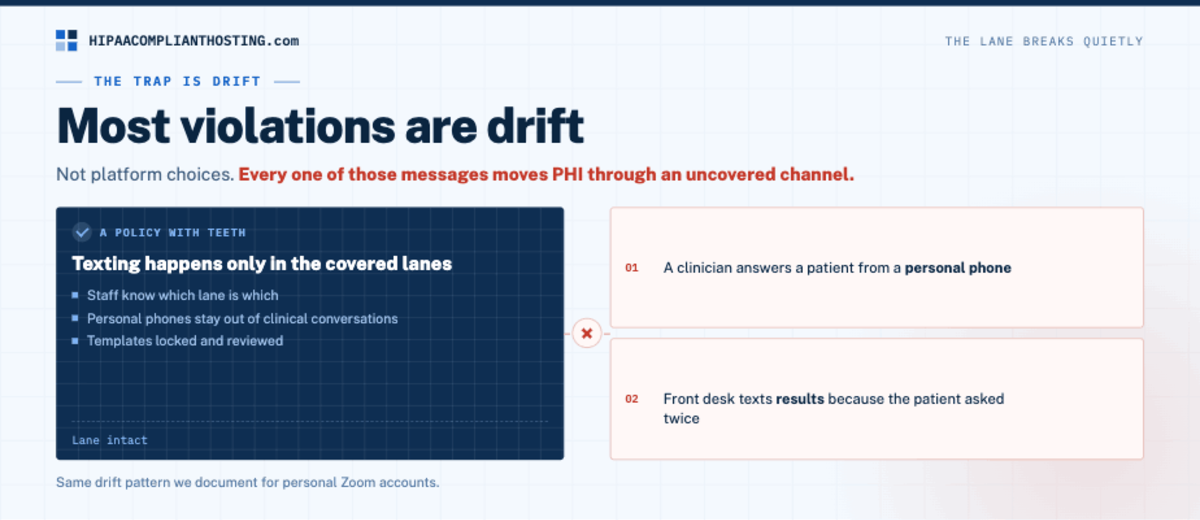
Most texting violations are not platform choices. A clinician answers a patient from a personal phone. A front desk texts results because the patient asked twice. Every one of those messages moves PHI through an uncovered channel. The fix is a policy with teeth. HIPAA compliant texting happens only in the covered lanes. Staff know which lane is which. Personal phones stay out of clinical conversations. It is the same drift pattern we document for personal Zoom accounts.
Your website is where the lanes start
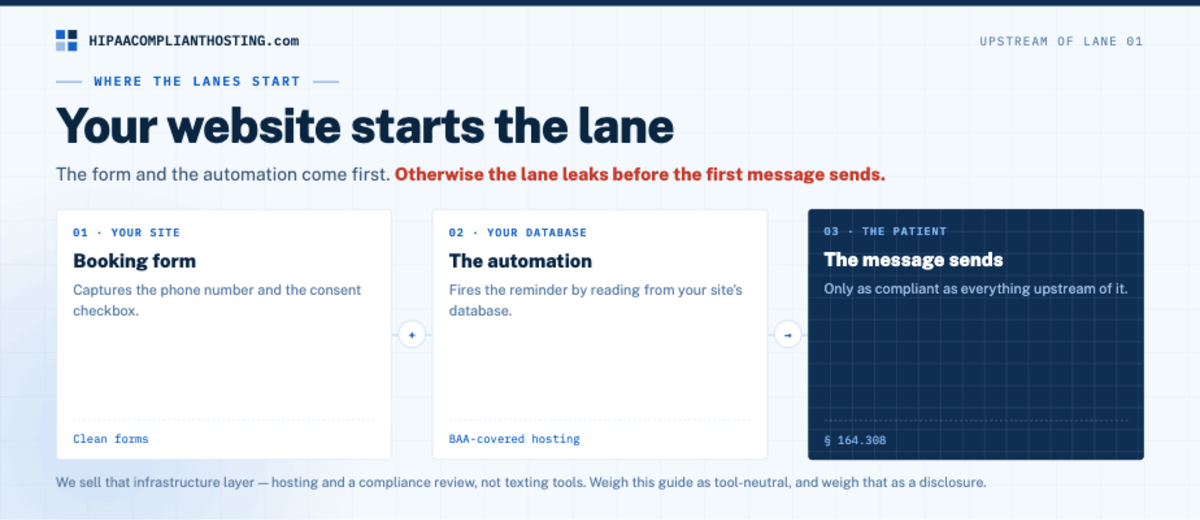
The booking form that captures the phone number and the consent checkbox lives on your site. The automation that fires the reminder reads from your site's database. Those pieces need BAA-covered hosting and clean forms. Otherwise the texting lane leaks before the first message sends. If that automation runs on n8n, our guide to an n8n HIPAA compliant setup shows where the data from each run lands and how long it stays. The booking side is mapped in is Calendly HIPAA compliant, and the wider visit path in HIPAA compliant telehealth. We sell that infrastructure layer: HIPAA compliant hosting and a client-side compliance review, not texting tools. So weigh this guide as tool-neutral, and weigh that as a disclosure. Tell us how patients book and hear from you and you will get a straight answer.
Frequently asked questions
Is texting HIPAA compliant?
It can be, in three lanes. Lean appointment reminders by SMS with safeguards. Plain texting a patient chose after a documented risk warning. And secure messaging apps under a signed BAA. Standard SMS alone never qualifies as HIPAA compliant texting for clinical details.
Can I text appointment reminders to patients?
Yes. OCR permits SMS reminders with reasonable safeguards when the body carries minimal PHI: name, date, time, practice, callback number. Collect opt-in consent at booking and honor STOP requests, which the TCPA requires on top of HIPAA.
Can a patient ask me to text them normally?
Yes. Warn them plain SMS is not secure. Document the warning and their choice, then honor it. The preference belongs to the patient. Your sending system still needs its own controls.
Is WhatsApp or iMessage HIPAA compliant?
No. Neither offers a BAA path, so neither can carry clinical content for a practice. Encryption without a BAA fails the contract test, the same as consumer email.
Do I need a BAA with my texting platform?
Yes, for any platform that stores or transmits PHI on your behalf. TigerConnect, Spruce, and Twilio's HIPAA-eligible products offer one. Get it signed before the first patient message, and confirm current terms with the vendor.
Recap: HIPAA compliant texting
To recap, HIPAA compliant texting runs in three lanes. Keep reminder texts lean and consented. Let patients choose plain texting only after a documented warning. Put everything clinical in a secure app under a signed BAA. Keep personal phones out of it. And remember the lanes start at your website. The forms, consent capture, and automations behind the texts need BAA-covered infrastructure of their own.
This article is general information, not legal advice. OCR guidance, TCPA rules, and vendor BAA terms are as published in July 2026 and change; confirm current terms with each vendor, consult qualified counsel, and base your safeguards on a documented risk analysis. We sell HIPAA compliant hosting and compliance reviews, not texting services. Reviewed July 2026.
Sources
HIPAA Journal: Is Texting in Violation of HIPAA? (2026 update)
HHS: Individuals' Right of Access (incl. communications in the form the individual requests)
45 CFR § 164.308 (administrative safeguards, BAA requirement): ecfr.gov
45 CFR § 164.312(e) (transmission security): ecfr.gov