


Is CodeIgniter HIPAA Compliant? Shield, the Off-by-Default Settings, and 2026 CVEs
HIPAA Compliant Hosting · https://hipaacomplianthosting.com/blog/is-codeigniter-hipaa-compliant
Last updated: September 21, 2026
CodeIgniter is not HIPAA compliant on its own, and no framework is. HIPAA regulates the organizations that handle patient data, not the code they use. CodeIgniter 4 also needs more setup than most frameworks, because several safeguards ship turned off. A CodeIgniter HIPAA compliant app starts with a host that signs a Business Associate Agreement (BAA). Then you switch on CSRF protection, secure cookies, and two-factor login, and add an audit trail. You also need a patched version, since three Critical flaws were fixed in 2026. This guide lists every default to change and what CodeIgniter Shield adds. It also covers who can sign the BAA. Every fact was checked against CodeIgniter's user guide and GitHub on September 14, 2026.
TL;DR: Quick answer
CSRF protection is off by default in CodeIgniter 4. So is the secure flag on session cookies. You turn both on yourself.
CodeIgniter Shield, the official auth library, adds login, groups, permissions, and email two-factor codes. Its two-factor and email activation steps are off until you set them.
CodeIgniter encrypts data with AES-256-CTR and a SHA512 HMAC, but only when your code calls it. There is no built-in audit log.
CodeIgniter 4.7.4, released July 7, 2026, fixed two Critical flaws. A third Critical flaw was fixed in 4.7.3 in May 2026.
CodeIgniter has no official hosting product, so no CodeIgniter vendor signs a BAA. Your host must.
Is CodeIgniter HIPAA compliant? The three-layer answer
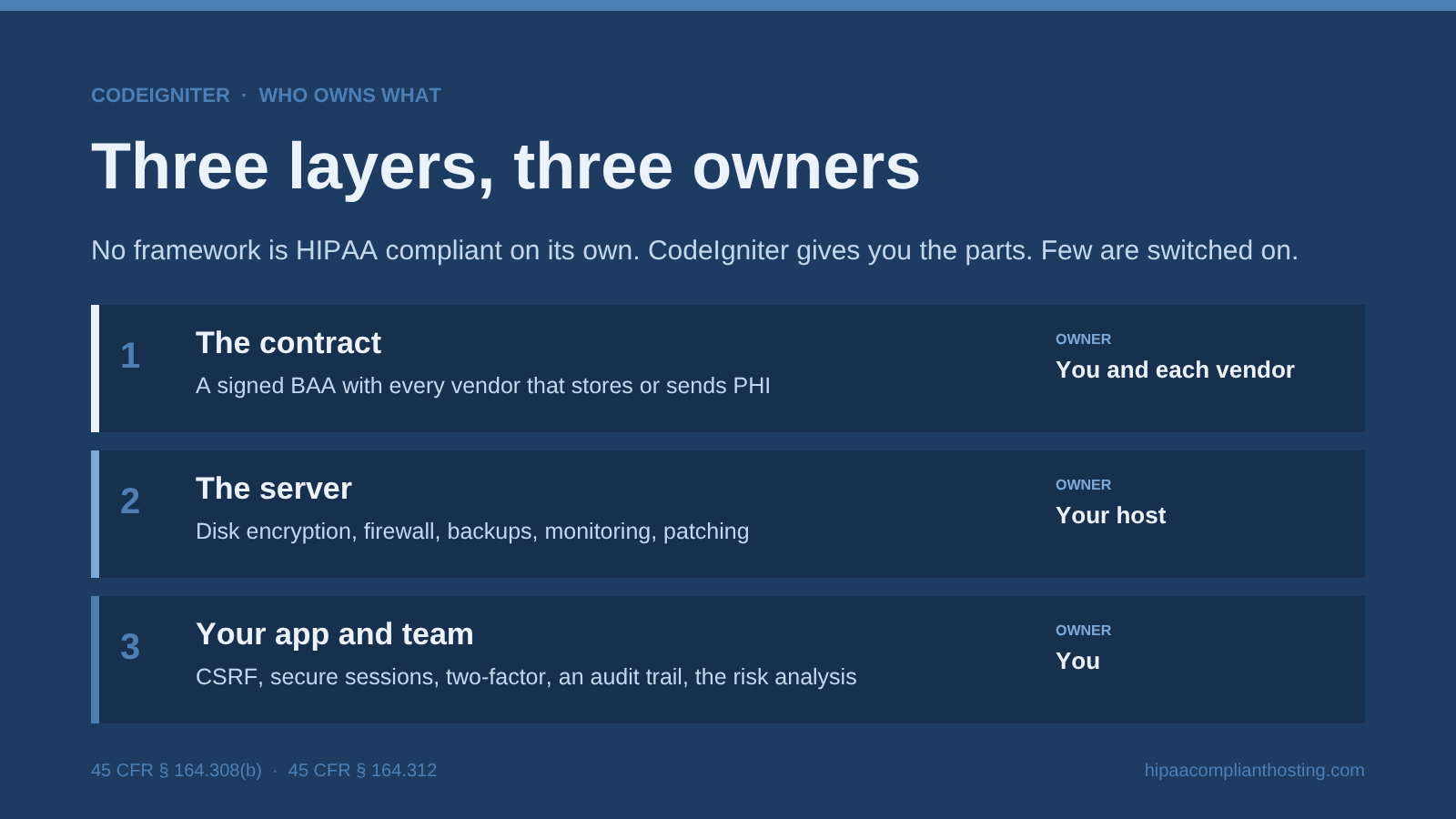
A CodeIgniter HIPAA compliant system has three layers, and each one needs an owner. The first is the contract. Any vendor that stores or processes protected health information (PHI) for a covered entity is a business associate under 45 CFR § 160.103. Under 45 CFR § 164.308(b), you need a signed BAA with that vendor first. Our HIPAA business associate agreement guide explains what it must cover. The second layer is the server. The host runs the physical safeguards, disk encryption, firewalls, backups, and patching. The third layer is your app and your team. The HIPAA Security Rule lists five technical safeguards in 45 CFR § 164.312. They are access control, audit controls, integrity, person or entity authentication, and transmission security. CodeIgniter and Shield give you the parts for most of them. Few of those parts are switched on for you. You also run a risk analysis under 45 CFR § 164.308(a)(1). CodeIgniter still powers many clinic, lab, and billing apps built years ago. That history is why the CodeIgniter HIPAA compliant question often starts with an old version. Teams moving to a newer PHP framework can compare the Laravel HIPAA compliant and Symfony HIPAA compliant routes.
What does CodeIgniter 4 give you for the HIPAA technical safeguards?
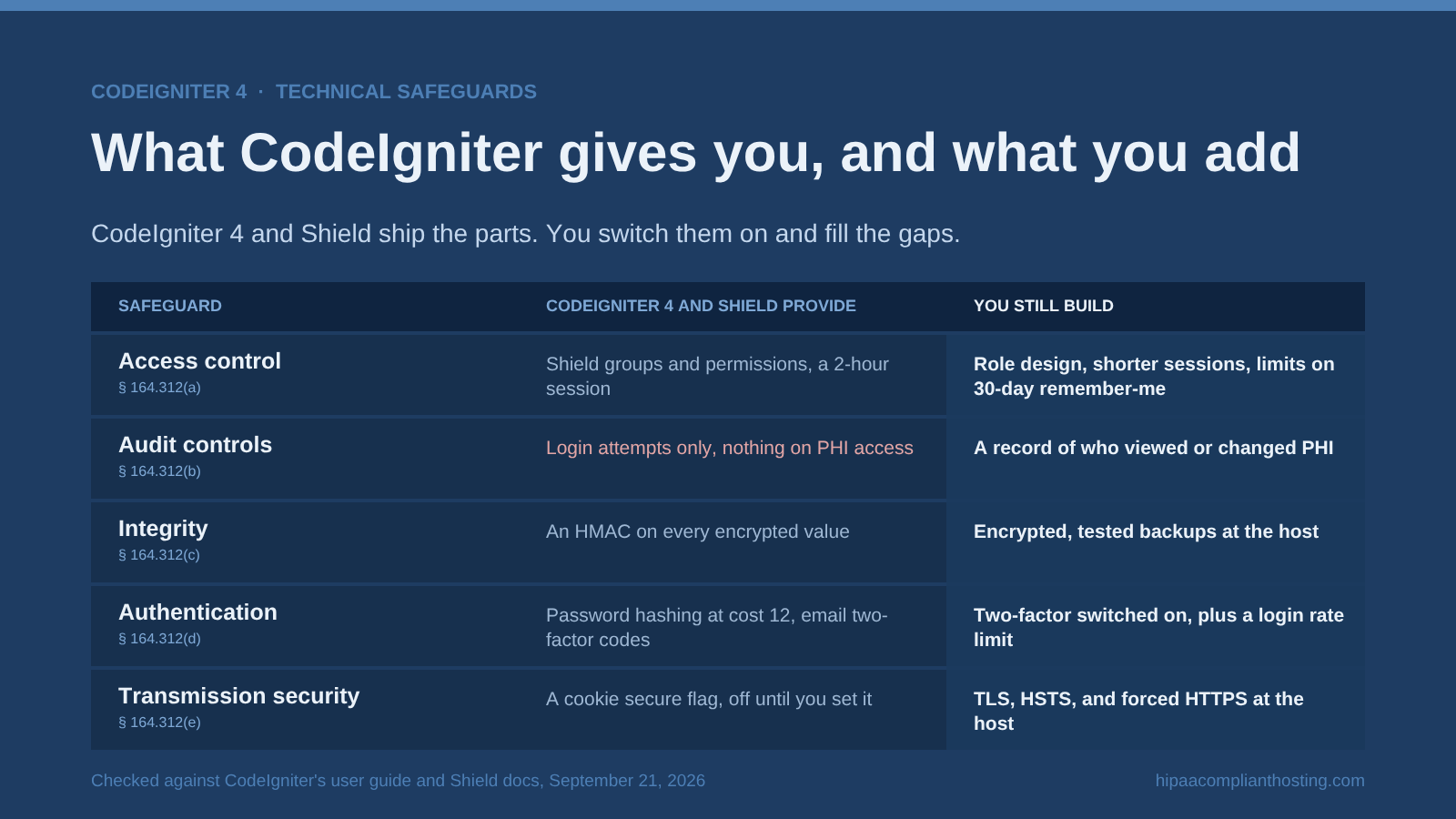
Here is how CodeIgniter 4 and Shield map to each rule in 45 CFR § 164.312. The last column is what a CodeIgniter HIPAA compliant app still needs from you or your host.
Safeguard (45 CFR § 164.312) | What CodeIgniter 4 and Shield provide | What you still add |
|---|---|---|
Access control, (a) | Shield groups and permissions; a 2-hour session expiration by default | Role design, a shorter session, and limits on 30-day remember-me logins |
Audit controls, (b) | Shield records every login attempt in its auth_logins table; general logging | A record of who viewed or changed PHI, plus server and database logs from the host |
Integrity, (c) | An HMAC on every encrypted value | Encrypted, tested database backups at the host |
Person or entity authentication, (d) | Shield password hashing at cost 12; email two-factor codes; token login for APIs | Turning on two-factor, and a rate limit on login built with the Throttler |
Transmission security, (e) | A cookie secure flag you can enable; trusted proxy checks since 4.7.4 | TLS, HSTS, and forced HTTPS at the host or proxy |
CodeIgniter's own security guidelines say to encrypt all sensitive data at rest. The framework gives you the tool, not the habit. Its Encryption service uses OpenSSL with AES-256-CTR, a SHA512 HMAC, and HKDF key derivation. Since version 4.7.0, a previousKeys option lets you rotate keys. But nothing encrypts a model field for you. Your code must call encrypt and decrypt for every PHI field. That is the core of CodeIgniter HIPAA compliant encryption at rest and in transit at the app level.
Which CodeIgniter safeguards are off by default?
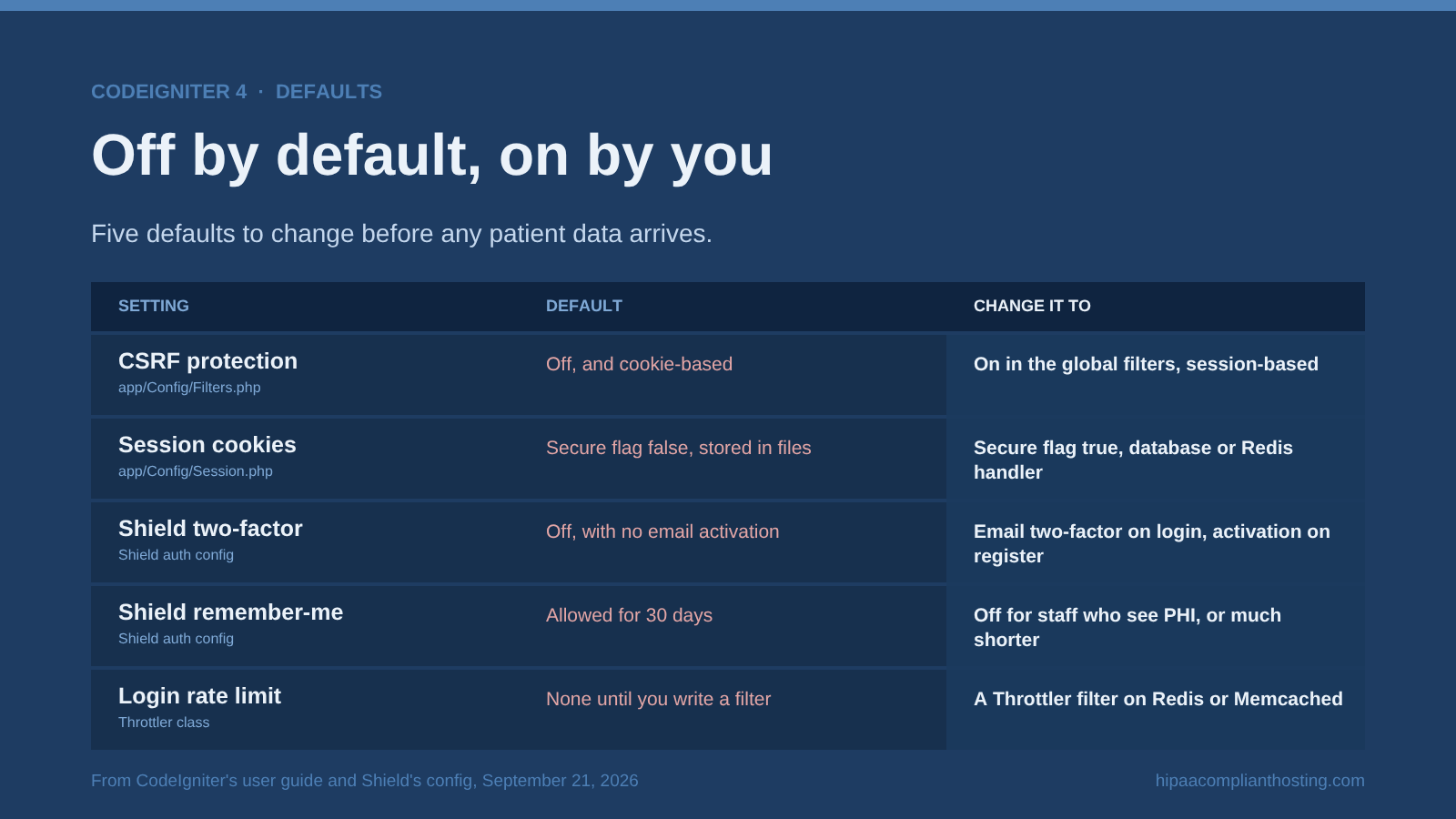
More than most teams expect, which is why CodeIgniter HIPAA compliant reviews start here. These defaults come from CodeIgniter's user guide and Shield's config file. Each one needs a change before a CodeIgniter HIPAA compliant app goes live.
Setting | Default | Change it to |
|---|---|---|
CSRF protection | Off; the csrf filter is not in the global filters | Add csrf to the globals in app/Config/Filters.php |
CSRF method | Cookie-based | Session-based, which the guide recommends for apps with sessions |
Session cookie secure flag | False | True, so cookies only travel over HTTPS |
Session handler | Files | Database or Redis, or files in a 0700 directory |
Shield login and register actions | Null, so no two-factor and no email activation | Email two-factor on login, and email activation on register |
Shield remember-me | Allowed, for 30 days | Off for staff who can see PHI, or much shorter |
Login rate limiting | None until you write a filter | A Throttler filter backed by Redis or Memcached |
The Throttler deserves a note in any CodeIgniter HIPAA compliant plan. CodeIgniter's guide says the class does no rate limiting on its own. It is a token bucket you wire into a filter, and it needs a real cache handler. The remember-me default matters too. A 30-day login cookie works against the automatic logoff rule, explained in HIPAA automatic logoff. Yii 2 has the same clash, and its docs say so plainly: with cookie auto-login on, the idle timeout does not work. The Yii HIPAA compliant checklist shows how to turn that timeout on and auto-login off.
Which CodeIgniter versions are safe to run?
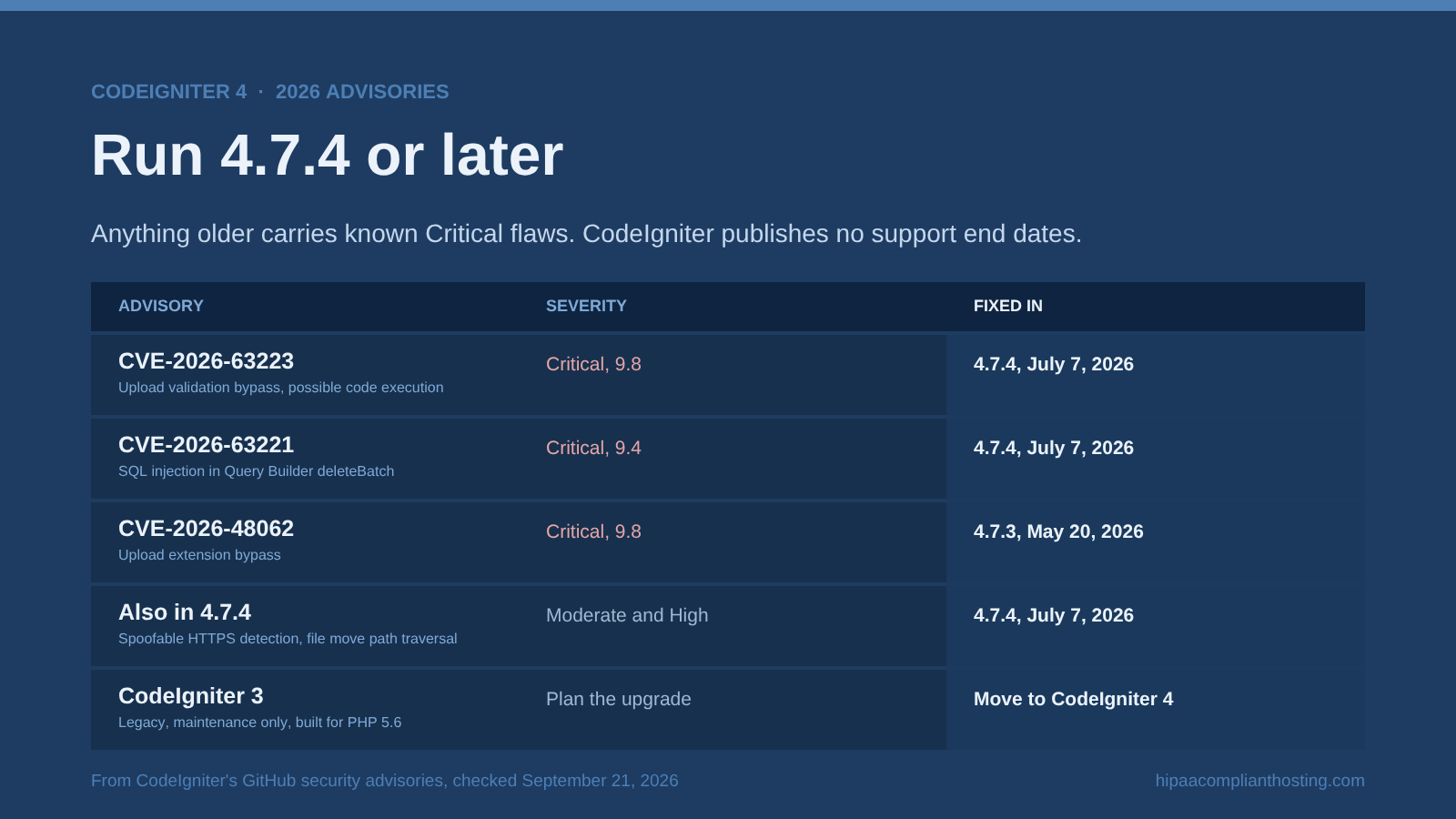
Only a current, patched CodeIgniter 4. The 2026 advisories make that plain. On July 7, 2026, CodeIgniter 4.7.4 fixed CVE-2026-63223, rated Critical at 9.8. That flaw could lead to remote code execution through file uploads, under certain setups. The same release fixed CVE-2026-63221, a Critical SQL injection in the Query Builder's deleteBatch method, rated 9.4. It also fixed spoofable HTTPS detection and a path traversal in file moves. Earlier, on May 20, 2026, version 4.7.3 fixed CVE-2026-48062, another Critical upload bypass rated 9.8. A CodeIgniter HIPAA compliant app on anything older than 4.7.4 carries known Critical risks.
CodeIgniter 3 is a different story for any CodeIgniter HIPAA compliant plan. Its GitHub page calls it the legacy version, in maintenance, receiving mostly security updates. It was built for PHP 5.6. Shield, the CodeIgniter 4 auth library, released version 1.4.1 on August 18, 2026. CodeIgniter publishes no support calendar with end dates for version 3 or 4, so record your version and upgrade plan in your HIPAA risk analysis. Unlike CodeIgniter, CakePHP publishes support end dates, and its 4.x line lost security fixes on September 10, 2026. If you also maintain a CakePHP app, our CakePHP HIPAA compliant guide covers safe releases and the safeguards CakePHP 5 still lacks.
The 9 settings that make a CodeIgniter app HIPAA-ready
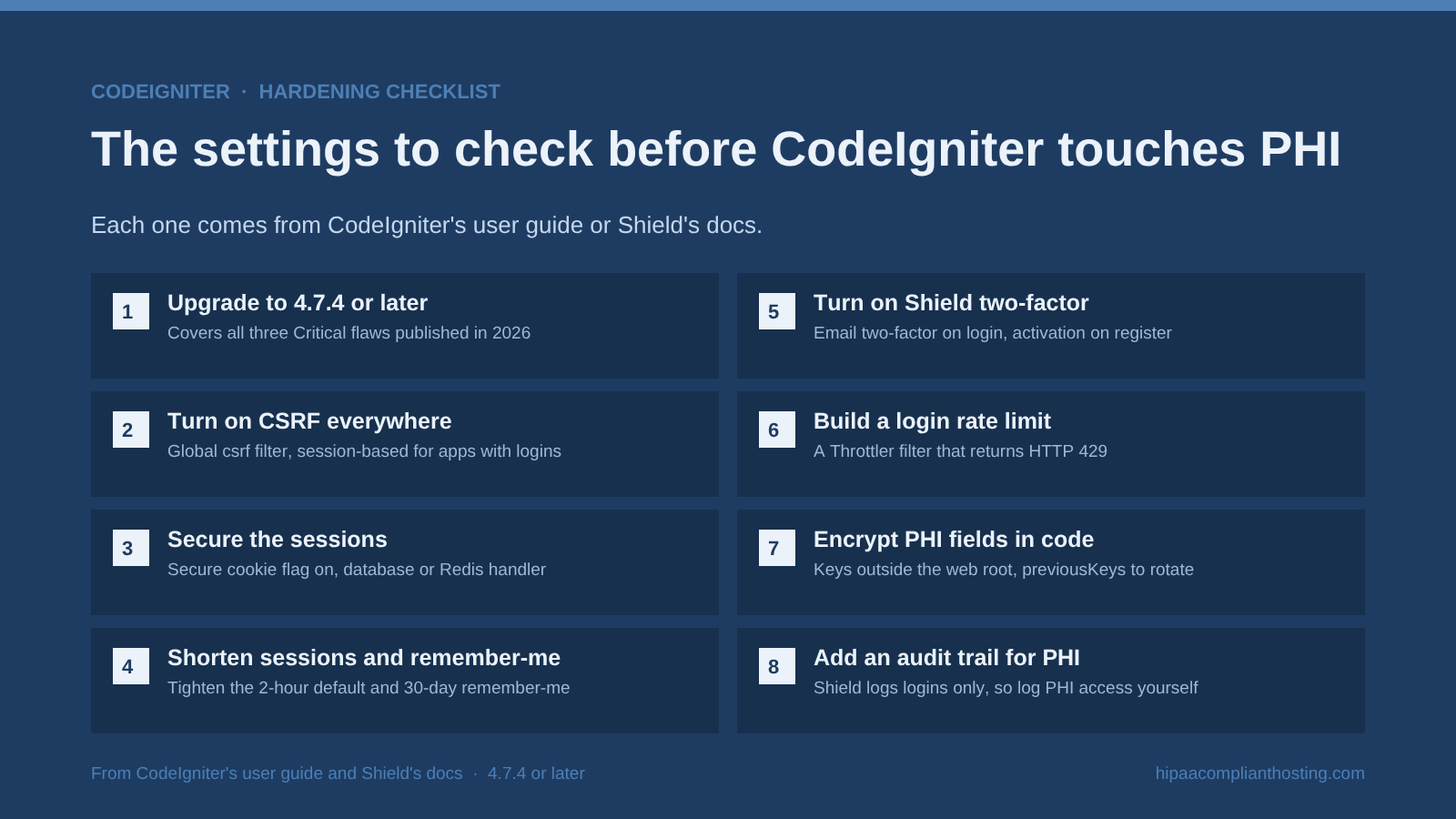
These are the first settings we check in CodeIgniter HIPAA compliant reviews. Each one comes from CodeIgniter's user guide or Shield's docs.
Upgrade to 4.7.4 or later. That covers all three Critical flaws published in 2026.
Turn on CSRF everywhere. Add the csrf filter to the global before filters. Use session-based CSRF if your app has logins.
Secure the session cookie. Set the cookie secure flag to true and keep sameSite at Lax or stricter.
Move sessions off shared files. Use the database or Redis handler. If you keep files, lock the save path to mode 0700.
Shorten sessions and remember-me. The session expiration defaults to 2 hours. Shield's remember-me lasts 30 days. Tighten both for staff who see PHI.
Turn on Shield's two-factor and activation steps. Set the login action to email two-factor and the register action to email activation.
Build a login rate limit. Write a Throttler filter that returns HTTP 429, backed by Redis or Memcached.
Encrypt PHI fields in code. Generate a key with createKey, store it outside the web root, and use previousKeys for rotation.
Add an audit trail for PHI. Shield logs logins only. Record who viewed or changed patient records, and keep PHI out of log messages.
Item 6 ties to the rules in HIPAA MFA requirements. Shield's two-factor login uses emailed codes, not an authenticator app. If your policy needs app-based codes, add them through SSO or a separate library. With all nine in place, most CodeIgniter HIPAA compliant work inside the app is done.
Where do CodeIgniter apps leak PHI?
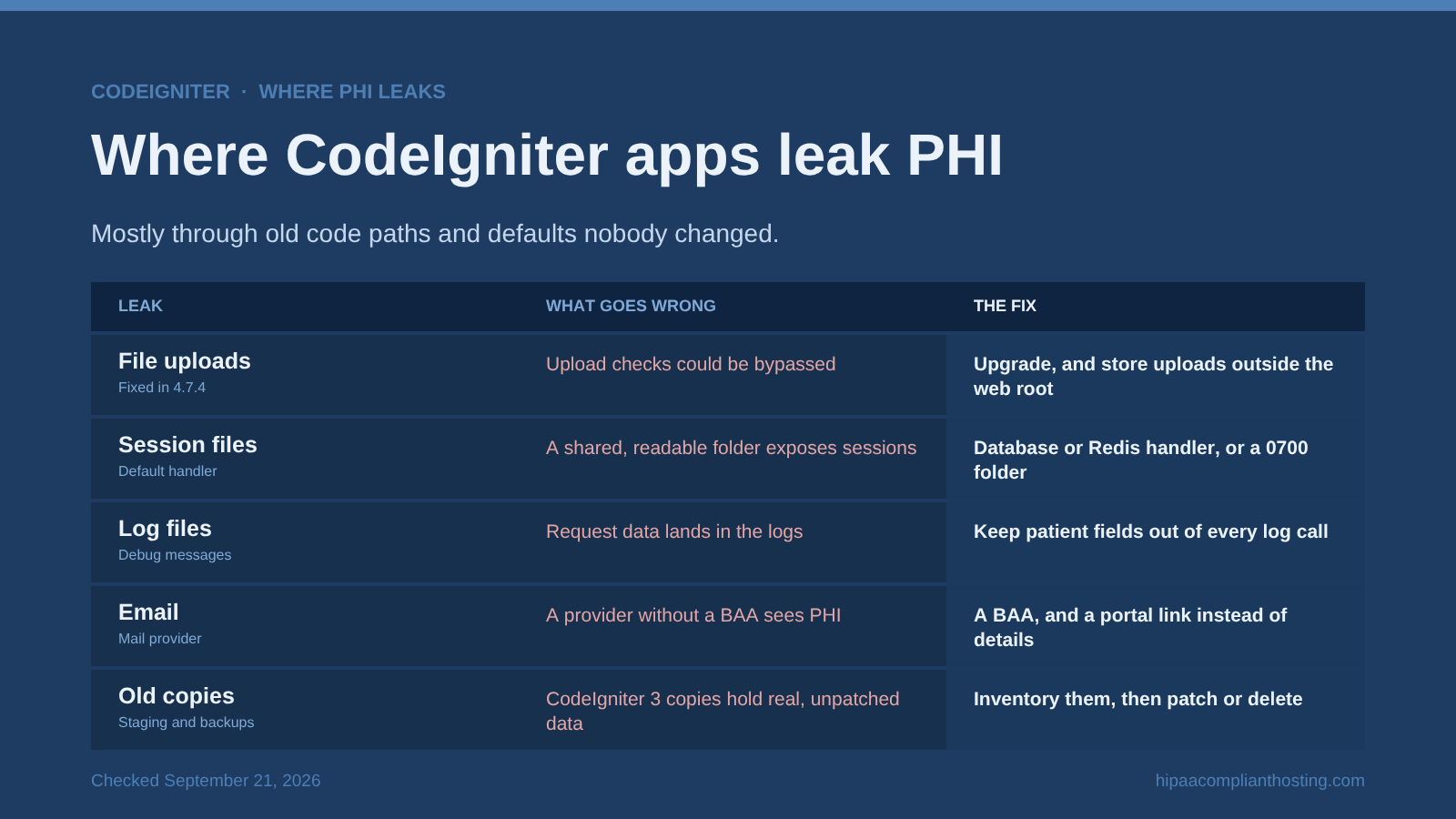
Mostly through old code paths and defaults nobody changed. A CodeIgniter HIPAA compliant setup closes each one. These are the leaks we see most in CodeIgniter HIPAA compliant reviews.
File uploads. Before 4.7.4, upload checks could be bypassed. Uploads stored in a web folder could run as code.
Session files. A shared, readable session folder lets anyone on the server steal a session.
Log files. Debug messages often include request data. Keep patient fields out of every log call.
Email. Your mail provider needs a BAA. Keep PHI out of email bodies and link to a secure portal instead.
Old copies of the app. Staging servers and backups of a CodeIgniter 3 app can hold real patient data with no patching at all.
The developers who maintain these apps carry part of this duty. The basics are in HIPAA training for web developers.
Who signs the BAA for a CodeIgniter app, and what does it cost?
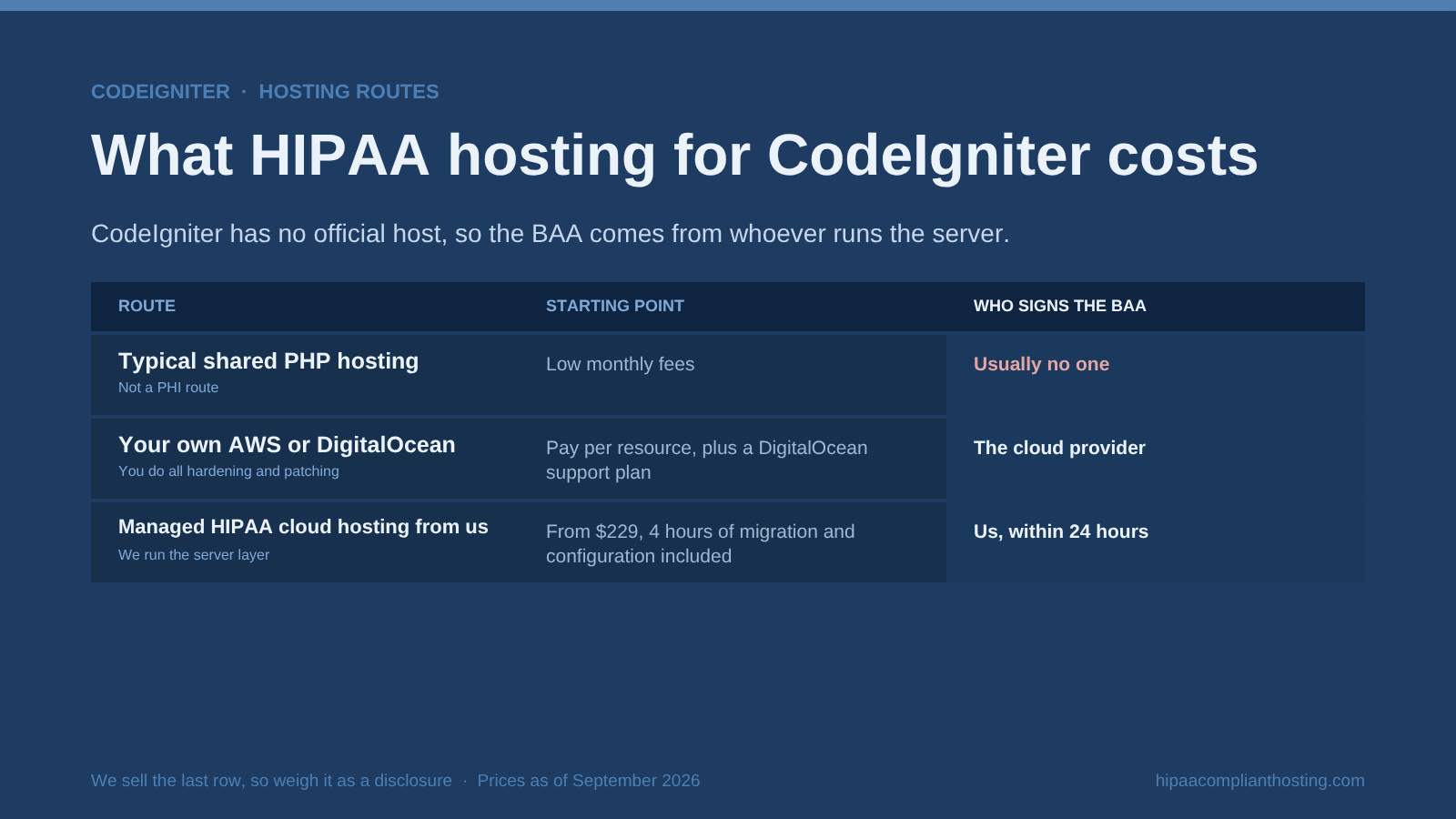
Your host does. CodeIgniter has no official hosting product that we could find, so no CodeIgniter vendor signs a BAA. A CodeIgniter HIPAA compliant budget starts with a host that will. Our September 11, 2026 review of app platforms found several that sign, each with conditions. AWS signs in AWS Artifact. DigitalOcean signs through Sales or Support, with a paid support plan. The full list is in HIPAA compliant app hosting.
Route | Published starting point | Who signs the BAA | What you still own |
|---|---|---|---|
Typical shared PHP hosting | Low monthly fees | Usually no one; check before you sign up | Not a PHI route without a BAA |
Your own AWS or DigitalOcean server | Pay per resource, plus a support plan on DigitalOcean | The cloud provider | All hardening, PHP and database patching, logs, backups, and the engineer's hours |
Managed HIPAA cloud hosting from us | From $229 per month, 4 hours of migration and configuration included | Us, within 24 hours | App settings, code upgrades, risk analysis, and other vendors' BAAs |
We sell the last row, so weigh it as a disclosure. The DIY row looks cheapest until you price the monthly patching. Your database needs the same care, as covered in HIPAA compliant database hosting.
If you would rather not run the server layer yourself
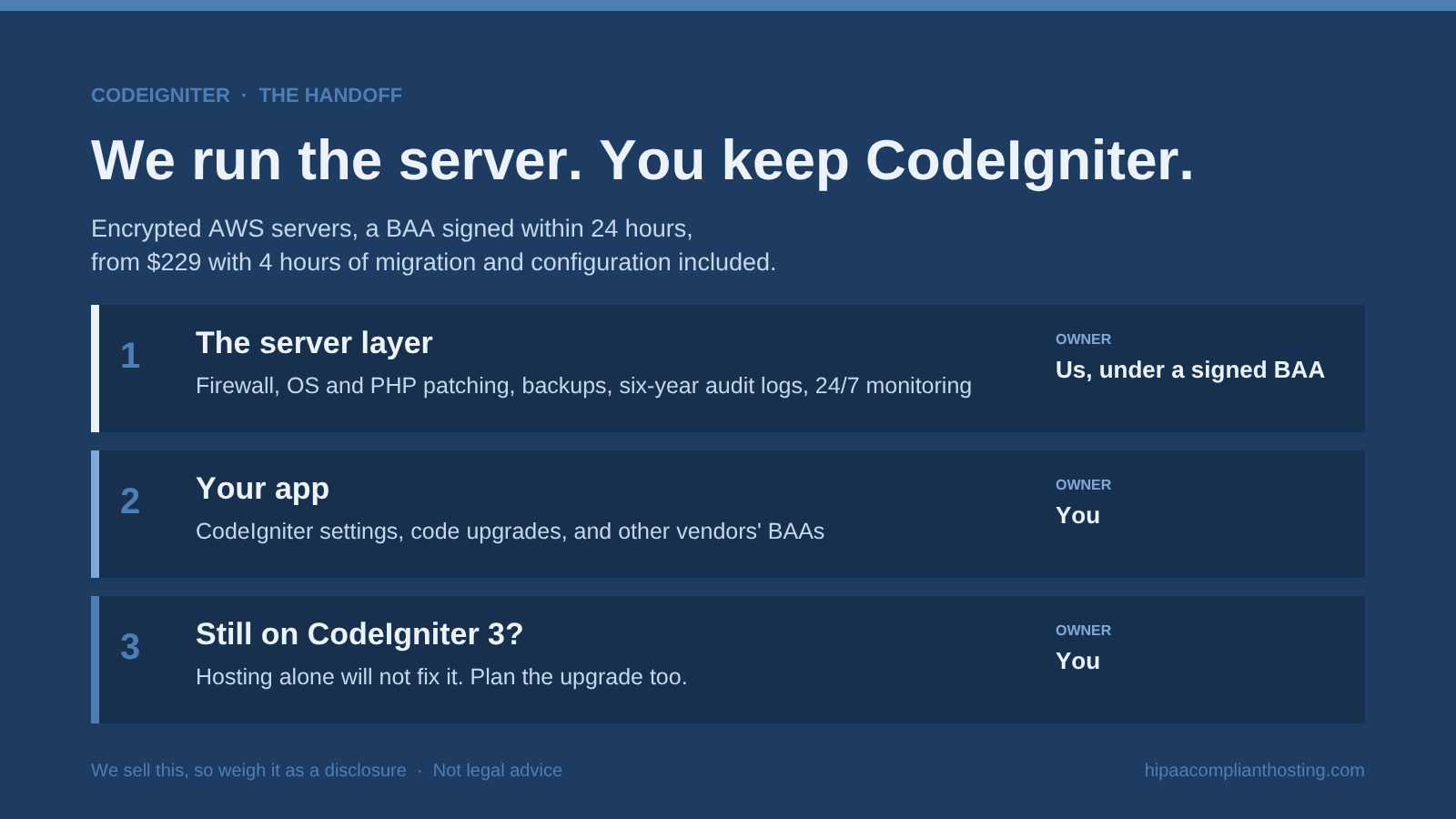
Most teams running CodeIgniter want to maintain their app, not a server. Our managed HIPAA cloud hosting runs CodeIgniter HIPAA compliant apps on encrypted AWS servers. Each server comes with a web application firewall, encrypted backups, audit logs kept for six years, and 24/7 monitoring. The BAA is signed within 24 hours. Plans start from $229 per month with 4 hours of migration and configuration included. The CodeIgniter-specific plan details are on our HIPAA compliant CodeIgniter hosting page. If you have containerized the app, HIPAA compliant Docker hosting starts from $259 per month. You keep CodeIgniter and your code. We run the server layer, patch the operating system and PHP runtime, and sign for it. We sell this, so weigh it as a disclosure.
Here is the honest inverse. If your CodeIgniter app never stores or sends PHI for a covered entity, HIPAA does not apply, and you do not need us. If your team runs AWS under AWS's BAA with an engineer who owns patching and logs, that path works and costs less in cash. And if your app is still on CodeIgniter 3, hosting alone will not fix it; plan the upgrade too. For everyone else, our HIPAA compliant hosting plans are public. You can request a quote or tell us what your app does and get a straight answer.
Frequently asked questions
Is CodeIgniter HIPAA compliant?
No framework is HIPAA compliant by itself. A CodeIgniter HIPAA compliant app needs a host that signs a BAA. It also needs CSRF protection, secure cookies, two-factor login, encrypted PHI fields, and an audit trail turned on. Several of those are off by default in CodeIgniter 4.
Does CodeIgniter have CSRF protection by default?
No. CodeIgniter 4 includes CSRF protection, but it is off until you add the csrf filter to the global filters in app/Config/Filters.php. The user guide recommends session-based CSRF for apps that use sessions.
Is CodeIgniter 3 end of life?
CodeIgniter's GitHub page calls version 3 the legacy version, in maintenance and receiving mostly security updates. It was built for PHP 5.6. No end date is published. For a HIPAA app, plan a move to a patched CodeIgniter 4.
Which CodeIgniter version fixes the 2026 Critical CVEs?
Version 4.7.4, released July 7, 2026, fixed CVE-2026-63223 and CVE-2026-63221. Version 4.7.3 fixed CVE-2026-48062 in May 2026. Running 4.7.4 or later covers all three.
Do I need a BAA for a CodeIgniter app?
Yes, if the app stores or sends PHI for a clinic, health plan, or other covered entity. Every vendor that touches that data needs one, starting with your host. CodeIgniter has no official host, so your hosting provider must sign.
Recap: CodeIgniter HIPAA compliant
To recap, a CodeIgniter HIPAA compliant app needs a host that signs a BAA and a hardened server. It also needs a lot of settings switched on. CodeIgniter 4 ships with CSRF off, secure cookies off, and Shield's two-factor off. It has strong encryption tools but no automatic field encryption and no audit log. Shield adds groups, permissions, email two-factor, and login records. Upgrade to 4.7.4 or later, turn on every default in the table above, and keep PHI out of logs, uploads, and email.
This article is general information, not legal advice. Versions, defaults, and support status change often. The details here reflect CodeIgniter's user guide, the Shield repository, and GitHub advisories as read on September 14, 2026. The latest release and advisory list were rechecked on September 21, 2026. Hosting details come from our September 11, 2026 review. Confirm current terms with each vendor, consult qualified counsel, and base your safeguards on a documented risk analysis. We sell HIPAA compliant hosting and compliance reviews. Reviewed September 2026.
Sources
CodeIgniter user guide: Version 4.7.4 changelog and Security guidelines.
CodeIgniter user guide: Security and CSRF, Sessions, Encryption, Throttler.
CodeIgniter Shield: Documentation, Auth config defaults, and Releases.
GitHub advisories: CVE-2026-63223, CVE-2026-63221, and CVE-2026-48062.
CodeIgniter 3: Repository and maintenance status.
45 CFR § 164.312 (technical safeguards): law.cornell.edu.
45 CFR § 164.308 (administrative safeguards, BAA requirement): ecfr.gov.
45 CFR § 160.103 (definitions): ecfr.gov.