


Google Workspace Signed Your BAA. Here's What It Still Doesn't Cover (2026)
HIPAA Compliant Hosting · https://hipaacomplianthosting.com/blog/google-workspace-baa-what-it-does-not-cover
Last updated: September 22, 2026
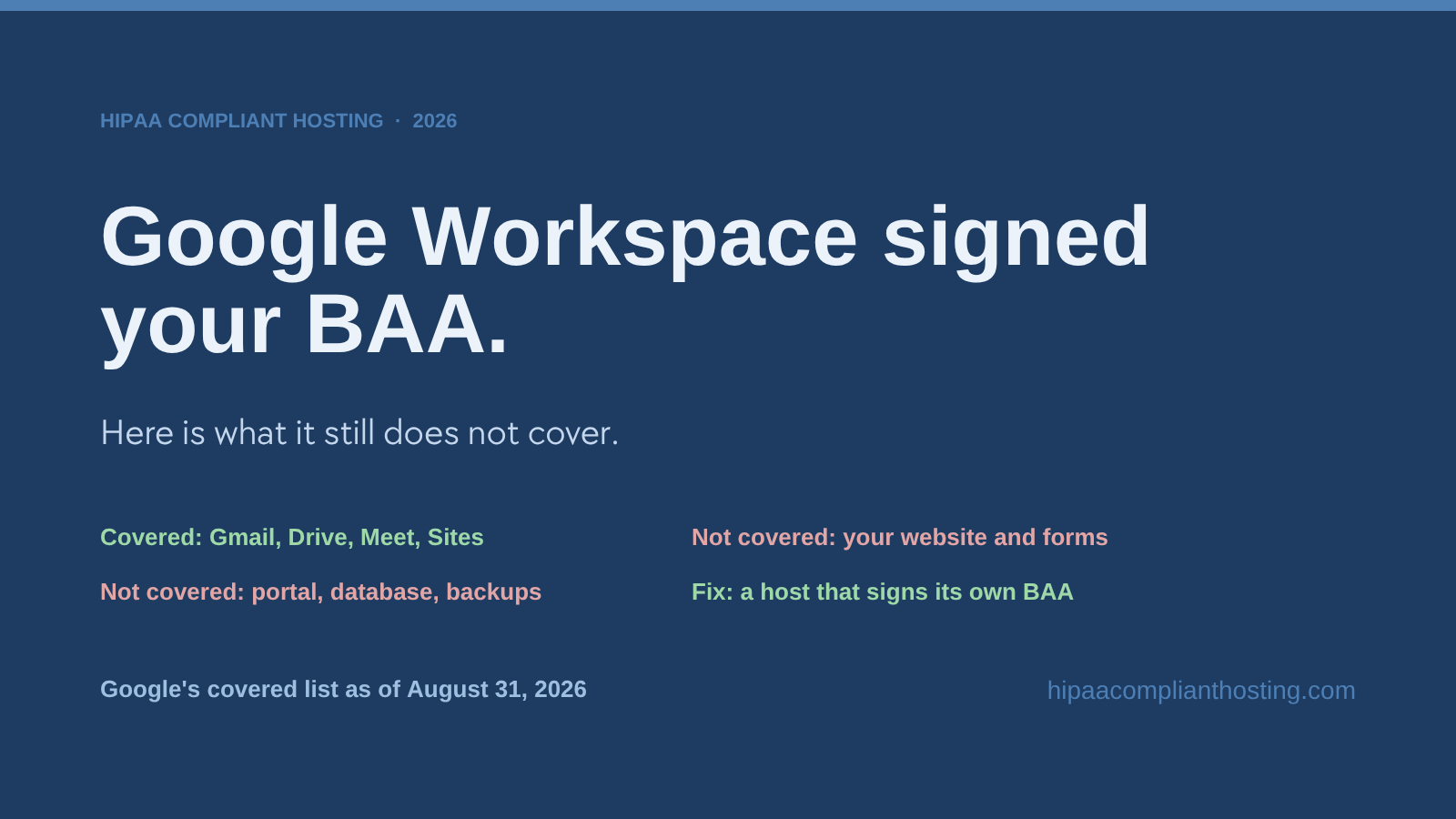
You accepted the BAA in the Admin Console, turned off the services it does not cover, and enforced MFA. Good. That covers the apps on Google's list, and nothing else your practice runs. The Google Workspace BAA follows Google's apps. It does not follow patient data once that data leaves them. Your website, your intake forms, your patient portal, and the database behind them sit outside it. So do the email your web server sends and the backups of all of the above. Each of those needs its own Business Associate Agreement with whoever hosts it. This guide maps the six gaps, gives you a three-question test, and lists what a BAA-covered host has to provide. We sell HIPAA compliant hosting, so weigh our advice accordingly. Every fact here was checked against Google's published HIPAA terms on September 22, 2026.
TL;DR: Quick answer
The Google Workspace BAA covers a set list of apps. Gmail, Calendar, Drive, Docs, Sheets, Forms, Meet, Chat, Sites, Vault, and Gemini in Workspace are on it, with about a dozen others.
It does not cover your website, its intake or appointment forms, or a patient portal. It does not cover the database behind them, notification email sent from your web server, or backups.
Google Sites is on the covered list, but it cannot run a form pipeline with server-side storage, a database, or a portal with custom code.
A host that stores or transmits ePHI is a business associate under 45 CFR § 160.103. It must sign its own BAA under 45 CFR § 164.308(b) and § 164.504(e).
The three-question test near the end tells you in under a minute whether this gap is open at your practice.
What the Google Workspace BAA covers, and where it stops
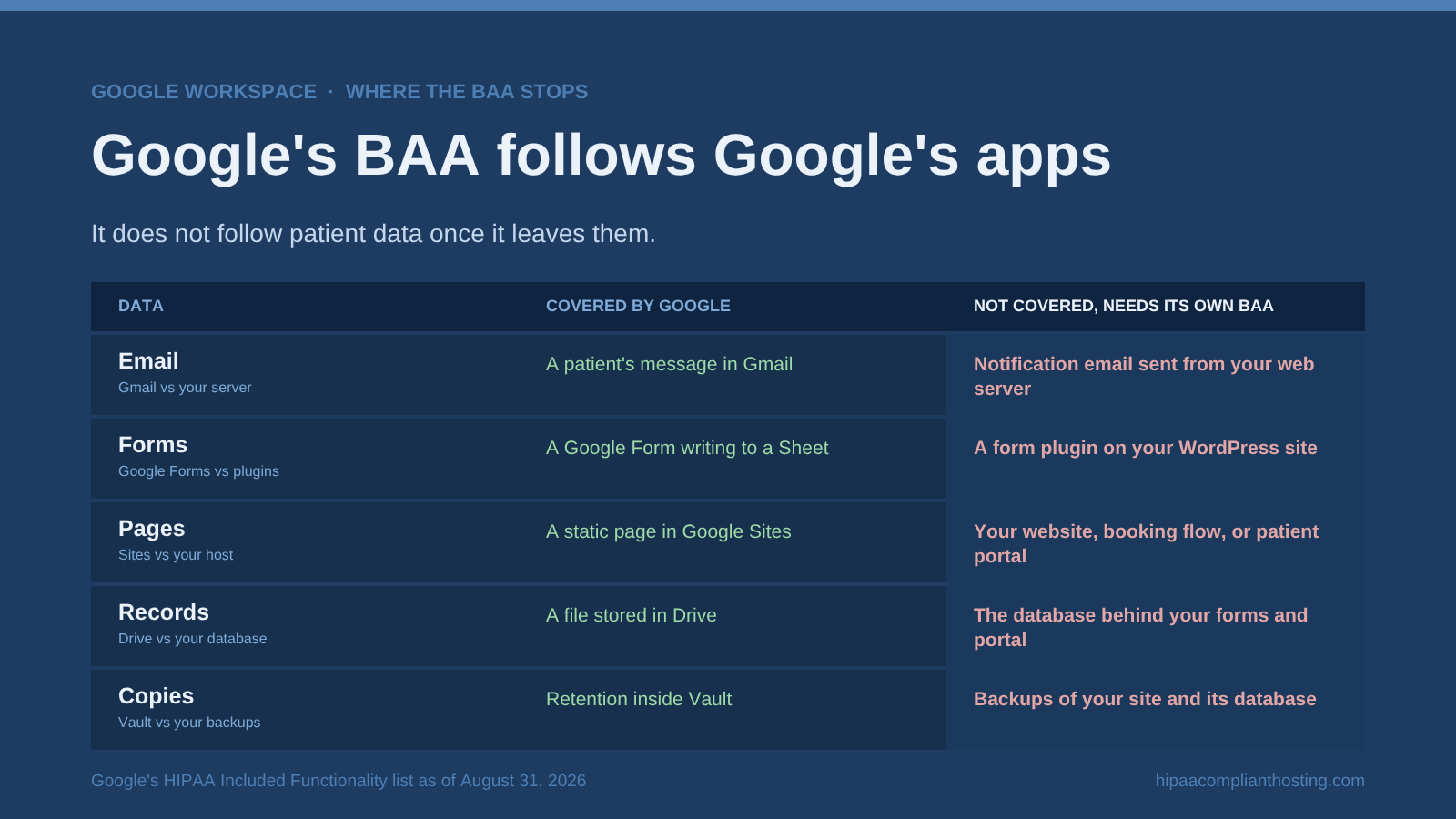
Google publishes its covered list as the HIPAA Included Functionality. As of August 31, 2026, that list names the core Workspace apps and a few platform tools. Everything else your practice runs sits outside it.
Covered by the Google Workspace BAA | Your infrastructure, not covered |
|---|---|
Gmail, Calendar, Drive, Docs, Sheets, Slides, Forms, Vids, Meet, Chat, Keep, Sites, Groups, Tasks, Cloud Search, Vault, Voice (managed users), Cloud Identity, AppSheet, Apps Script, Gemini in Workspace and the Gemini app | Your website and its hosting, website contact and appointment forms, a patient portal or intake flow, the database behind them, notification email sent from your web server, backups of any of these, and analytics or ad pixels on those pages |
The rule of thumb is simple. The Google Workspace BAA follows Google's apps. It does not follow the data once it leaves them. A patient's message in Gmail is covered. The same patient's symptoms, typed into a form on your WordPress site and stored in your site's database, are not. Have you not yet accepted the BAA, or do you want the hardening checklist for the suite itself? Our guide to Google Workspace HIPAA compliance covers that side. This article is about everything the suite does not touch. Google's list changes, so confirm current terms in Google's HIPAA implementation guide.
The six exposures outside the Google Workspace BAA
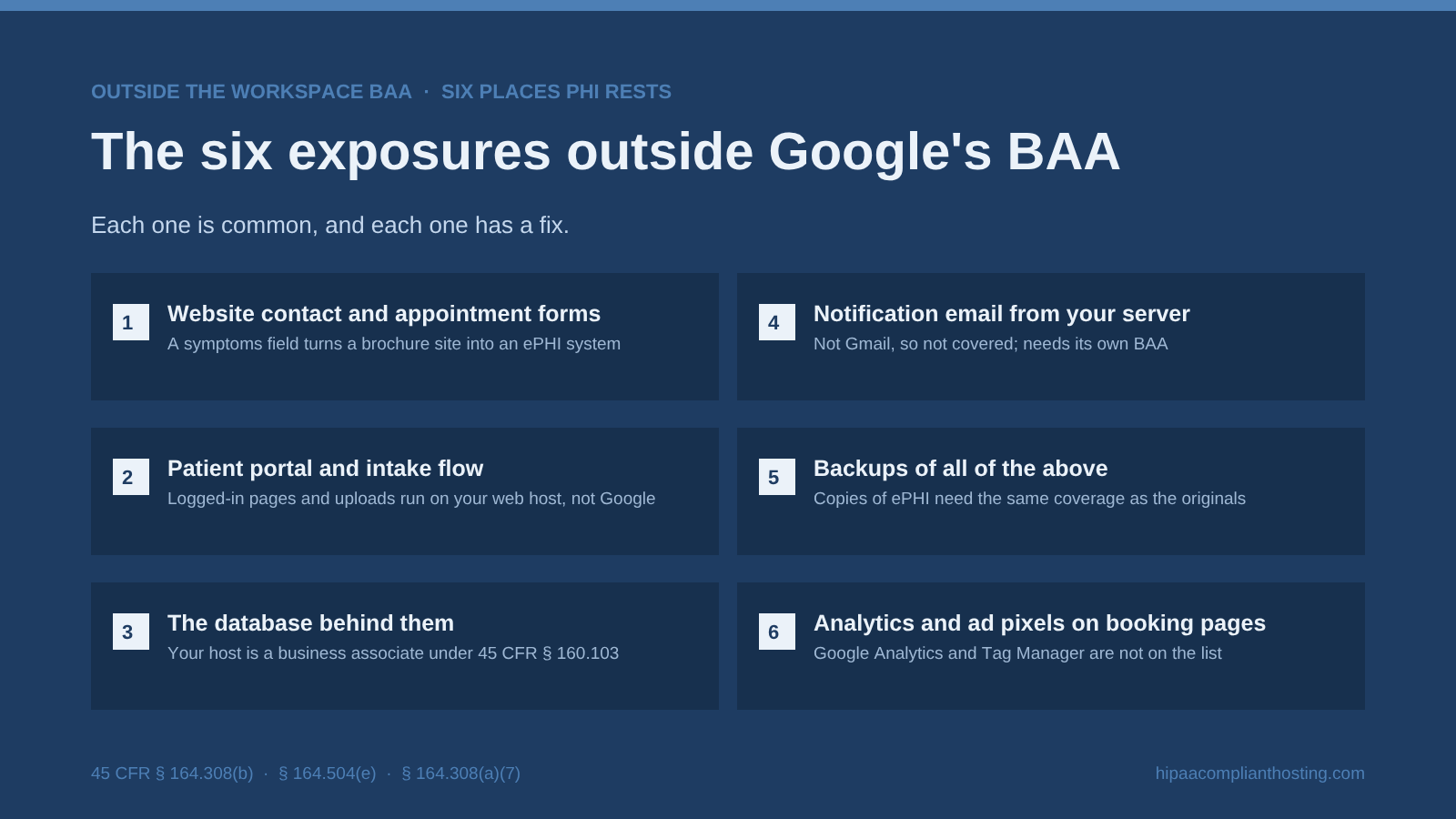
These are the six places we find patient data resting outside the Google Workspace BAA in practice reviews. Each one is common, and each one has a fix.
1. Website contact and appointment forms
A "tell us about your symptoms" field turns a brochure site into an ePHI system. The form plugin, the server it posts to, and the email it sends all sit outside Workspace. A typical failure: a clinic's contact form saves every submission to the site database on a shared host that signs no BAA. Under 45 CFR § 164.308(b), that missing contract is a violation on its own, before any breach. The fixes are in HIPAA compliant forms, and the plugin-level setup is in HIPAA compliant WordPress forms.
2. Patient portal and intake flow
Logged-in pages, file uploads, e-signatures, and intake questionnaires do not run on Google's covered apps. They run on your web host. A typical failure: a practice builds a portal on its marketing site's hosting plan, because the plan was already paid for. Every record in that portal now rests on infrastructure with no BAA. The full requirements list is in HIPAA compliant website.
3. The database behind them
Form entries, portal records, and CMS tables rest on your host's disks. A host that maintains ePHI for you is a business associate under 45 CFR § 160.103, and needs its own BAA under 45 CFR § 164.504(e). A typical failure: the site was set up years ago, the host was chosen on price, and nobody has asked whether it signs a BAA. Our decision framework in who needs HIPAA compliant hosting walks through the edge cases.
4. Notification email leaving your server
This one confuses even careful admins. Gmail under the BAA is covered. Email sent by your web server is not Gmail. Picture a WordPress form that emails "New submission from Jane, knee pain, wants Tuesday" to the front desk. That message leaves your server through SMTP, or through a transactional email service, before it ever reaches Gmail. That path needs its own BAA. A typical failure: form notifications route through a free email relay that has never signed one. The provider comparison is in HIPAA compliant email.
5. Backups of all of the above
The contingency plan standard at 45 CFR § 164.308(a)(7) requires retrievable, exact copies of ePHI. Those copies are ePHI too. Backup files of your site database need the same BAA coverage and encryption as the originals. A typical failure: a host's nightly backup lands in a storage bucket owned by a third vendor that has no BAA with anyone. What to require is in HIPAA backup and disaster recovery.
6. Analytics and ad pixels on booking pages
The Google Workspace BAA does not cover Google Analytics, Google Tag Manager, or Google Ads. After AHA v. HHS (N.D. Tex., June 2024), an IP address plus an unauthenticated page visit is not automatically PHI, but analytics or ad pixels that capture form contents or authenticated portal activity still create exposure. A typical failure: a Tag Manager container installed for a marketing campaign fires on the booking confirmation page. The verdict and a 15-minute self-check are in is Google Analytics HIPAA compliant.
Google Sites is on the covered list. Why that does not close the gap
Google Sites appears on the HIPAA Included Functionality list. So it is a fair place for a practice to look. For a static informational page, it works under the Google Workspace BAA. A page that lists hours, services, and a phone number holds no PHI in the first place. The same goes for a Google Form that writes to a Sheet inside the covered account. Both apps are on the list, and the data stays inside Google's boundary.
The gap opens the moment a practice needs more than that. Sites cannot run server-side code, a database, or a patient portal with custom logic. It cannot host a WordPress site, a booking plugin, or a secure upload flow. Most practices need at least one of those, and the moment they do, they are back on third-party hosting, and the BAA question restarts. Storage inside Drive is the same story: covered on Google's side, but only until the file leaves. The details are in is Google Drive HIPAA compliant.
The three-question test
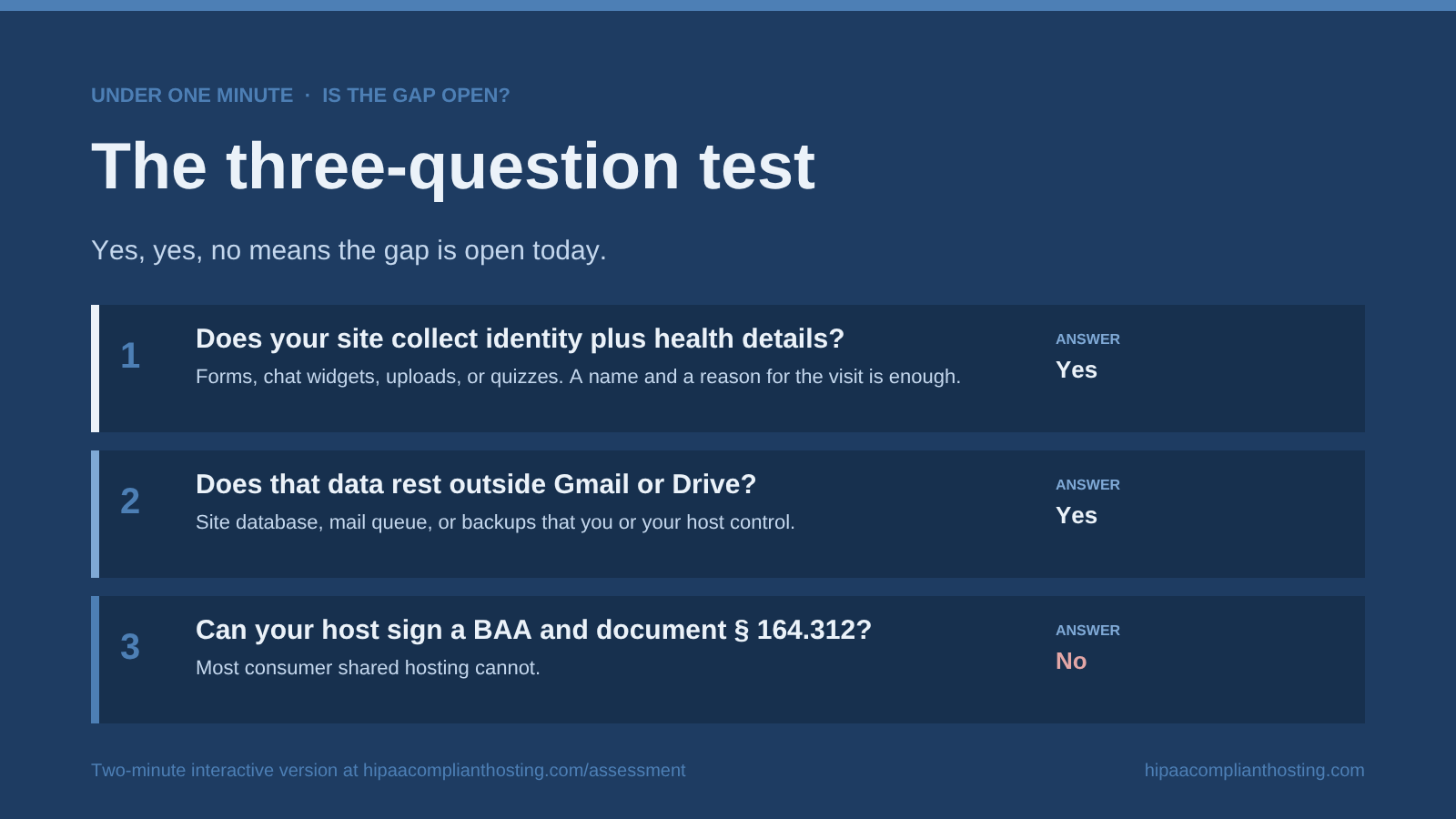
Does any form, chat widget, upload, or quiz on your site collect identifying information plus health information? A name and a reason for the visit is enough.
Does that data rest in a database, mail queue, or backup that you or your host control, rather than in Gmail or Drive? Form entries in the site database count. So do notification emails and nightly backups.
Can your current host sign a BAA and document the 45 CFR § 164.312 safeguards? Most consumer shared hosting cannot.
Yes, yes, no means the gap is open today. Yes, yes, yes means you are covered on paper; check that the safeguards are real. No to the first question means the Google Workspace BAA may be all you need, and standard hosting is fine. The interactive version takes about two minutes. It is our HIPAA hosting assessment.
What BAA-covered hosting has to include
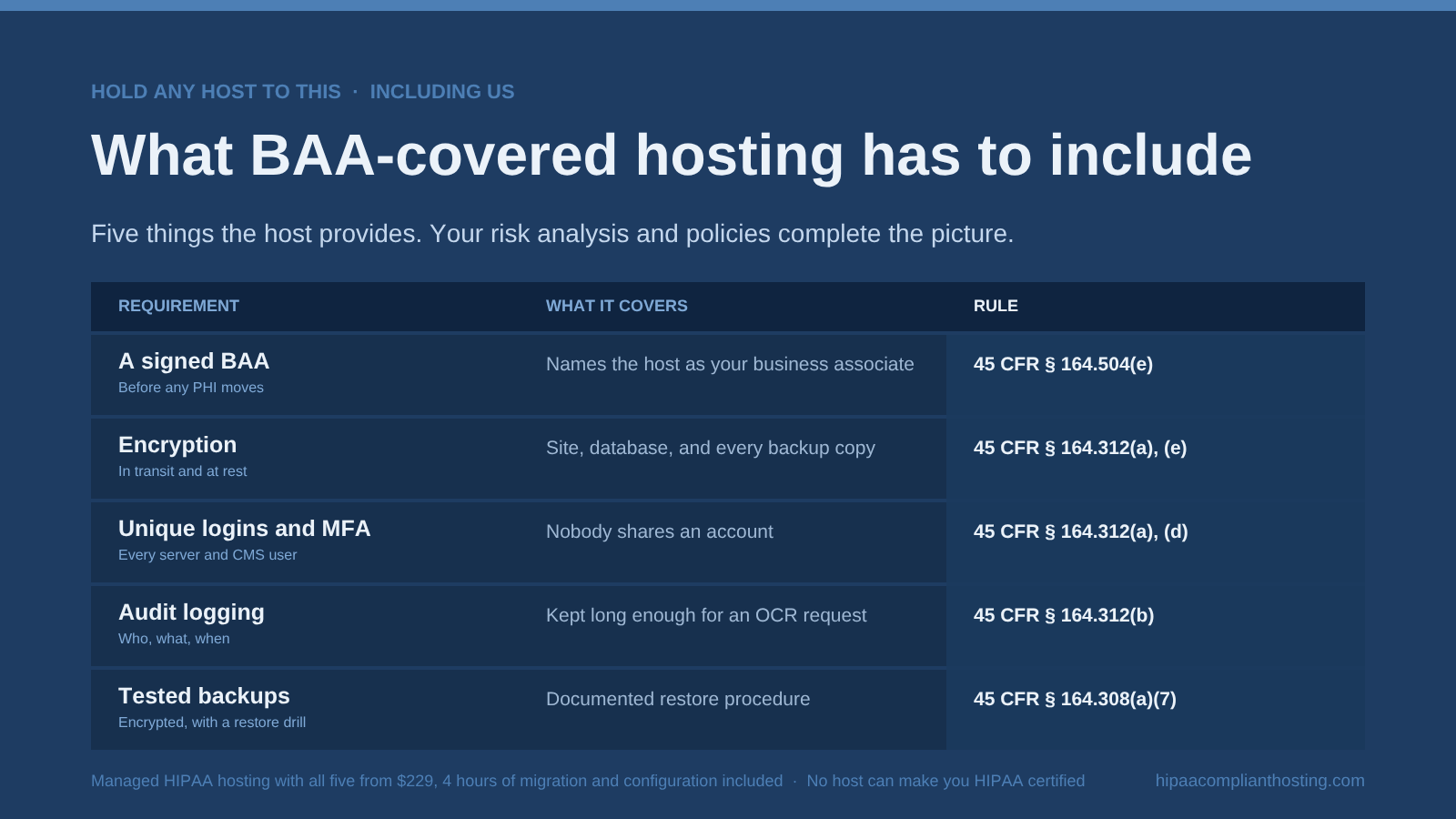
If the test put your site in scope, the host you choose needs to provide five things. Hold any provider, including us, to this list.
A signed BAA that names the host as your business associate, per 45 CFR § 164.504(e). Get it before any PHI moves, not after.
Encryption in transit and at rest for the site, the database, and every backup copy, per 45 CFR § 164.312(a) and (e).
Unique logins and MFA for every person who can reach the server or the CMS, per 45 CFR § 164.312(a) and (d).
Audit logging that records who accessed what and when, kept long enough to answer an OCR request, per 45 CFR § 164.312(b).
Tested, encrypted backups with a documented restore procedure, per 45 CFR § 164.308(a)(7).
On cost, managed HIPAA hosting that includes all five starts from $229 per month, with 4 hours of migration and configuration included. Self-run cloud servers under AWS's own BAA can cost less in cash and more in engineer hours. Every item on the list becomes your job. Our managed HIPAA cloud hosting takes those jobs off your plate: encrypted AWS servers with backups, audit logs, and monitoring run for you, and a BAA signed within 24 hours. The full price bands are in our HIPAA hosting cost guide. One more thing to know before you shop: no host can make you "HIPAA certified." No such certification exists. A host provides BAA-covered infrastructure; your risk analysis, policies, and training complete the picture.
Already on Workspace? Your suite is covered. Check whether your website is.
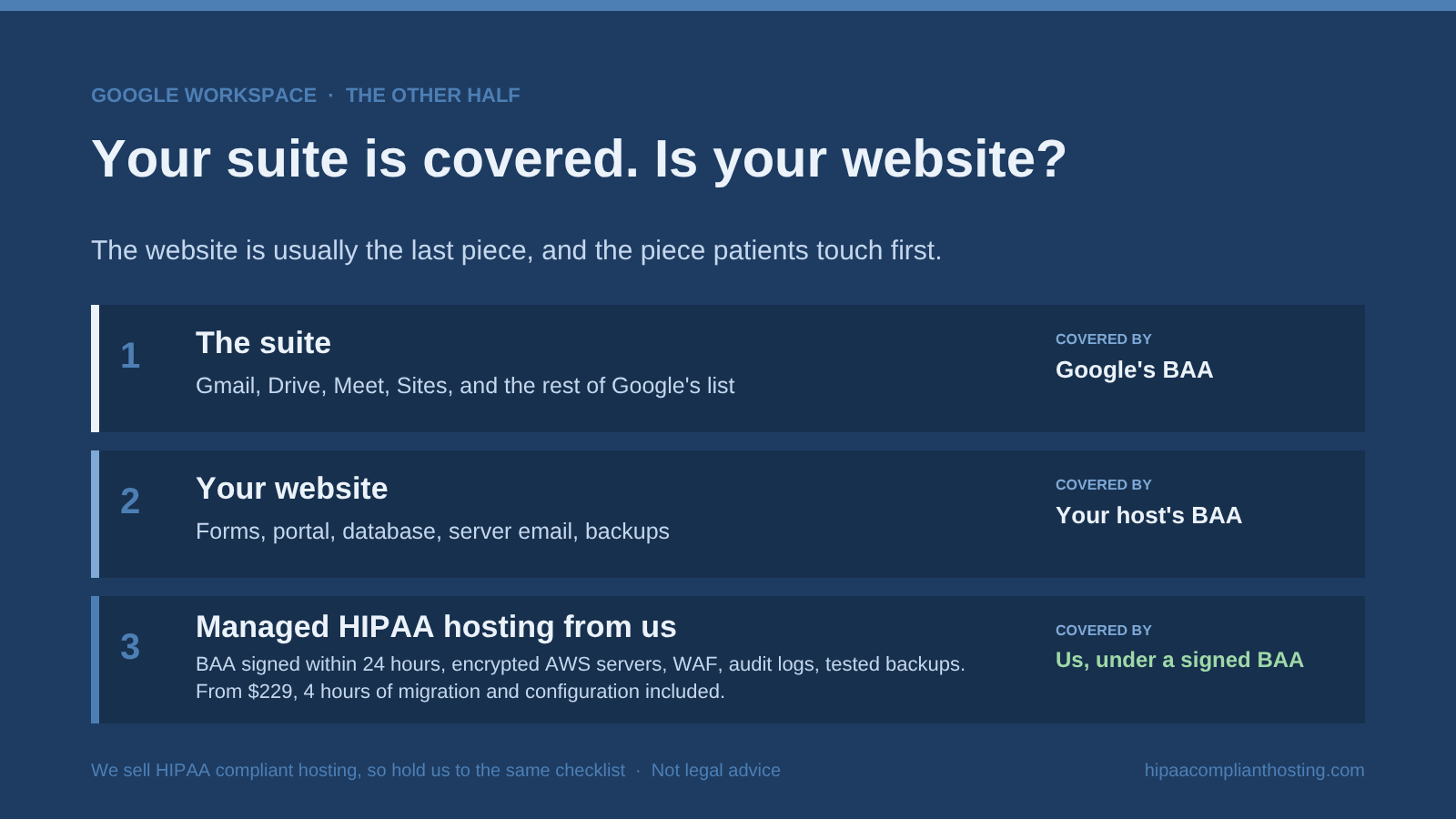
Your Google Workspace BAA already did the hard part for the apps your staff work in. The website is usually the last piece, and it is the piece patients touch first. Run the two-minute assessment to see whether your site is inside or outside the line. If you would rather talk it through, tell us what your site collects and we will say whether you need this. Sometimes the honest answer is no. If you do, our HIPAA compliant WordPress hosting comes with the BAA signed within 24 hours. You get encrypted AWS servers, a web application firewall, audit logs, and tested backups, from $229 per month with 4 hours of migration and configuration included. It is one part of our wider HIPAA compliant hosting lineup. We sell HIPAA compliant hosting, so hold us to the same checklist.
Frequently asked questions
Does the Google Workspace BAA cover my website?
No. The Google Workspace BAA covers the apps on Google's HIPAA Included Functionality list. Your website, its forms, and the server it runs on are outside that list, unless the site is a static page built in Google Sites. The host that stores your site's data needs its own BAA.
Does the Google Workspace BAA cover Google Forms?
Yes. As of August 31, 2026, Google Forms is on the covered list. A Google Form that writes responses to a Sheet inside your covered account stays inside the BAA. Forms built with a website plugin or a third-party form tool are a different case. Those post to your web server or to the tool's servers, and neither is covered by Google.
Is Google Sites enough for a patient portal?
No. Google Sites is covered, but it is a static page builder. It cannot run a database, server-side code, logged-in patient accounts, or secure uploads with custom logic. A real portal needs hosting that signs its own BAA.
Do I need a separate BAA for my web host if I already have one with Google?
Yes, if your site stores or transmits ePHI. Google's BAA binds Google. It says nothing about your web host, which is a separate business associate under 45 CFR § 160.103 and needs its own contract under § 164.504(e).
Recap: the Google Workspace BAA and your website
To recap, the Google Workspace BAA covers Google's apps and stops there. Your website, its forms, a patient portal, and the database behind them sit outside it. So do server-sent email, backups, and any tracking pixels on those pages. All of them need their own BAA-covered hosting. Google Sites does not close the gap for anything beyond a static page. Run the three-question test, and if it comes up yes, yes, no, fix the hosting side first.
This article is general information, not legal advice. Google's HIPAA Included Functionality list changes; the version cited here is dated August 31, 2026, and Google's help page was last updated September 18, 2026. Confirm current terms in Google's HIPAA implementation guide, consult qualified counsel, and base your safeguards on a documented risk analysis. We sell HIPAA compliant hosting. Reviewed September 2026.
Sources
Google Workspace: HIPAA Included Functionality (as of August 31, 2026)
Google Workspace Help: HIPAA compliance with Google Workspace and Cloud Identity
Google Cloud: HIPAA compliance
45 CFR § 160.103 (definitions): ecfr.gov
45 CFR § 164.308 (administrative safeguards, BAA, contingency plan): ecfr.gov
45 CFR § 164.312 (technical safeguards): ecfr.gov
45 CFR § 164.504(e) (business associate contracts): ecfr.gov